


Review: LA CAGE AUX FOLLES at Dr. Phillips Center For The Performing Arts
The characters of La Cage aux Folles teach us that authenticity doesn’t stop at the self; it flourishes when others reflect it back to us with acceptance and love.
Over brunch one morning back in June, I was telling a friend about a new novel idea I’d been outlining as a writing project. I read to him a short summary I’d written, not thinking much of it at the time. However, I had subconsciously tapped my chest when I read the phrase “live authentically.” My friend stopped me, asked me to repeat the last sentence I read. After I had done so, he said, “That’s you. You put yourself in that novel and you didn’t even know it.” In that moment, I realized that living authentically isn’t just about deciding who we are and what we stand for. It’s also about with whom we choose to share that self. How we view ourselves is primary, but how others view us is just as important. Authenticity lives in the act of creating and relating. It’s in the art of telling stories, of writing fictional characters, and in the simple act of trusting someone across the brunch table to see us, perhaps, more clearly than we saw ourselves.
That’s what La Cage aux Folles has been doing for the past fifty years: telling a story that keeps reinventing itself while staying true at its core. The story saw its roots as a 1973 stage play, which in turn became a hugely-popular 1978 French and Italian film. And that led to a 1983 Broadway stage rendition which won the Tony Award for Best Musical. Perhaps the best-known version of La Cage aux Folles is the 1996 comedy The Birdcage, which trades in Saint-Tropez for South Beach but otherwise is a winning rewrite with the same heart, soul, and humor of all the previous iterations. Across all these versions, the message is preserved: identity isn’t fixed or inherited, but cultivated through love, partnership, and community. The characters of La Cage aux Folles teach us that authenticity doesn’t stop at the self; it flourishes when others reflect it back to us with acceptance and love.
We see that acceptance and love immediately in Encore Performing Arts’ production of La Cage aux Folles. The venerable theatre company has put together a rendition of this tale that turns the most thematic aspect of the story – a sense of home and belonging – into a commentary on the very plight of homelessness in Central Florida. Encore has partnered up with the Coalition for the Homeless of Central Florida to ensure that shelter, food, and crucial services are provided for anyone who must suffer without in the greater Orlando area. And it asks us to open our hearts not just for the characters of La Cage aux Folles, but for those of us less fortunate. The arts have always been meant to support a community, whether it be an emotional connection or a financial contribution. And Encore Performing Arts continues this ethos through their partnership with the Coalition and this production of La Cage aux Folles to ensure everyone – both on the stage, in the wings, and in the audience – knows they have a home and a sense of belonging.
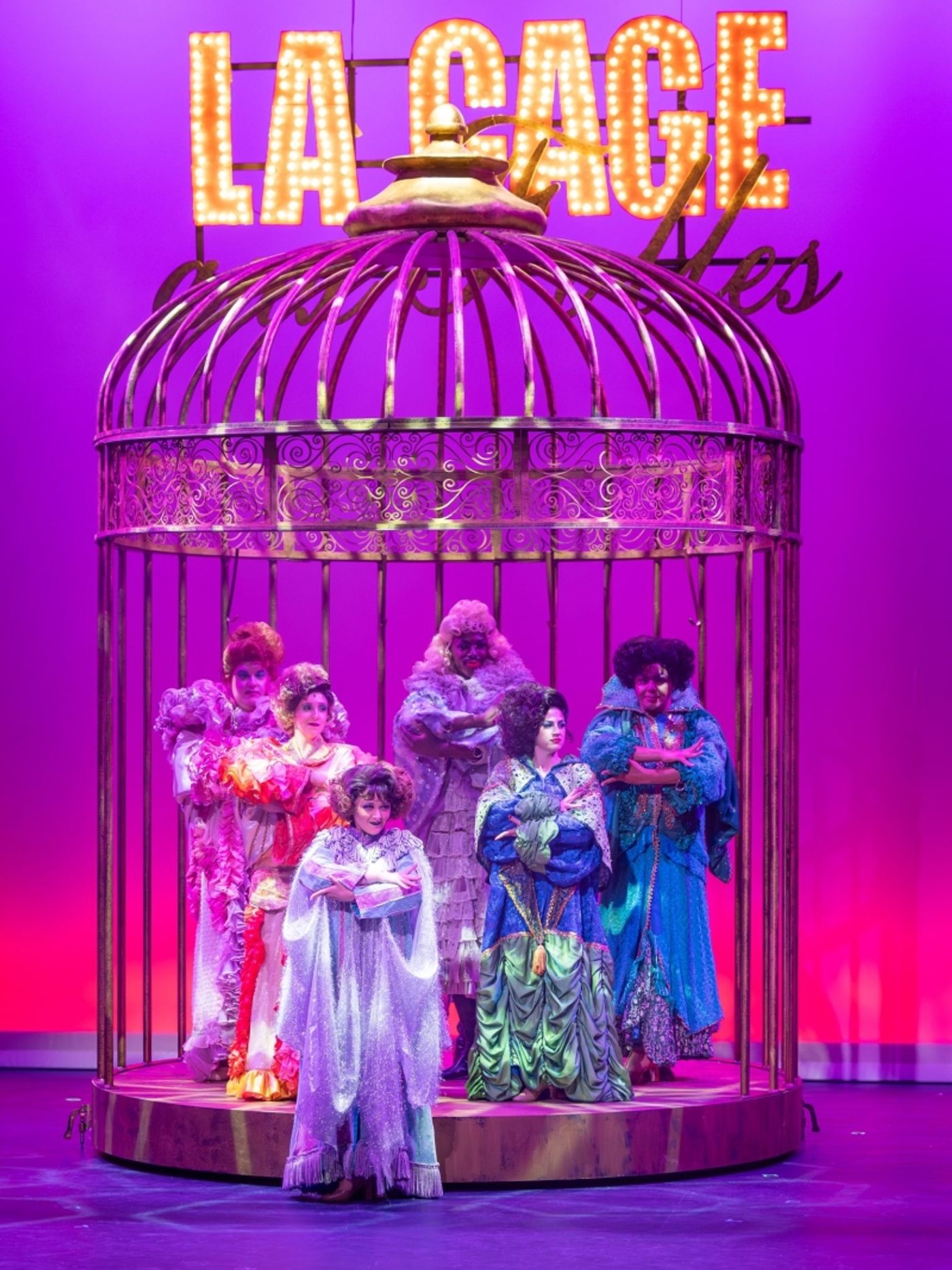
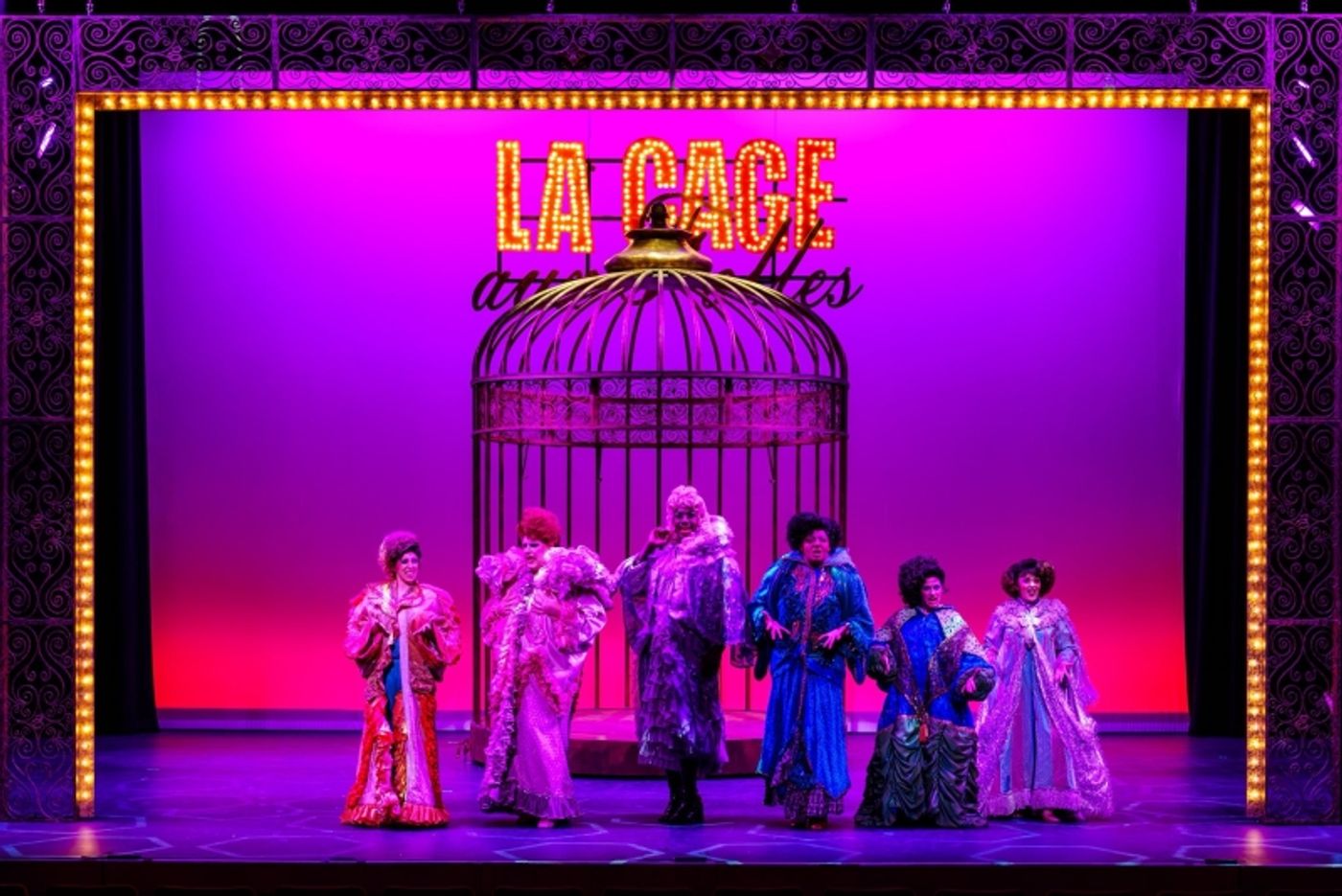
As the stage story begins, the curtain rises inside La Cage, a Saint-Tropez nightclub run by Georges (Daniel McDonald), its emcee and master of ceremonies. Here, spectacle is survival: sequins, feathers, and the dazzling Cagelles strut in full chorus (“We Are What We Are”), celebrating drag as both art and affirmation. The six Cagelles – Hannah (Kai Carter), Phaedra (JT Diaz), Dermah (Mary Howe), Chantal (Kevin Meza), Mercedes (Mary Strickland), and Monique (Emily Wilkerson) – end up elongating their acts as the lead performer, Zaza (Nick Kroger) is still not ready. Zaza is the stage personality of drag performer Albin, Georges’ partner in show business and in life. She eventually takes the spotlight, though explains to the Cagelles why she takes her time (“A Little More Mascara”).
The mood shifts, however, when Georges’ son Jean-Michel (Gabriel Bermudez) arrives with news (“With Anne on My Arm”): he plans to marry Anne Dindon (Gabriella Vultaggio), the daughter of an uber-conservative politician, Edouard Dindon (Robert Laurita). Jean-Michel then asks the unthinkable of his father: he wants Georges to pretend to be a straight, foreign diplomat. And he wants to make sure that Albin, who raised him just as much as Georges, not be present. Albin’s more effeminate behavior and presence simply would not do when meeting Anne’s parents. Rather, Jean-Michel has asked his birth mother, Sybil, to visit and stand in as his mother. Georges is shocked by his son’s request, doing his best to try to keep it from Albin (“With You on My Arm” and “Song on the Sound”).
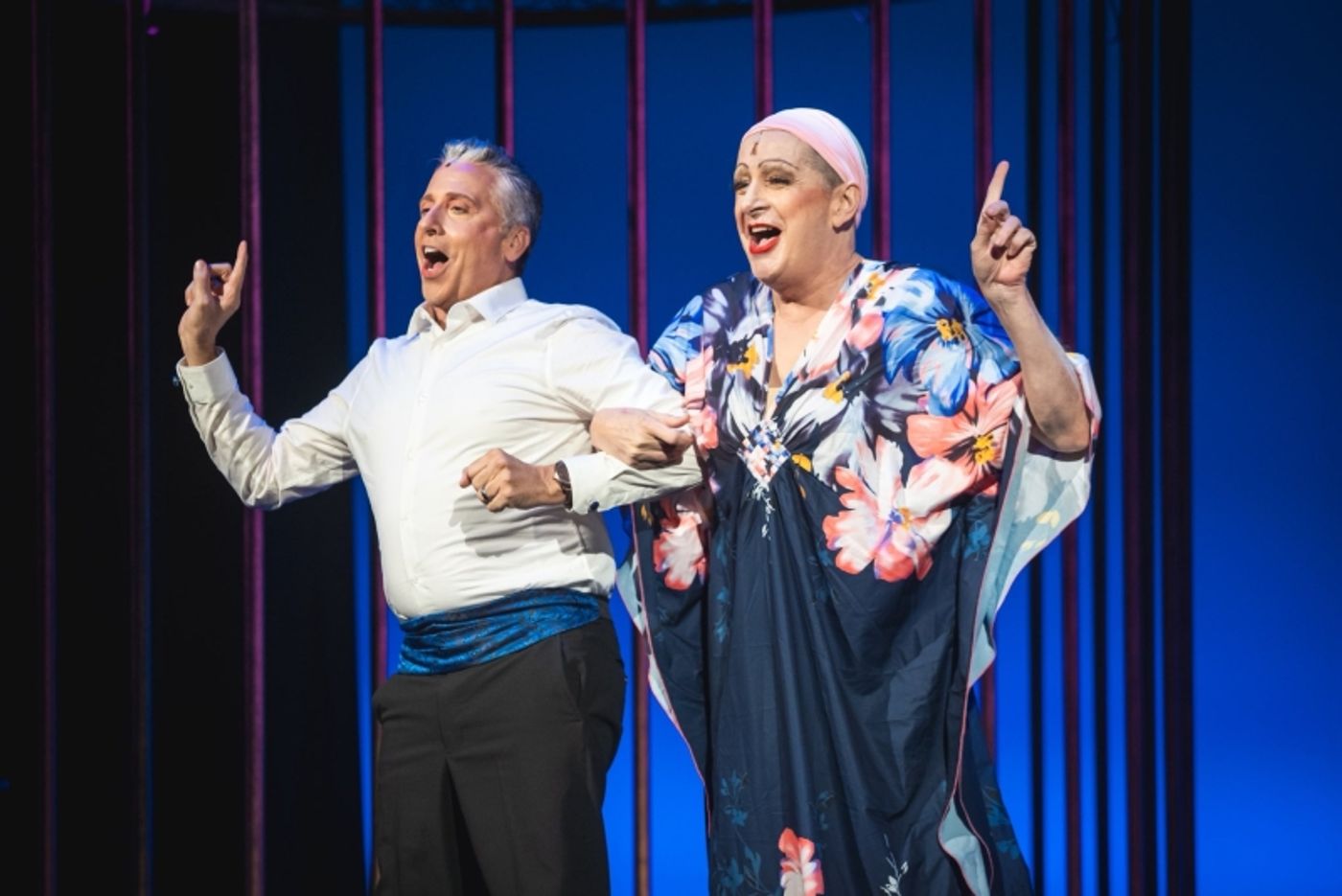
Tension builds, however, once Albin discovers what Jean-Michel has asked of Georges. After a rousing, multi-costume-changing showstopping number of “La Cage Aux Folles,” Albin defiantly chooses to embrace his femininity, singing “I Am What I Am” as an affirmation that his sexuality and public-facing persona is not something to be shameful, but something to be celebrated. And if the boy he raised as a son wants to deny him his parenthood for the sake of his own future family, then Albin will comply in order to keep him in his life.
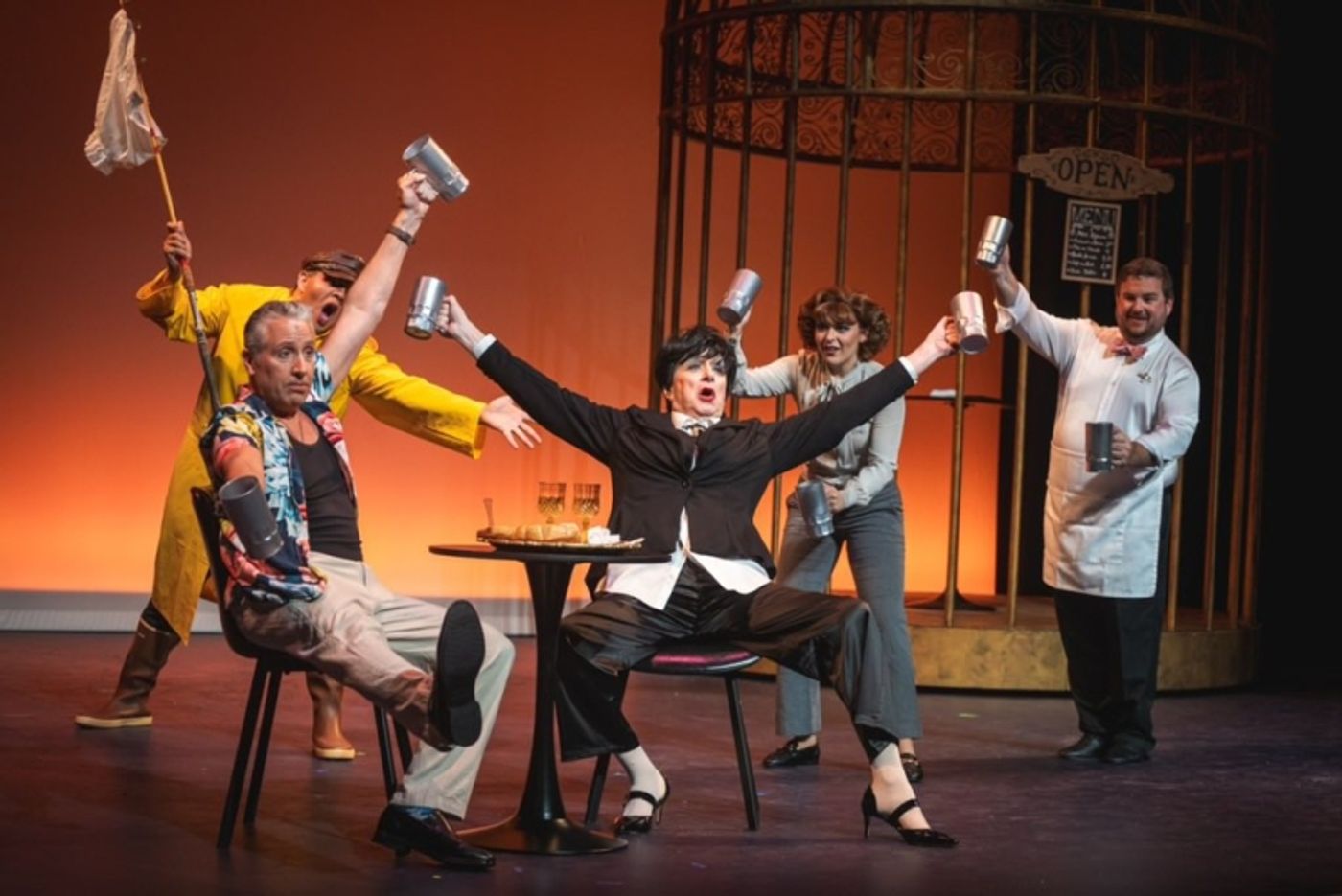
As Act II begins, Georges hopes to teach Albin ways to present as a traditional, masculine male. With the help of some neighbors and friends, Georges’ attempt to give Albin “Masculinity” is both hilarious and stereotypical, as is Albin’s failure to properly evoke accurate “straight white male” behavior. Even when presenting Jean-Michel with this alternate “Uncle Albert” persona, the young man still rejects Albin and,again, reiterates that he only wants his future in-laws to meet Georges and Sybil. The rejection stings Albin, and enrages Georges (“Look Over There”). That tension becomes more palpable once the Dindons actually arrive (“Cocktail Counterpoint”), with Georges and Albin’s home stripped entirely of its identity in order to present a staid, monk-like appearance of conservative values. Madame Dindon’s politeness strains against her husband’s rigid traditionalism, and the stage becomes a minefield of mistaken identities, frantic improvisations, and mounting chaos. The musical numbers continue to underscore the stakes, balancing levity with sincerity, until the walls inevitably crumble. What follows is less about keeping up appearances than about daring to let them drop, showing how authenticity ultimately resists disguise.
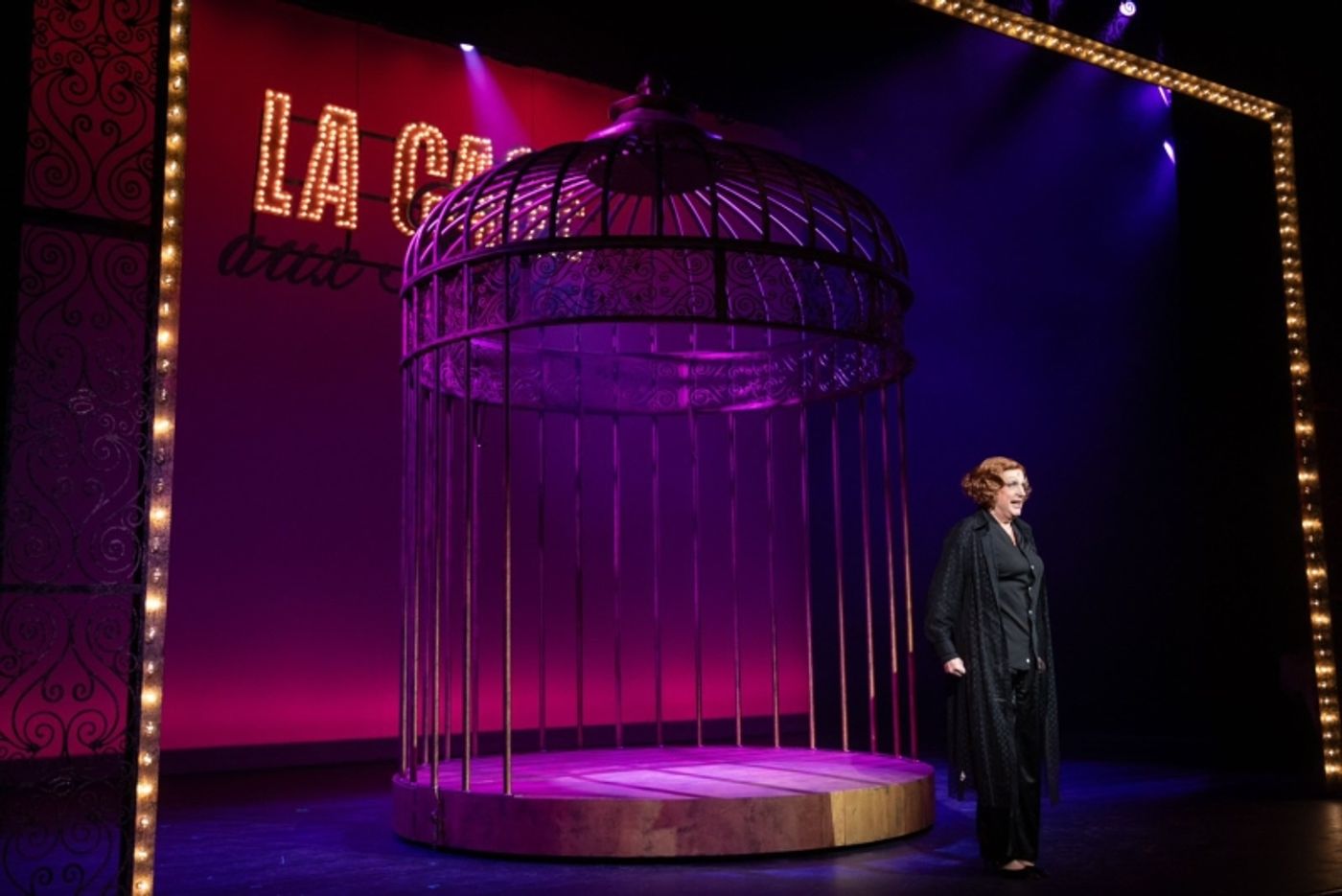
Encore Performing Arts’ production leans directly into that message of authenticity by turning the very stage into a metaphor. Instead of hiding behind a traditional proscenium realism, this production strips the set down to its essence. We don’t need the intricacy of a full, four-walled set to know it’s a home. Instead, at the center sits a large, gilded cage, gleaming under the lights. It’s introduced as part of the show-within-the-show, a playful space for the Cagelles to strut, dance, and delight. But the cage does not stay in one place. With a simple turn or shift, it transforms: at one moment, a marker of backstage chaos; the next, a backdrop for Georges and Albin’s shared home; later still, a suggestion of a seaside exterior, framing their lives against the vastness of the coast.
That fluidity is the production’s genius. The cage refuses to be a single thing, just as the characters themselves refuse to be flattened into stereotypes. On one level, it reminds us of the ongoing tension Georges and Albin live with: they may have been “out of the closet” for years, but the threat of retreating back inside remains. The cage is never gone, always looming, always ready to contain them again. And yet, its very opulence suggests another reading. A cage is a prison, yes, but it is also a shelter. It protects as much as it confines. In this staging, the cage becomes a visual paradox: both a reminder of society’s pressures to conform and a glittering fortress against a world that can be cruel to those who dare to live authentically.
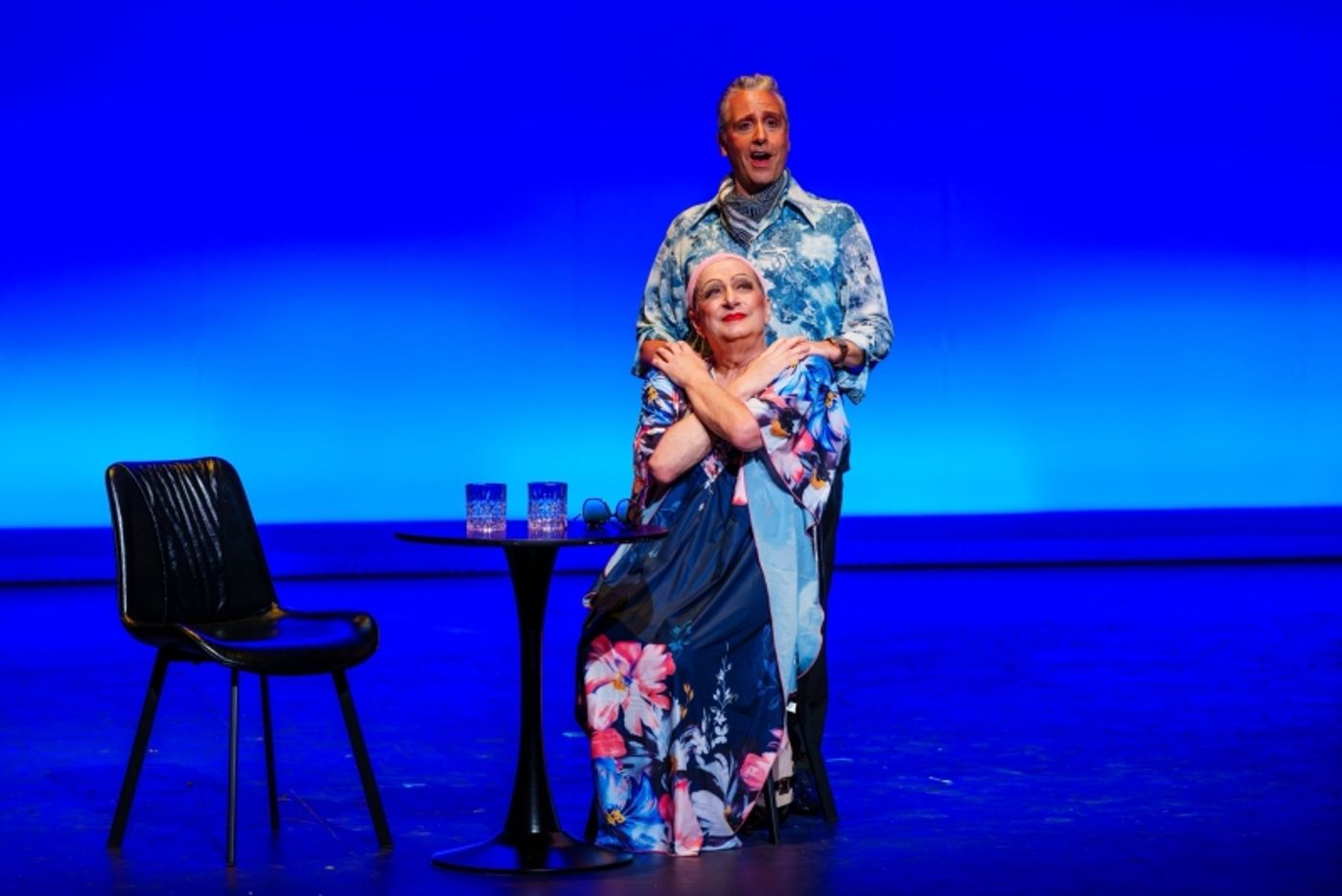
That same interplay of confinement and liberation carries through in the performances of Daniel McDonald (Georges) and Nick Kroger (Albin). McDonald takes on Georges as the steady counterbalance, the so-called “straight man” in the comedic sense. He’s a natural grounding force in scenes where Albin is soaring into full histrionics. It’s the classic dynamic of camp-gay versus straight-gay: “I’m calm and grounded, he’s about to fly right out of here.” What makes their partnership resonate is that neither actor reduces the roles to these stereotypes. McDonald resists playing Georges as blandly practical, instead layering him with warmth and quiet conviction. Likewise, Kroger brings flamboyance without ever losing the undercurrent of Albin’s vulnerability.
Together, they treat Georges and Albin not as the broad caricatures of gay identity but rather as parents: they are, for the bulk of this play, two men whose first concern is their son’s happiness. Queerness is simply part of their truth, but not the whole of it. That choice reframes the libretto itself, which can often tip toward cliché by handing Albin the zingers (“Is this the English Muffin to whom you refer?”) and Georges the mild rejoinders (“That’s the one.”). Even if the text seeks to cage them within such well-worn tropes, McDonald and Kroger’s performances insist on something richer. We see two men who have built a life together over 25 years, carrying the intimacy, compromises, and affections of a long marriage. In that way, McDonald and Kroger embody the cage itself: constrained by the expectation of others, yet quietly breaking free through the authenticity of their choices.
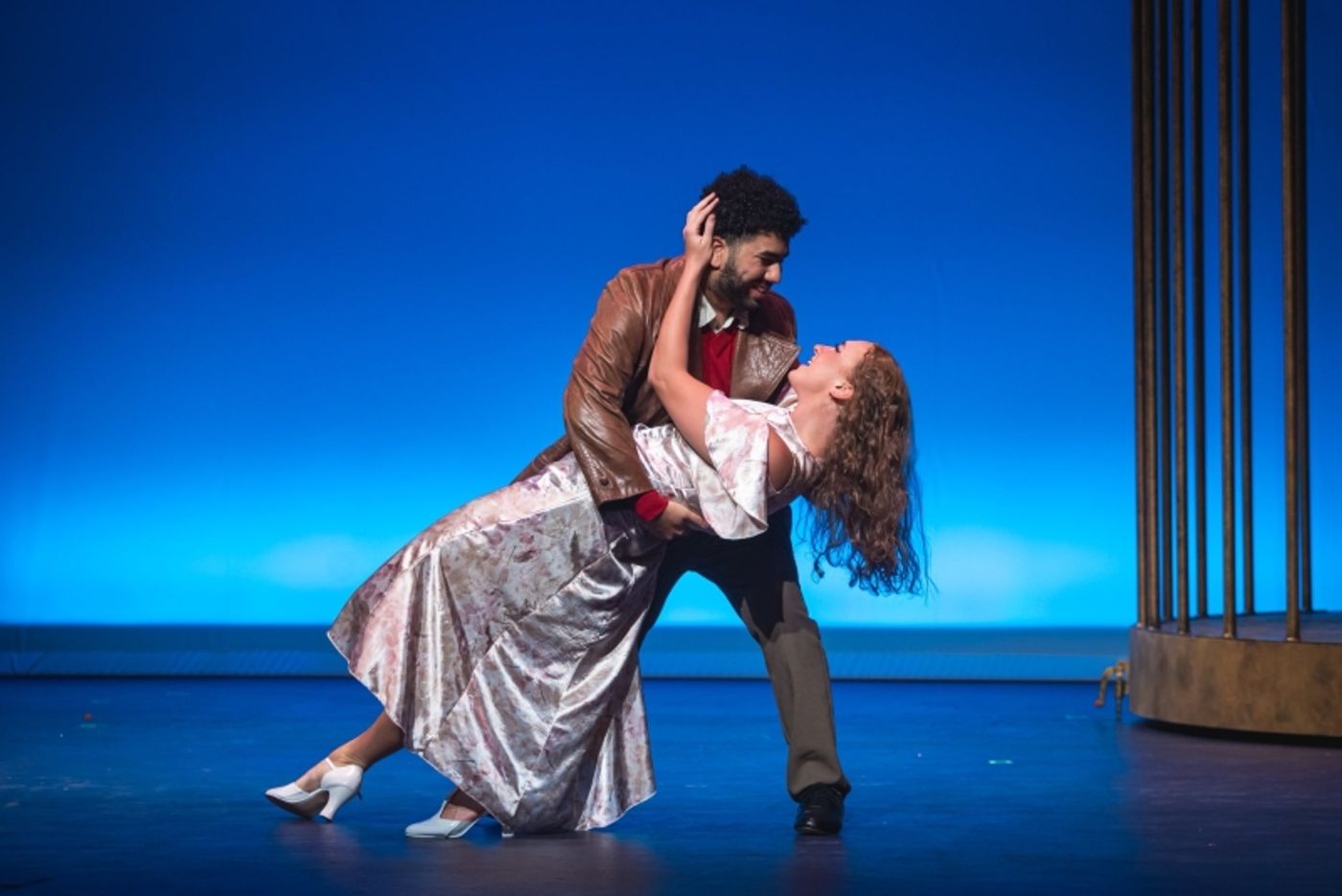
If Georges and Albin embody the cage as both confinement and sanctuary, then Jean-Michel is the one rattling the bars from the inside. Gabriel Bermudez plays him with the perfect mix of entitlement and youthful arrogance. For much of the play, Jean-Michel is an ungrateful son who dares to ask his parents to compromise who they are for the sake of his future. It’s a galling request, one that exposes how much of an asshole Jean-Michel can be. And yet, Bermudez keeps him human by leaning into that twentysomething “I know better than my parents” swagger. His eventual turn toward supporting Albin lands all the stronger because we’ve seen just how flawed and demanding the character can be.
Gabriella Vultaggio’s Anne Dindon, by contrast, gets less narrative meat to work with. She’s sweet, likable, and a necessary bridge between families, but the libretto doesn’t give her nearly as much dimension as the others. That said, Vultaggio makes the most of her stage time, slipping in little flashes of charm that hint at how much more she could bring if the role allowed. Much of her time spent on the stage is in dance sequences, the character herself doesn’t even get proper line of dialogue until Act II. Yet when she does speak, it’s words that her parents need to hear, and words that do, solidly, define her character as an admirable one.
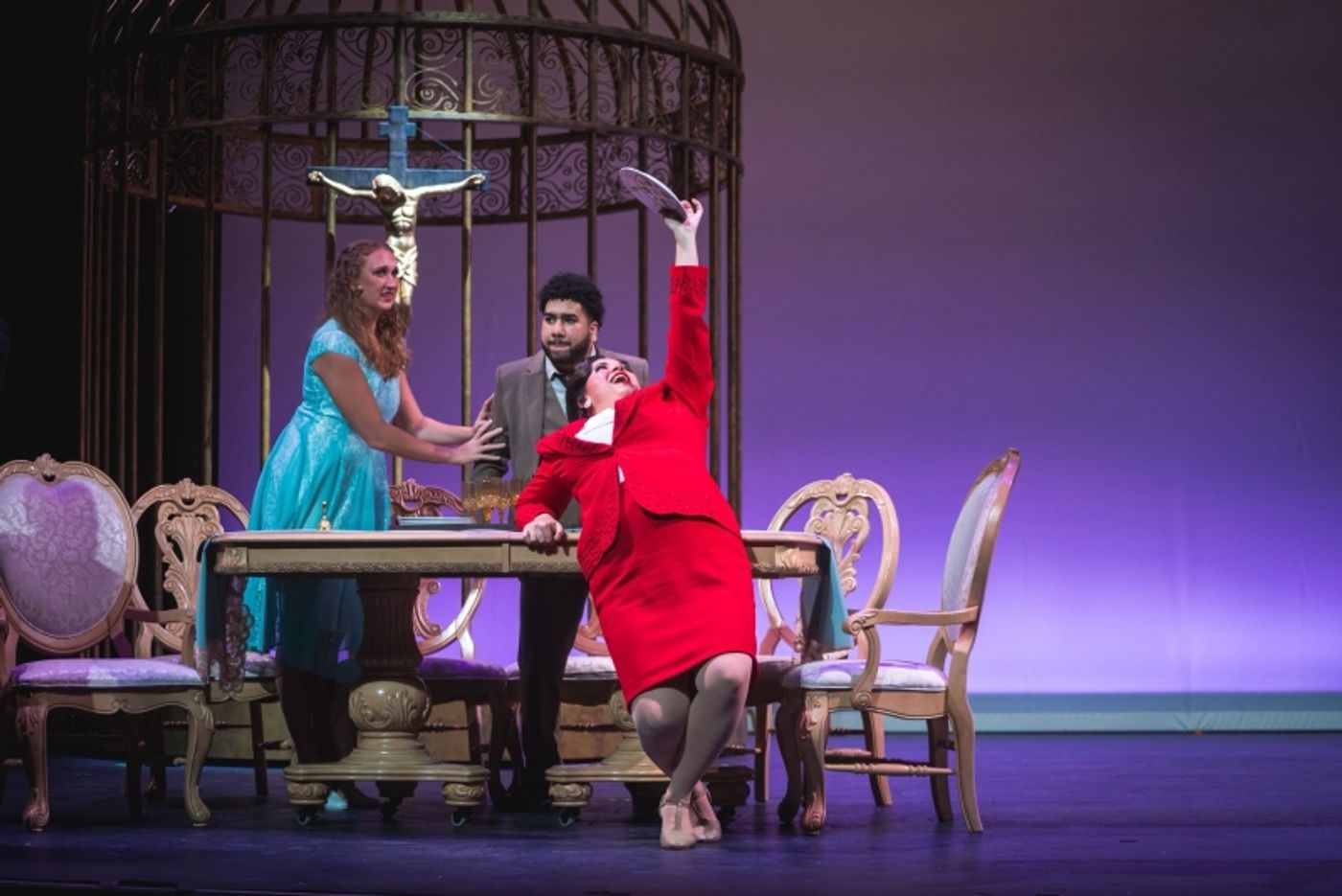
The real fireworks come with Edouard and Marie Dindon. Robert Laurita and Candice Shields throw themselves into the uptight absurdity of these characters, and the audience relished every second. For longtime Encore theatergoers, there was an extra wink: the pair had previously played a tender couple in Encore’s 2020 production of Cabaret. Here, they flip the script completely, channeling a more zany sense that begs to ask an oh-so-1970s question, “What if the Ropers from ‘Three’s Company’ were even more uptight and sexually frustrated?”. That level of energy helps make the ultra-conservative characters much more palatable given their moral standing. And Laurita and Shields’ delight in skewering the Dindons’ rigidity added just the right touch of farce to balance the show’s more heartfelt beats.
Of course, La Cage aux Folles wouldn’t be La Cage aux Folles without the Cagelles, the radiant ensemble that frames the entire production. What makes Encore’s staging so effective is how each performer pulls double duty. One moment, they're strutting the stage in sequined gowns, the next slipping into minor walk-on roles that keep the story’s world humming. JT Diaz and Mary Howe rock the heels as Phaedra and Dermah in one scene, then play stereotypical angry-French-lovers Etienne and Colette in another. Kai Carter and Paul A. Lance have their own, invisible-episode subplot of drag queen Hannah and backstage manager Francis dating and getting physically violent. Every ensemble player’s energy is infectious, their chemistry palpable, and together they make drag feel less like spectacle and more like community.
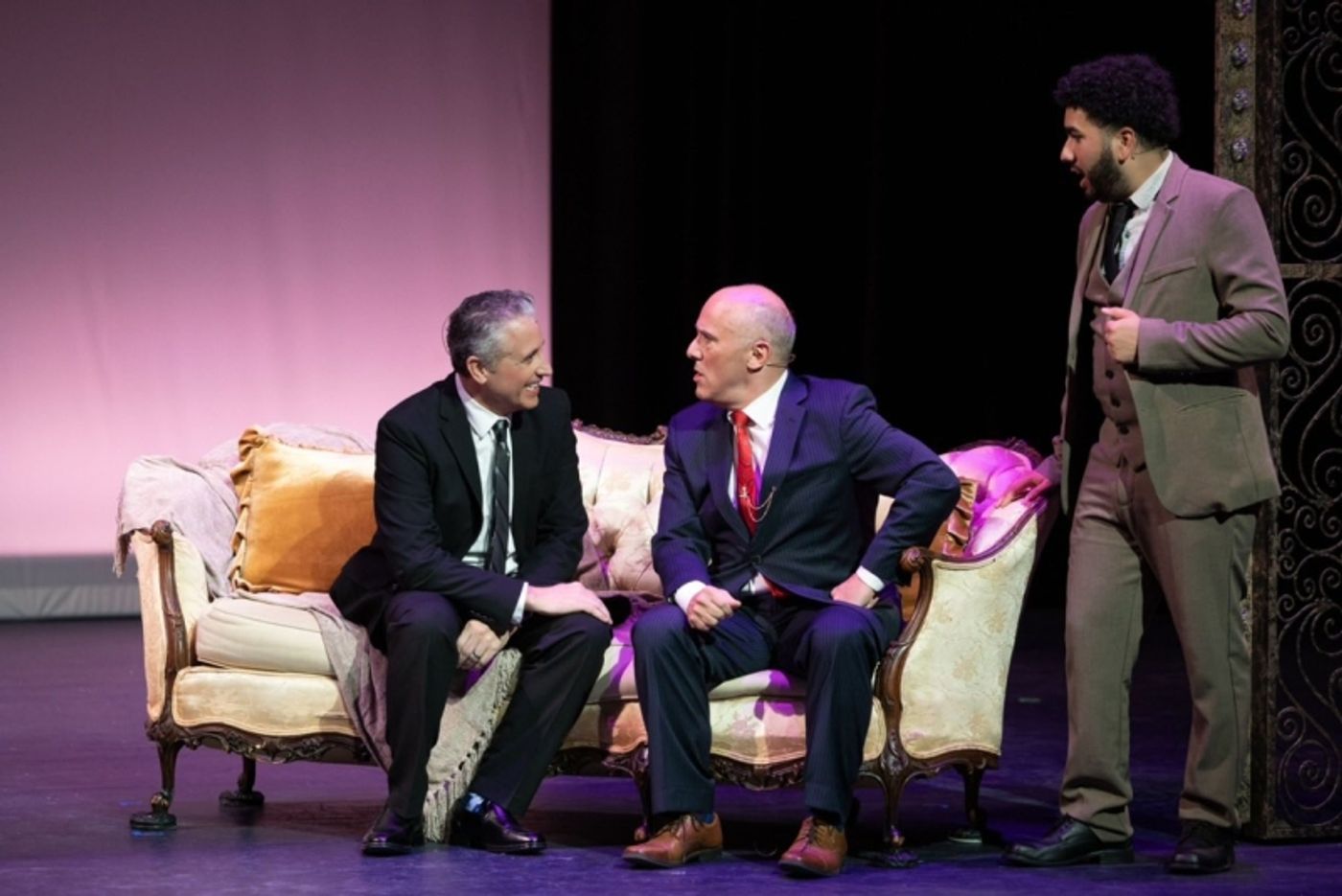
It is through that sense of a drag community that La Cage aux Folles delivers a fitting, final twist: Edouard Dindon, the archetypal conservative, being dressed in drag. On the surface, it could easily be read as simple comeuppance; most would look at it as a “punish the homophobe” gag. But Encore’s production, and indeed the show itself, reminds us that even this costume choice and plot point is far more nuanced. Putting Monsieur Dindon in drag is hardly about ridicule; it’s about empathy. In that moment, Edouard steps, however awkwardly, into the world he’s spent his entire time in the show resisting. Thus, he’s now experiencing firsthand the boldness, joy, and vulnerability of the community he’s dismissed. The humor lands, of course, but beneath it lies something deeper: a lesson in authenticity that extends beyond mere self-expression. It’s about learning to be unashamed in a space where judgment might be expected, about understanding lives unlike one’s own, and about recognizing that even the most reluctant participant can encounter truth when given the chance.
The most unforgettable performance of the night didn’t belong to a lead at all, but to Finn Wilks as Jacob, the butler. If any character could chew scenery for a living, it would be Jacob, and Wilks made a full feast of it in the best possible ways. Their command of the stage came not just from punchline delivery, but from a deliberate artistry: the sly choreography of movement across the set, the razor-sharp instinct of when to drop a line (“Bon appetit…”), and the crisp elocution that made every quip sparkle. Traditionally, Jacob has been treated as a minor role in many productions, a scene stealer of otherwise no consequence. But here, casting a non-binary performer (Wilks uses he/they pronouns) expanded the part into something far more dynamic.
What also makes Jacob such a standout is not only their comedic flair, but their dream: to join the Cagelles as a drag performer. They pester Georges for a part, eyes gleaming with ambition, and at one point even refer to themself as “a transsexual goddess.” It’s a line that often earns a laugh, but in Wilks’ delivery, it landed with something deeper: a reminder that drag is not confined to cis gay men who contour well and kill it in heels. Drag, after all, is a stage open to all identities and all expressions. In their hands, Jacob stopped being a throwaway punchline and instead became a sly emblem of the show’s central truth: authenticity isn’t limited to the leads, it radiates through the margins, where someone dares to want more than what the world expects them to take.
I must admit: drag is not a culture I know intimately. I don’t watch “RuPaul’s Drag Race.” I don’t wear makeup. My one pair of fishnet stockings only comes out for Rocky Horror Picture Show screenings. So my lens on drag has been narrow, filtered through the occasional glimpse rather than full immersion. And that’s precisely why La Cage aux Folles is essential. It doesn’t require prior knowledge or fluency in drag culture. Rather, it extends an open invitation to anyone willing to learn. It says: here is joy, here is play, here is power. Drag culture in La Cage aux Folles isn’t just the “bold face” of the gay community; it’s a celebration of visibility itself, a way of inviting even those on the periphery to understand more deeply what it means to live authentically, unbothered, and unashamed.
Honestly, we probably could have made a drinking game out of how often I’ve used the word authentically in this review. And yet, it’s not hyperbole. Authenticity is the true backbone of this show, of these characters, and of mine, the writer. From Georges and Albin navigating the push-and-pull of family and societal expectation, to Jean-Michel’s challenging selfishness, to Jacob daring to proclaim themself a “transsexual goddess,” the production continually asks: what does it mean to be true to yourself, even when the world wants to cage you? Every turn of the gilded set, every perfectly timed quip, every exuberant dance step works together to remind us that authenticity isn’t passive. It dare not be passive. It’s a conscious practice, a continuous performance, and above all, a personal choice
And that’s where my brunch story comes full circle. Just as I tapped my chest over the phrase “live authentically,” realizing the act of creating a character is itself a declaration of self, Encore’s La Cage aux Folles extends that same invitation to its audience. Watching the performers inhabit the cage both literally and metaphorically wasn’t just about seeing Georges and Albin live fully and openly. It was about feeling, for those two hours, permission to do the same in our own lives: to cultivate our identities, to share them selectively, to celebrate them boldly, and to trust the people who see us as we truly are. In the end, the night left me with the same thrill I felt at brunch: the recognition that authenticity is not a solitary endeavor, but a communal, joyous, and sometimes audacious act – one which must be celebrated not just on stage or in stories, but in our own lives.
LA CAGE AUX FOLLES plays exclusively this weekend, September 19 through 21, at Dr. Phillips Center’s Alexis & Jim Pugh Theater. Tickets can be acquired online or at the box office, pending availability. Photography provided by Tiffany Bagwell Photography, Matthew Hiemenz Black Hat Photography, and Howard Clifton. Used with permission.


|
Songs for a New World Dr. Phillips Center for the Performing Arts (8/28-8/30) |
|
DELORIS SCRUD MOVIN' ON UP Starlite Room @ SAVOY Orlando (9/10-9/12) |
|
THE PROM Theatre at St. Luke's (8/06-8/16) |

|
Ted Swindley’s Honky Tonk Angels Athens Theatre (2/26-3/21) |

|
Disney's Finding Nemo Athens Theatre (1/22-2/27) |
|
Death Trap Little Theatre New Smyrna Beach (8/27-9/06) |
|
Gothic Attitude Gothic Attitude (4/16-1/16) |
|
The Wizard of Oz Athens Theatre (4/16-5/09) |
|
Hadestown (Non-Equity) King Center for Performing Arts (4/20-4/21) |
|
Deer Tick Revolution Live (11/11-11/11) |
Reader Reviews
To post a comment, you must register and login.