


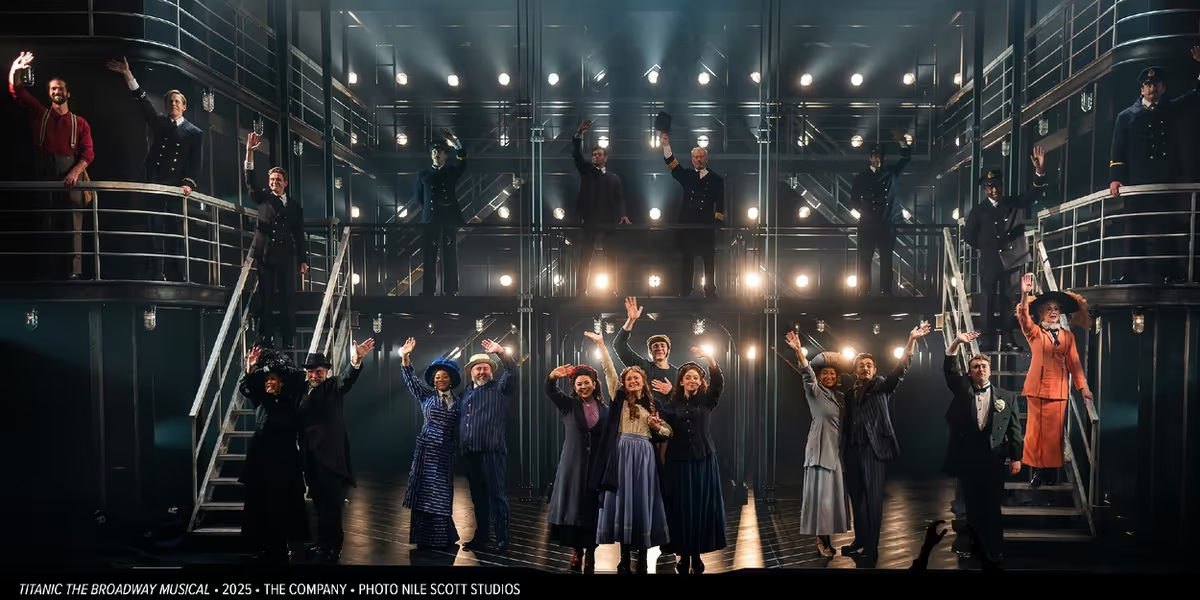
How does a regional theater, limited by its stage, capture the scale of the “ship of dreams”—a floating city of steel—while simultaneously honoring the desperate intimacy of the 1,517 souls who perished?
Through its usual tradition of tackling ambitious material with innovation, The Ogunquit Playhouse has answered this question not by competing with Hollywood spectacle, but by embracing the profound humanity and genius of Maury Yeston’s Tony-winning score and Peter Stone’s story and Book. And under the keen direction of Shaun Kerrison, the result is a production that is not only visually ingenious but profoundly moving. Much like the Playhouse’s production of “Come from Away” earlier in the season, “Titanic” keeps the focus on the storytelling of a real-life event.
Yeston’s score drives the musical. It contrasts grand, brass-heavy anthems—echoing the confidence of builders and owners—with tender, often melancholy folk tunes, and waltzes. The first-class passengers move to sophisticated, almost pompous operetta, heard best in "The Latest Rag." Meanwhile, the third-class passengers weave a simple melody telling of their dreams and optimism of a new life in America in the chorus of "Lady’s Maid,” wonderfully sung by DeLaney Westfall, Allyson Gishi, and Elizabeth Mandell as three passengers named Kate. (It is an Irish thing!) The music doesn't just narrate; it defines the emotional disparity between the decks.
The technical aspects of the show are extraordinary. Scenic designer, Adam Koch, creates a multi-level world of iron staircases, open decks and platforms that shift, move, and tilt as the ship sails to impending disaster. The set has incredible height and depth that captures the grandeur of the ship. Jose Santiago’s lighting design effectively moves from the bright glow of the ship's luxury to the cold, moonlit blue of the sinking ship. Sound design by Kevin Heard provides a low metallic hum, the sound of the ship’s engines, which contrasts perfectly with the cold silence that is pierced only by the anguishing human cries for those that would perish. And as for the moment the ship hits the iceberg, the theater literally trembles like an earthquake has hit Ogunquit.
In a nicely played twist of casting even actors in secondary roles portray multiple parts. An actor playing a first-class passenger in one scene becomes a regular rogue as a third-class passenger. Likewise, a stoker in the engine room becomes a millionaire on the upper decks.
The play’s dramatic weight is carried by the conflict between three key figures: Captain E. J. Smith (Charles Shaughnessy), a man of experience hoping for one last voyage; Thomas Andrews (Ben Jacoby), the dedicated, meticulous ship designer whose creation turns against him; and J. Bruce Ismay (Wesley Taylor), the owner whose obsession with speed ultimately condemns the vessel.
Shaughnessy shows poise and courage in a role that fits his distinguished looks and stage worthy vocals. Jacoby is as solid as ever from previous jaunts on the Ogunquit stage, taking on a more dramatic role than usual. Taylor perfectly plays the haunting cowardice of a man stripped bare by his own reckless ambitions. The trio are mesmerizing in the musical number where they cast blame on one another for the ship’s demise.
There are other brilliant portrayals on this voyage. We witness the tender, final duet of Isidor and Ida Straus, (David Benoit and Debra Cardona) whose refusal to be parted is one of history’s most profound affirmations of love. Their love song “Still” is a show highlight.
You also root for the dedicated naïveté of the radioman Harold Bride (Charlie Franklin) who treasures his role on the ship, you admire stoker Frederick Barrett (Matias De La Flor) who takes pleasure in powering the mighty vessel and you’ll find a bit of comic relief from the second class passengers, Edgar and Alice Beane (Brian Ray Norris and Rashidra Scott), the latter wanting more from life as she envies those in first class.
Music director Ken Clifton adeptly leads a litany of tunes, including the 15-minute-long opening number, a stirring start to the show. Some are very moving, “Godspeed Titanic,” some romantic, “”I Have Danced,” some playful, “I Give You My Hand,” and some forgettable, “Dressed in Your Pyjamas in the Grand Salon.”
The final scene, a haunting tableau where survivors reunite with passengers lost (“In Every Age”) leaves the audience with a sense of hope, emotion, and human endurance.. Ogunquit pulls on the heartstrings perfectly as the list of passengers lost on the voyage scrolls on the entire set.
At curtain call, Ogunquit makes the actor portrayals even more powerful and moving as real life photos of their characters are projected overhead.
“Titanic” is storytelling at its best as it highlights a pivotal moment in our history. It reminds us that every person on that ship, regardless of their class or station in life, carried a unique story and an equal dream to strive for greatness.
And while the epic musical experiences of “Les Misérables,” “Phantom of the Opera,” or “The Hunchback of Notre Dame” are higher in my all-time favorites list, “Titanic” still remains steadfast as one of the most unforgettable nights of theater.

Sign up for all the news on the Summer season, discounts & more...

|
Æther and Unearthed Westbrook Performing Arts Center (9/19-9/19) |

|
The Producers OGUNQUIT PLAYHOUSE (8/27-9/26) |

|
Arcadia Portland Stage Company (9/30-10/25) |

|
Revelation Portland Stage Company (5/05-5/23) |

|
Seven Sisters Dramatic Repertory Company (10/02-10/11) |

|
Steel Magnolias The Public Theatre (10/23-11/08) |

|
It's a Wonderful Life Portland Stage Company (12/05-12/24) |
|
|
Count Arthur Strong - And Its Goodnight From Me! Monmouth Savoy Theatre (3/05-3/05) |

|
The Rocky Horror Picture Show Spooktacular Tour with Patricia Quinn Waterville Opera House (10/24-10/24) |

|
The Real Sherlock Holmes Portland Stage Company (1/27-2/21) |

Reader Reviews
To post a comment, you must register and login.