


Review: Adrienne Haan Jaunts Through History in TEHORAH at The Actor's Temple
In TEHORAH (Hebrew for “pure”), Adrienne Haan commemorates the end of the Holocaust with a show spanning four continents of Jewish music, language and culture

Tehorah (Hebrew for “pure”) is a show from Adrienne Haan, one she has previously performed at Carnegie Hall, commemorating the end of the Holocaust. The show was graciously hosted by Congregation Ezrath Israel in their Actors’ Temple, a fittingly historic venue that many big names have stopped by in the past.
In the past, Haan, a native of Germany and a true “chanteuse internationale,” has performed the show on four continents, from Canada (Toronto) to Poland (Łódź, Warsaw, Wrocław, and Łomża) to Paraguay (Ciudad de Asunción) to South Africa (Cape Town). Fittingly, the show also spans four languages, from German to English to Yiddish to Hebrew – languages that all have extensive traditions of Jewish songwriting Haan draws upon.
The show was organized into three parts. Beginning in Weimar Germany, the section sought to evoke the spirit of the era’s famous cabaret. Haan paid tribute to some classic standards of the time, notably Kurt Weill’s famous tune Die Seeräuberjenney ("Pirate Jenny"), with its equally-famous lyrics by Bertolt Brecht. Haan’s performance of the song was quite traditional, opting for the classic cabaret style over some of the more stretched interpretations others have found in the song. Haan was in her element, stalking the stage in her red sequins while singing the tune, making for a memorable number. During other numbers she brought a unique flair, making use of masks and other props to heighten the theatricality of her performance.
The second section focused on the persecution, decline, and destruction of European Jewry during the Nazi era, drawing heavily on Chava Alberstein’s arrangements of various Yiddish-language lyricists. "I Stand Beneath a Carob Tree" (Ikh shtey unter a bokersboym, in transliterated Yiddish), with its deeply moving lyrics by the Russian-born Zhame Telesin, was a particularly somber moment in the set list, one Haan handled quite well. The song itself captures a sense of utter grief in a quiet moment quite strikingly, especially in its final stanza.
Finally, the show ended by moving into more contemporary Hebrew-language song, highlighting the music of Sasha Argov. In particular, "My Beloved With the White Neck," a collaboration between Argo and Yaakov Shabtai, felt like a particularly bespoke choice. Shabtai was one of the authors who best utilized modern Hebrew in his works, making the song choice a fitting conclusion to the narrative. The music itself was also quite beautiful, and the violin and piano accompanying Haan played the arrangement quite well. The song choices in the final section overall struck a good balance, providing a satisfying thematic conclusion to the larger emotional narrative. There is no grand triumph at the end of the story, but there is an enduring resilience, one worth celebrating.
Learn more about Adrienne Haan on her website at adriennehaan.com
Find more upcoming events at the Actors Temple at actorstempletheatre.com

|
Flame: The Songs of Brady & Browne 54 Below (8/23-8/23) |
|
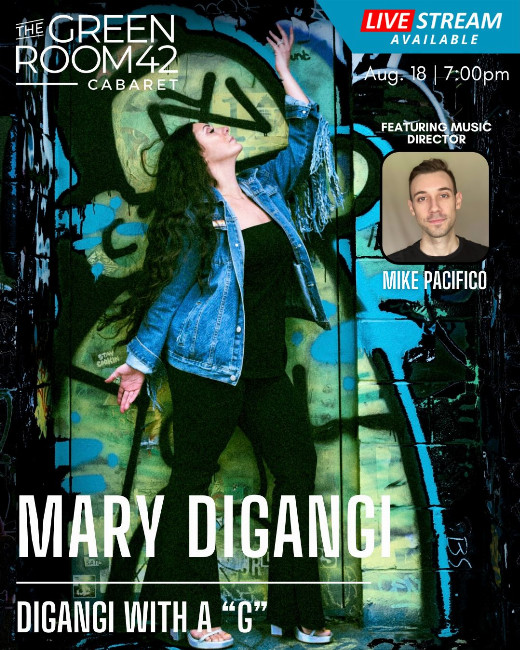
DiGangi With A “G” The Green Room 42 (8/18-8/18) |

|
Lisa Stephen Friday: A Musical for Henrietta Joe's Pub (9/13-9/13) |

|
Aliza Kelly's Haunted Tea Party: The Spooky Season Astrology Tour Joe's Pub (10/21-10/21) |
|
Generation Women Joe's Pub (8/11-8/11) |

|
James Tom, curated by Murray Hill Joe's Pub (11/05-11/05) |

|
Samantha Stratton: After One 54 Below (8/20-8/20) |

|
Anayka She Joe's Pub (8/29-8/29) |

|
Marcus Goldhaber: The Promise of You 54 Below (9/18-9/18) |
|
Unprofessional Variety Show: Never Forget Joe's Pub (9/19-9/19) |
Reader Reviews
To post a comment, you must register and login.