


Review: DEAD MAN WALKING, London Coliseum
Visceral and devastating production proves a testament to the power of opera
 A confession. It’s a guilty pleasure of mine to read the death notices on Wikipedia - I am my mother’s son after all and, without the columns of classifieds in the Liverpool Echo, where else is there to look?
Between “Serbian oncologist, 87” and “Olympic bobsleigher (1952), 96” it’s always a jolt to see “Convicted murderer, 37”. I seldom click to read of the crime and that’s important in keeping my opposition to its use both rational (it doesn’t work and it’s medieval) and abstract (names from Alabama and China comfortably distant). Well, this morning, the rational side still holds, but it’s impossible to ease into the abstract after watching (it felt more like feeling) this extraordinary UK premiere production of Jake Heggie’s visceral opera.
.jpg?format=auto&width=1400)
We open on the crime itself which, and I do not write this lightly, fully justifies the nuclear-level content warnings - a nightmarish re-imagining of Bruce Springsteen’s “The River”, four times Tony winner, Terrence McNally’s libretto off to a strong start (and it only gets better).
Prologue over, but heart rate elevated, where it stayed for three hours, (and rising again now as I think about the production), we’re dropped into Hope House, a Roman Catholic institution in Louisiana, where Sister Helen is leading a kids’ choir in a hymn, “He Will Gather Us Around”.
I was getting Sondheim vibes straight away, as the score drew on the kind of eclectic influences he would use to underpin the words (mostly delivered in the recitative style). But, almost imperceptibly, the holy trinity of opera’s unique storytelling became solidly established. The music, lyrics and acting seamlessly fed off each other, the enhanced storytelling, that only opera and musical theatre at their absolute peaks can deliver, was there in front of me, insistent. I couldn’t avert my eyes now.
But this was no Sweeney Todd nor Hamilton nor even an exotically other Madama Butterfly, this was 80s USA with a Volvo on stage and people wearing the clothes I once did when I also rocked a Billy Ray Cyrus mullet. And there’s no soprano lead to send the score skywards, mezzos in charge with that more real, more human register. I knew I wasn’t going to get a metaphorical Get Out Of Jail Free card from the emotional wringer that was already squeezing my chest.
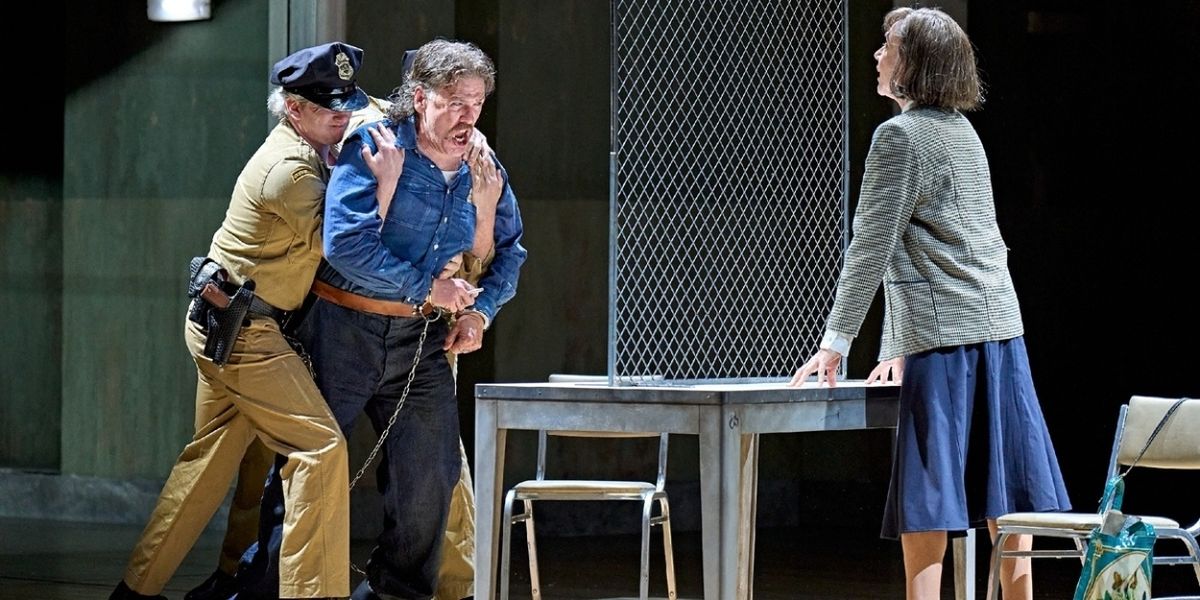
Christine Rice is tremendous as the nun, Helen (a version of Sister Helen Prejean, who wrote the non-fiction book on which this opera, like the film of the same name, is based). We see her needy nature, coming from a good place, but rooted - okay, perhaps rooted - in her guilt at becoming a Bride of Christ while surrounding herself with children. Doubling down on her compulsion to love her saviour above all else, she writes to convicted rapist/murderer Joseph De Rocher on Death Row, visits him and becomes his spiritual adviser. In the second half particularly, she exhorts him to confess his guilt in order to gain some peace and to provide a degree of comfort to the victims’ distraught parents. There are times when it feels more Catholic than The Godfather staged in the Sistine Chapel.
Matching Rice’s devastating debut in her role, Michael Mayes is extraordinary in a role he has made his own over the last two decades. He never lets us forget the fact that De Rocher is a criminal of the worst kind, a man wallowing in self-pitying denial, a model for those who support capital punishment to cite in their bleak argument. Yet, you do see the deeply flawed human being in there, partly because Mayes makes the man so very real, partly because his singing, though loaded with anger, is beautiful and partly because you know that he had to build this psychological carapace to survive at all. Pathos and poignancy to breach the most cynical of prejudices.
These pretty much incomparable leads get excellent support as the impact of the crimes are shown on the innocents left behind, the necessary counterbalance to what could easily be an apologia for shocking evil. Dame Sarah Connolly, another mezzo-soprano, brings a mother’s love to the role of Mrs Patrick De Rocher, exploring the plaintive tones available to her, especially in the aria she sings at the Pardon Board hearing. Jacques Imbrailo is utterly heartrending as the father of one of the victims, his life broken, Helen’s once strongest accuser finding some solace in her love too. As it happens, do-gooders (a miserable tabloid phrase) can do good even for those who decry them.
It is director, Annilese Miskimmon’s, singular achievement to hold the rising tide of sentimentality at bay - if tears come, for whom are they shed? - while allowing conductor, Kerem Hasan’s music to illuminate the light and dark of the human soul. That sounds easy for a seasoned practitioner of her craft, but, if it were, why does one so seldom see it? Alex Eales’ set, all unfinished grey concrete and functional chairs, really comes into its own in the cathartic final reckoning, a traumatising experience on both sides of the fourth wall.
There is much made in the programme of the support the cast has received from ENO in dealing with the emotional hit taken to bring this production to the stage, with post-run help also made available. Easy to scoff at such sensitivity - it’s only make-believe after all, isn’t it? But 12 hours after leaving the theatre, I can feel my own insides still churn at its memory - and that’s not going to be blinked away any time soon.
Dead Man Walking is at the London Coliseum until 18 November
Photo images: Manuel Harlan






Reader Reviews
To post a comment, you must register and login.