


Review: David Greig's Riveting TOUCHING THE VOID at Stageworks
The production closes February 1.
I used to bite my fingernails as a child, chewing them about as far as they could go. It’s a habit that I’ve gladly outgrown as an adult. That is, until last Friday night. Why, you may ask, did my childhood habit suddenly return? Because I saw a play so gripping, so edge-of-your-seat and suck-in-your-breath exciting, that I couldn’t help myself. I started biting my nails again. That’s how intense, how Powerful with a capital P, the latest Stageworks thrill-ride, Touching the Void, is. I don’t know how long it will take for my fingernails to grow back.
Touching the Void is a play by Scottish playwright David Greig, known for his stage adaptation of such works as Charlie and the Chocolate Factory and Local Hero. Based on Joe Simpson’s harrowing true-life tale (as well as a book and a movie), the play is everything I love about the theatre. It utilizes every aspect of the stage—scenic design, sound effects, video, lighting, and extraordinarily strong performances—to give us an idea of the horrors Mr. Simpson faced. Not since The Royale have I seen a story told in such a way that you can’t imagine experiencing it in any other way. (The last sentence is quite ironic to write since the 2003 movie was so intense that Roger Ebert called it “more frightening than my nightmares” and “the most harrowing film about mountain climbing I have ever seen.”)
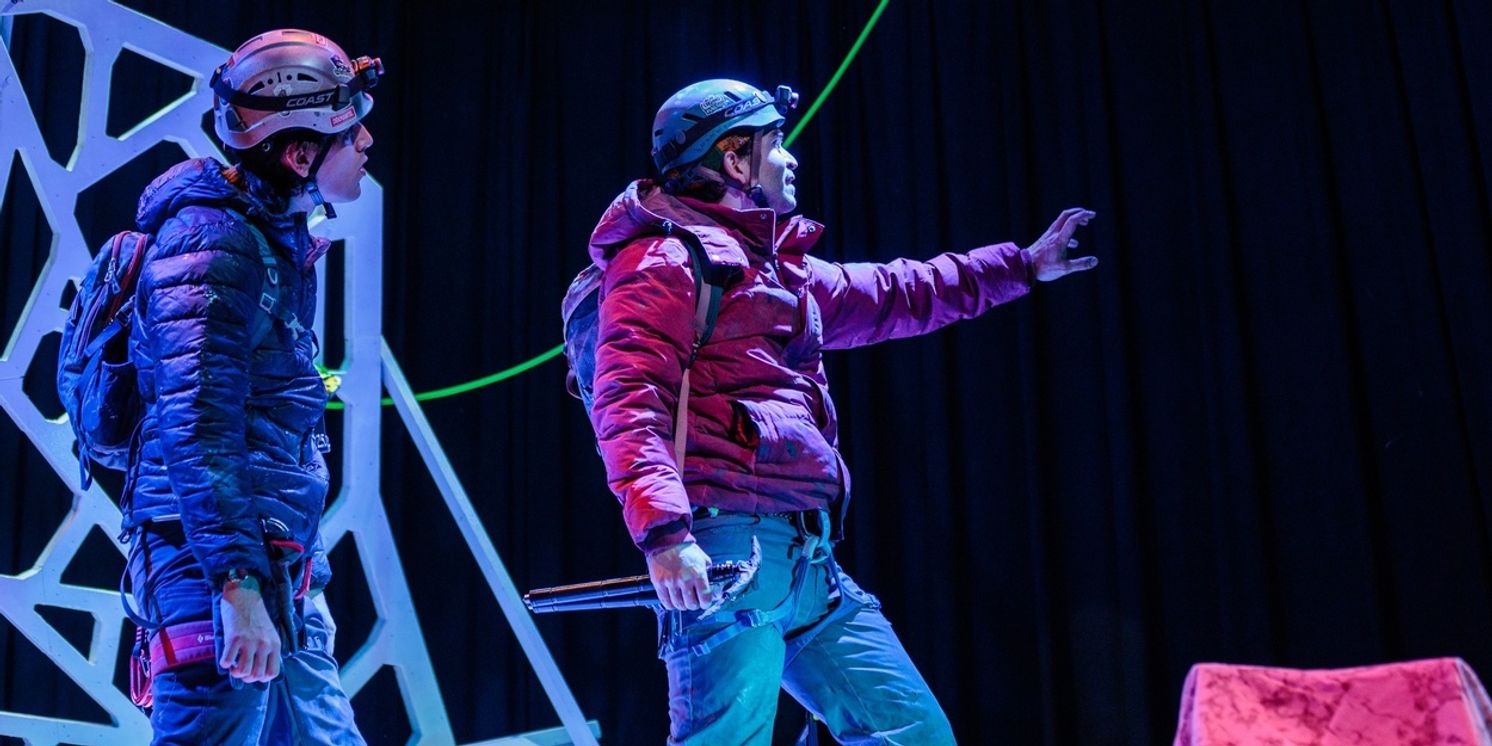
The play version of Touching the Void is about as intense a night at the theatre than I can imagine; if you have a fear of heights, as I do, then you might want to cover your eyes during some of it. It also showcases the difference between a movie version of events and a play. In the movie, the camera moves about the mountain, and we watch everything on a screen; it will get your heart pumping but we feel at a safe distance. Not so with the play. Here, you as a member of the audience sit so close to the stage in the intimate Stageworks theatre that it’s like you’re actually right there in the action; we feel like we’re trapped on the actual mountain with Joe and Simon.
It’s the 1980s in the Peruvian Andes, and two young mountain climbers, Joe Simpson and Simon Yates, are trying to become the first climbers to reach the summit of the west face of Siula Grande. But things don’t go as planned (if they did, we wouldn’t have a book, a film or this play). Joe breaks his leg as he slips down an ice cliff. Simon tries to help, but he accidentally lowers Joe off the cliff. To aid his own survival, Simon cuts the rope, and Joe plummets into a deep crevasse. Simon thinks Joe is dead and climbs down the mountain by himself, leaving Joe alone and abandoned and on the brink of death.
Told as if in a fever dream, the play goes back and forth in time, retelling the true-life events and re-imagining other scenarios. It plays with your thought process, challenging us to determine what is real and what is imagination. We know it’s based on actual events and that the main characters survive (that’s not a spoiler; the real-life Joe Simpson’s recounting of the events in his 1988 memoir sold over a million copies and has been translated in over twenty different languages). But knowing the outcome doesn’t make the jounrey any less terrifying.
Even at the end, we find ourselves questioning what really happened. “Did he die?” the person next to me asked after the show. “Is he dead?” We know the truth, but the dreams and reality crosshairs so effectively that we oftentimes don’t know what’s what. Like Joe, we’re disoriented.
That also becomes the power of the play. We may know the eventual outcome, but that doesn’t take away from the acrophobic horrors that we experience in real time.
The Stageworks production is, in a word, phenomenal It utilizes every audible and visual means to tell this tale. And the performances are uniformly excellent.
As Joe, Luis Rivera truly looks like a man in off-the-charts anguish. He screams, growls, yawps. In his more leisurely scenes (there are only a couple), he exudes his trademark onstage likability. But when he’s in distress, his turmoil becomes our turmoil. It’s exceptional, sustaining this intensity for so long. This almost wipes the audience out just viewing it; imagine what it’s like to actually perform with the intensity meter marked at “11” for such a prolonged period?
And when Joe literally falls from great heights, the audience gasps in unison. We believe the character’s agony because Luis Rivera unblinkingly inhabits the character’s extreme pain. We think he’s dead; then alive; then dead again. It’s a heart-thumping rollercoaster ride, full-tilt distress personified.
And his climbing partner, Simon, Robert Logan Mays does quite well, feeling both terror and sorrow and even guilt at cutting the rope and leaving Joe for dead. Tall and quite charismatic, this twentysomething resembles so many of the people I went to college with in the 1980s (they look like forgotten members of bands like Modern English or Spandau Ballet).
Seth Henley-Beasley is welcome relief to the tumult as Richard, Joe and Simon’s friend who waits for them from the home base. I have seen Henley-Beasley in various shows at USF (I last saw them as the Mad Hatter in Alice By Heart) and they add much-needed humor and light here.
Brianna McVaugh is quite a find as Sarah, Joe’s sister. She showcases such range and drive, almost like a life force, the soul that drives the show. In Joe’s imagination, she guides him, prods him, kicks him into action. She gets to display the gamut of emotions throughout, and is so real, so natural, that we believe her, even the dream scenes. And a mere reading of a letter becomes an emotional avalanche.
As mentioned earlier, all the technical aspects of the show are used to the ultimate degree. Tom Hnason of Suncoast Productions has created a beautifully brilliant monster of a set. The centerpiece, a Goliath recreation of the snowy mountain, resembles the skeletal remains of a mammoth brontosaurus as sculpted by Andrej Mitevski. It’s insanely good.
Celeste Silsby Mannarud’s lighting design adds so much, at times Severini-like dots swirl around it, looking like cells moving through a body. Andres Mota’s costumes works quite well; I particularly like the Led Zeppelin T-shirt that Sarah wears (“Stairway to Heaven” becomes a major theme in the play).
Best of all is Karla Hartley’s direction. This is one beautifully guided production, where the staging is seamless, using not just the stage left and stage right, but the highs and the lows, the ups and the downs. There may just be four cast members, but the bodies move about in various speeds that it becomes a work in constant motion without feeling fast-forwarded. It's one tight production. To give you a sense of the incredible pace of the show, at the end of Act 1, I thought 35 minutes had gone by, but it was actually over an hour in length. This was a shock to me. But in all great shows, as we watch each riveting moment and get completely wrapped up in the storyline, time ceases to exist.
Touching the Void is a show that you want to watch again, to see the things you may have missed the first time. (The ending can be quite confusing.) It will invoke so many reactions, look-away horror of people in pure survival mode. And it helps that, even in Florida, it's quite cold outside, maybe on the verge of snow not seen in our area in half a century, which adds to our experience of the freezing conditions presented on the stage. It's exhilerating. My only advice: Come with bandages on each of your fingers so that you don’t bite your fingernails the way I did.
Stageworks’ gripping Touching the Void ends its run on February 1.
Photo credit: James Zambon Productions.
Reader Reviews
Videos