


Review: COME FROM AWAY at The Phoenix Theatre Company
The production runs through March 29th at The Phoenix Theatre Company.
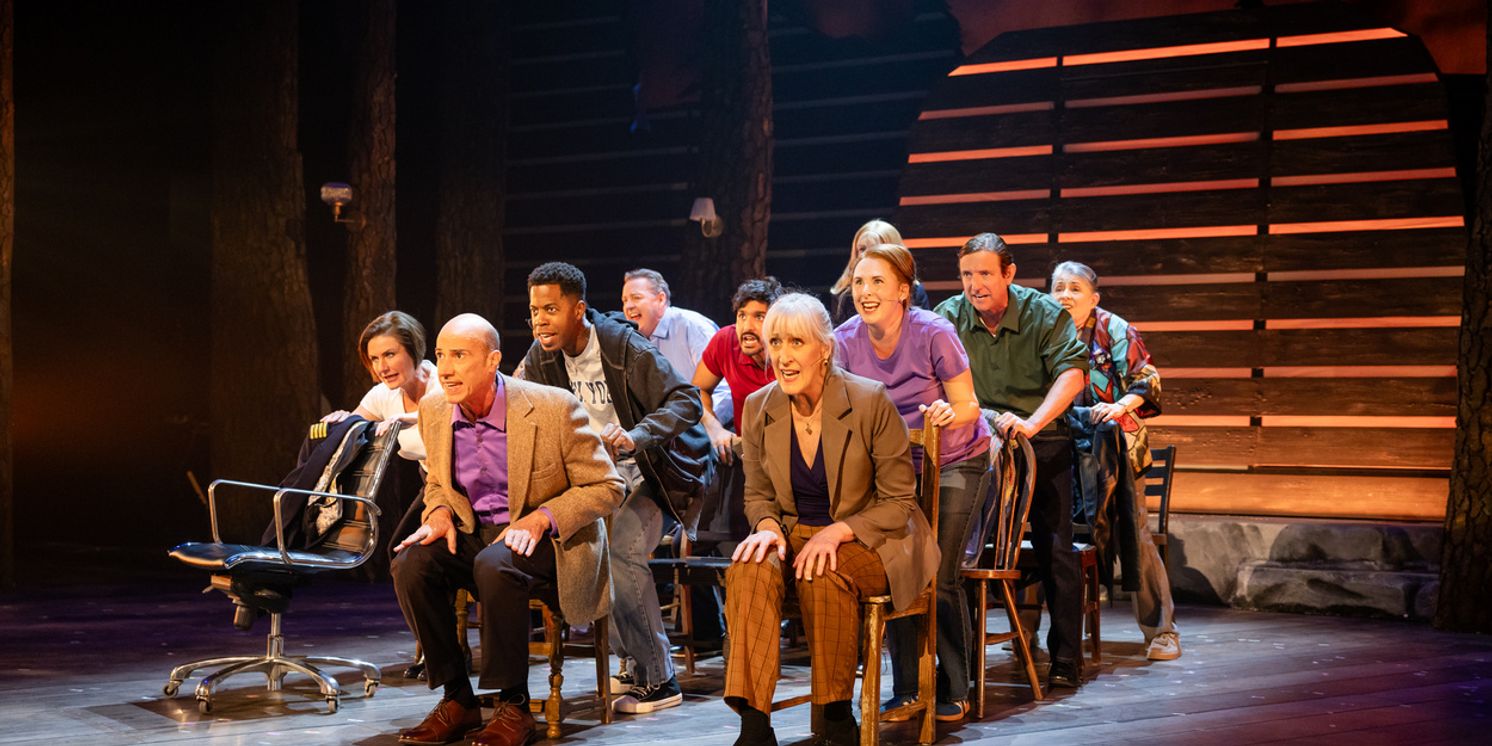
Guest contributor David Appleford’s take on The Phoenix Theatre Company’s production of COME FROM AWAY.
You might walk into COME FROM AWAY expecting a warm bath of Canadian niceness. Then the lights go down, the music kicks in, and suddenly you’re swept into a production built on adrenaline and affection in equal measure. Any instinctive suspicion you may have harbored about the tastefulness of a “9/11 musical” evaporates almost immediately. The show is neither polite nor beige. It’s the kind that makes you suspicious of your own tears, only to win you over with sincerity and deft theatricality.
Now playing at The Phoenix Theatre Company’s new Dr. Stacie J. and Richard J. Stephenson Theatre through March 29, COME FROM AWAY takes what could have been a maudlin civic pageant—a musical about 9/11’s emotional aftershocks in the backwoods of Newfoundland—and turns it into something human-sized and full of quicksilver emotion. The show zips by in 100 unbroken minutes: it moves the way people do when they’re trying to stay useful in a crisis.
Based on the true story of Gander, Newfoundland, a town that suddenly became the impromptu host to 7,000 stranded passengers from 38 grounded planes, this could easily have been a dutiful inspirational musical, a sepia-toned tribute to human decency with all the dramatic tension of a Hallmark movie. Instead, COME FROM AWAY is smarter, funnier, and more moving than anyone had a right to expect. It sidesteps sermonizing and becomes a lively, quietly piercing piece of theater about what disoriented people do when they’re scared and forced to depend on strangers.
The project began with the vision of Michael Rubinoff, a Toronto lawyer and theatre producer who brought together writing duo Irene Sankoff and David Hein. In 2011, the pair traveled to Gander on the tenth anniversary of 9/11, interviewing locals and returning passengers and collecting stories both humorous and harrowing. Some made it into the musical verbatim, others were carefully blended to shape a coherent theatrical narrative.
What Sankoff and Hein do so deftly is resist Broadway bombast. Rather than inflate the story, they shrink it, focusing on the small, improvisational acts that make the larger miracle believable. The ice rink becomes a giant refrigerator, the bus queue a confessional, and a town of teachers, loggers, and SPCA workers transforms overnight into cooks, counselors, and emergency responders. When a stranded passenger tells us, “They just gave us everything,” she’s not speaking metaphorically.
The score plays a crucial role in keeping the show grounded; there are no grandstanding power ballads. Instead, the music draws from folk traditions and world rhythms, shaping character through texture and momentum rather than vocal display. Under Alan J. Plado’s music direction and performed by an eight-piece orchestra, the score pulses alongside the action. Numbers like Welcome to the Rock and Somewhere in the Middle of Nowhere bring a rough-hewn Celtic swagger, giving the production a lively, pub-like energy. When the locals erupt into Heave Away, you expect tankards to be raised in the spirit of Cornwall’s Fisherman’s Friends. The songs don’t linger long enough to become precious; they’re spirited and insistently alive.
The true marvel, though, is The Phoenix Theatre Company ensemble. They operate as a genuine unit, slipping into roles like second skins and achieving something rare: you feel the souls of both the “plane people” and the locals not as types, but as fleeting, fully imagined presences. Characters are recognizable but never cartoonish. Not everyone behaves nobly, and the show allows room for impatience and friction alongside generosity. Even its happy endings carry a certain Newfoundland reserve that feels earned rather than imposed.
Twelve actors play dozens of characters, switching roles with the precision of a street magician and the warmth of a regular at the local pub. They don’t grandstand; they share. Their stories interlace naturally: a frantic mother waiting for word of her firefighter son, a gay couple navigating small-town conservatism, a Muslim passenger suddenly viewed with suspicion.
There’s no saint-making here, just plainspoken moments of revelation delivered with a bracing honesty. To single out one performer without mentioning another would be a disservice, though several moments linger. Rusty Ferracane and Sally Jo Bannow bring touching spontaneity to an unexpected romance. Trisha Ditsworth makes a vivid impression as the caretaker tending to animals trapped in cargo holds. And Amy Jo Halliday’s trailblazing female pilot stops the show with her devastating account of loving flight, only to see it turned into a weapon.
Director Michael Barnard keeps everything buoyant and clear, the staging fluid, unfussy, and quietly assured. His direction and Nathaniel Shaw’s choreography are so closely intertwined that the line between them all but disappears. With minimal yet effective physical scenery by Robert Kovach, reminiscent of Broadway’s original design, and lighting by Keith A. Traux doing much of the heavy lifting, a mostly bare stage transforms effortlessly into planes, shelters, bars, and churches through a shift of light, the move of a table, or the swivel of a chair.
What’s most striking is that the show never cloys. It brushes against sentiment but never smothers in it. Even as it celebrates human goodness, it allows darker shadows of grief and xenophobia to fall. The Arabic chef Ali becomes a quiet emblem of post-9/11 Islamophobia; a payphone line turns into a battlefield; passengers scavenge for underwear while the world beyond remains frighteningly unstable. Yet the show keeps returning to its central, quietly radical idea that people are mostly kind, mostly decent, and often heroic in ways that don’t announce themselves.
In a time when so much theater begs to be taken seriously while forgetting to move you, COME FROM AWAY remembers the simplest and most subversive trick of all: it makes you care. It does so with a humility and vigor that feel bracingly out of step with our more cynical age. And it challenges us to believe that decency can be dynamic, that community can drive drama, and that in the aftermath of catastrophe, ordinary people are capable of extraordinary grace.
Those who lived through 9/11 will recognize the ache behind the show’s final refrain, Something’s Missing. For a brief moment, strangers treated one another like family; gestures of care came easily, almost reflexively.
When the cast takes its final bow, you may find yourself clapping through tears, not because you’ve been manipulated, but because somewhere in the rhythm and generosity of this exceptionally accomplished The Phoenix Theatre Company production, COME FROM AWAY reminds you what theater can do. It doesn’t just show us who we are. It shows how deeply, stubbornly, and improbably connected we remain.
The Phoenix Theatre Company -- www.phoenixtheatre.com -- 1825 N Central Avenue, Phoenix, AZ -- Box office: 602-254-2151
Photo credit to Brennen Russell

Reader Reviews
Videos