


Review: -320°F, Sadler's Wells
Hideki Noda returns to London with energetic provocation.
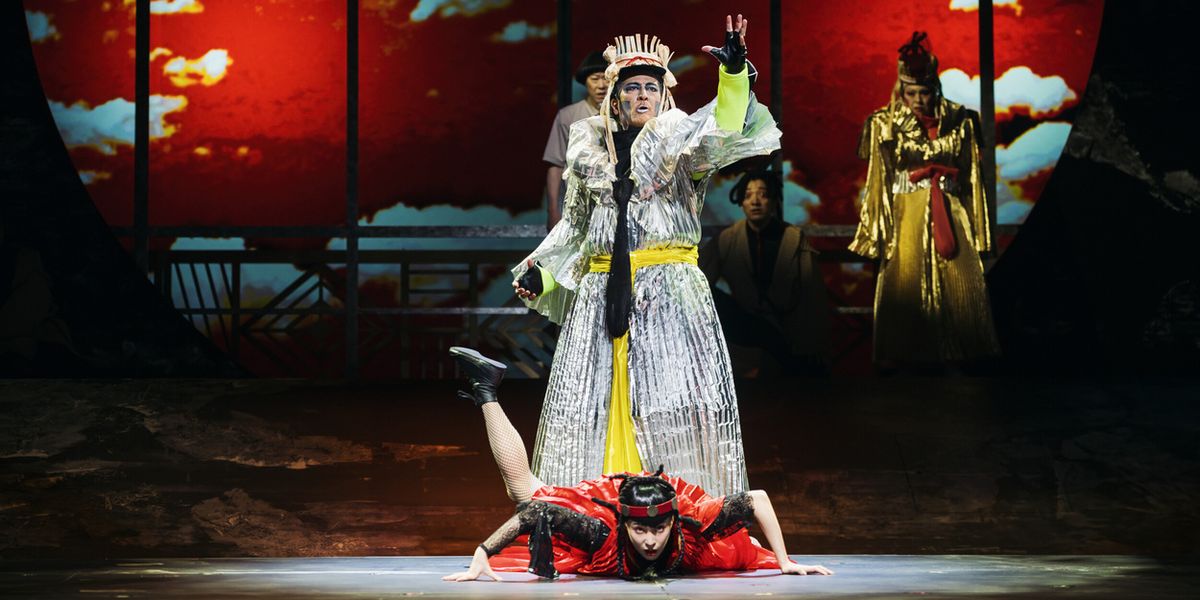

Science-fiction takes a bleak turn in Hideki Noda’s latest eye-opening and thought-provoking piece of theatre. At an excavation site, a research team led by Professor Kyuri is trying to unearth “Angel Bones”. With the funding coming from a large pharmaceutical company, the strings attached to the study are quick to emerge. When the sponsor learns that Kyuri’s assistant might be the key to finding what they’re looking for, their attention shifts and the stakes become much darker.
Hideki Noda reintroduces his idiosyncratic blend of movement and drama in a production that’s grounded by a strong philosophical framework and soars with brilliantly theatrical imagination. This is experimental theatre that verges on the completely and poetically bonkers. The play might be structurally complicated to explain, but it’s remarkably easy to follow due to Noda’s instinctive approach to storytelling.
Alex%20Brenner__11_4924_dx_s.jpg?format=auto&width=800)
Thematically speaking, −320°F is a little all over the place: it’s a parable against the greed and vanity of the ruling class as much as it is a provocative sci-fi romp and a dystopian satire. It buzzes with energy, and it’s surprisingly funny too. The core idea that props up the whole plot is that humans aren’t bound by blood, but by bones – the only part of the body that outlives all creatures. Eugenics, elitism, and pro-life attitudes also come into play, broadening the scope of the discussion and adding fuel to the fire.
The timeline jumps are cued in with specific visual prompts: the stage is engulfed by static and Help (Sadawo Abe) slips from modern times to the Middle Ages and ancient history to find the invisible strings that hold humanity together. In our exploration of science and faith, we meet gods and monsters at a neck-breaking pace.
Alex%20Brenner__11_5310_dx_s.jpg?format=auto&width=800)
Yukio Horio’s set design is elaborate in its minimalism. Screens and projections (by Taiki Ueda) transition the action, but the audience is asked to fill in the gaps between the limitations of stagecraft and the narrative demands of the show independently. Noda arranges the bodies to generate new shapes and enhance reality for the characters. A forearm becomes a fossil, a chain of arms turns into a skeleton. These purely physical moments are simply mesmerising.
The tonal ambiguity of the piece keeps you on your toes, as the conventions of Japanese performance handle the complexities of the subject matter with a flair that may come off as majorly OTT. Noda is an accomplished kabuki director too, and the influence of the genre is truly evident here. He nudges at Japanese tradition with makeup and other extravagant touches in some of the costumes to create a clear definition between the social roles of his portrayals.
Alex%20Brenner__93_7335_dx_s.jpg?format=auto&width=800)
Noda’s vision is magnificent in its epicness, but it tends to want to be a lot of things at once. For instance, he adds a d/Deaf arc to the mix with the Narrator, who’s in charge of telling “the story of the voiceless” meta-theatrically through Japanese Sign Language. Abe voices her performance by crouching behind her.
It’s a lot to juggle as a viewer, but the production is a compelling watch. The company as a whole is a cohesive unit too, with Suzu Hirose stealing the show with sheer magnetism as Mephisto/Jean/Quasi Himiko/Angel of Light. Noda himself takes on the role of Assistant Stalwart, a clever and accidentally comic researcher.
Ultimately, −320°F is an exquisite opportunity to engage with a type of theatre that culturally and conventionally differs from what we’re used to in London. It kick-starts a conversation on the meaning of being human and delivers it with a disarming mise-en-scène.
-320°F runs at Sadler's Wells until 11 July.
Photography by Alex Brenner
Sign up for all the news on the Fall season, discounts & more...
.jpg?format=auto&width=300)






Reader Reviews
To post a comment, you must register and login.