Pianist Simone Dinnerstein and Baroklyn Will Perform Music From New Album Complicité at Merkin Hall
The performance is on Tuesday, October 21, 2025 at 7:30pm.
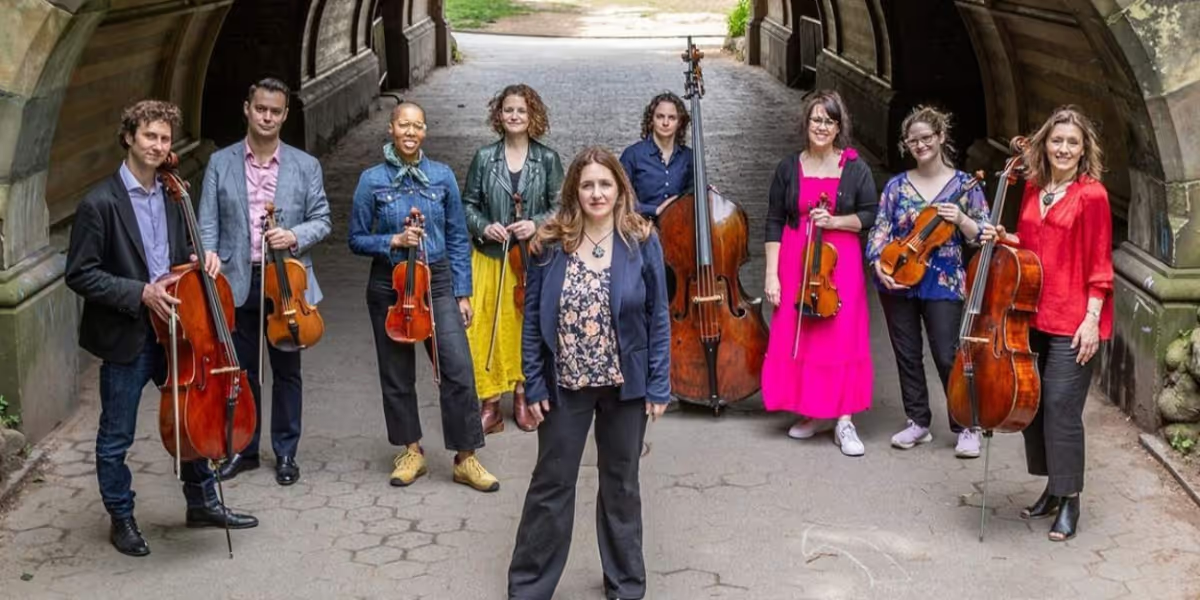
On Tuesday, October 21, 2025 at 7:30pm, GRAMMY-nominated pianist Simone Dinnerstein will perform with Baroklyn, the string ensemble she founded and directs, the music of their recent album Complicité, presented by Kaufman Music Center (KMC) at Merkin Hall (129 W. 67th St.) as part of KMC’s Piano Dialogues series. The concert also features mezzo-soprano Jennifer Johnson Cano and oboist Katherine Needleman with Dinnerstein and Baroklyn.
Simone Dinnerstein is well known for her distinctive musical voice and for her expressive performances of music by J.S. Bach. She first came to wider public attention in 2007 through her recording of Bach’s Goldberg Variations, reflecting an aesthetic that was both deeply rooted in the score and profoundly idiosyncratic.
Both the new album, Complicité, and the upcoming concert at KMC include Dinnerstein and Baroklyn’s arrangement of Bach’s chorale Herr Gott, nun schleuß den Himmel auf, BWV 617; Bach’s Keyboard Concerto in E Major, BWV 1053; J.S. Bach: Der Leib war in der Erden, BWV 161 (arr. Simone Dinnerstein and Baroklyn); Bach’s Cantata 170, Vergnügte Ruh, beliebte Seelenlust with continuo realization by Philip Lasser; and In the Air, Lasser’s recomposition of Bach’s Air on the G String.
Dinnerstein says of her group Baroklyn, “Baroklyn is a group of string players which I lead from the piano. We’re a community that shares the artistic vision that is most important to me, that music should be creative and new. Rehearsal is important to us, and I’ve been influenced by theater practice in which we listen to each other and pass musical ideas and phrases within the group. We rehearse and perform in a semi-circle around the piano and I rearrange parts to emphasize lines, voices and imitative qualities to create a sense of dialogue.” The ensemble’s name is a portmanteau of Baroque and Brooklyn, Dinnerstein’s home borough.
Of the album’s title, Dinnerstein says, “Complicité is a term that I first heard from my son, who studied the teachings of the French theatre practitioner, Jacques Lecoq. Three important ideas that Lecoq communicated to his students were le jeu (playfulness), complicité (togetherness), and disponsibilité (openness). I was so intrigued by these ideas, and the different exercises that my son learned in order to cultivate these skills within ensemble acting, that I decided to try a Lecoq approach with my own musical ensemble, Baroklyn.”
More about Simone Dinnerstein: Dinnerstein has played with orchestras ranging from the New York Philharmonic and Montreal Symphony Orchestra to the London Symphony Orchestra and the Orchestra Sinfonica Nazionale Rai. She has performed in venues from Carnegie Hall and the Kennedy Center to the Berlin Philharmonie, the Vienna Konzerthaus, Seoul Arts Center and Sydney Opera House. She has made fifteen albums, all of which have topped the Billboard classical charts. Her first fourteen albums were recorded with Grammy Award-winning producer Adam Abeshouse. During the pandemic she recorded three albums which form a trilogy: A Character of Quiet, An American Mosaic, and Undersong. An American Mosaic was nominated for a Grammy. Her most recent recording Complicité (Supertrain Records, 2025), is her first all-Bach album in over ten years and features Jennifer Johnson Cano, mezzo-soprano and Peggy Pearson, oboe d’amore along with the string ensemble Simone founded and directs, Baroklyn. Recorded with producer Silas Brown, the album also includes composer Philip Lasser’s continuo realizations and recomposition of Bach’s Air on the G String.
In recent years, Dinnerstein has created projects that express her broad musical interests. She gave the world premiere of The Eye Is the First Circle at Montclair State University, the first multi-media production she conceived, created, and directed, which uses as source materials her father Simon Dinnerstein’s painting The Fulbright Triptych and Charles Ives’s Concord Sonata. She premiered Richard Danielpour’s An American Mosaic, a tribute to those affected by the pandemic, in a performance on multiple pianos throughout Brooklyn’s Green-Wood Cemetery. Following her recording, Mozart in Havana, she brought the Havana Lyceum Orchestra from Cuba to the U.S. for the first time, performing eleven concerts. Philip Glass composed his Piano Concerto No. 3 for her, co-commissioned by twelve orchestras. Working with Renée Fleming and the Emerson String Quartet, she premiered André Previn and Tom Stoppard’s Penelope at the Tanglewood, Ravinia and Aspen music festivals, and performed it at Carnegie Hall, the Kennedy Center, and presented by LA Opera and the Cleveland Orchestra.