
Historic Spots To See From Your Favorite Broadway Shows
Did you know that you can visit these Broadway-relevant historic sites in New York City?
Do you have a burning Broadway question? Dying to know more about an obscure Broadway fact? Broadway historian and self-proclaimed theatre nerd Jennifer Ashley Tepper is here to help with Broadway Deep Dive. BroadwayWorld is accepting questions from theatre fans like you. If you're lucky, your question might be selected as the topic of her next column!
Submit your Broadway question here!
This time, the reader question was: What historic sites can I visit that are relevant to current Broadway productions?
One of the best parts of seeing a show in New York City is how there is often a relevant historic spot to visit, just steps away from the show you’re seeing.
The current off-Broadway production of Shakespeare’s Richard II, starring Michael Urie, is happening only steps from the historic Astor Place Riot. In 1849, the largest number of civilian casualties in the United States since the Revolutionary War happened at Astor Place—due to a theatre debate. Edwin Forrest, an American actor, and William Charles Macready, a British actor, were both playing the title role in productions of Shakespeare’s Macbeth in the area. A contentious rivalry brewed, with New York citizens growing passionate about who they thought was the better actor.
In the mid-19th century, theatrical riots were common—but they didn’t often turn deadly. However, class tensions were boiling. The contest between America’s first star actor, Forrest, and premiere British Shakespeare interpreter Macready came to symbolize the divide between the working class who believed America was for Americans and the upper class who still prized a connection with Britain. The Astor Opera House, where the riots converged, once sat where the 11-story condominium building above the 6 train entrance now is. Right at the site of the former Astor Place Starbucks, a violent uprising rooted in issues of class and nationality— in the guise of vitriol over Shakespearean interpretation—became an important moment in American history.
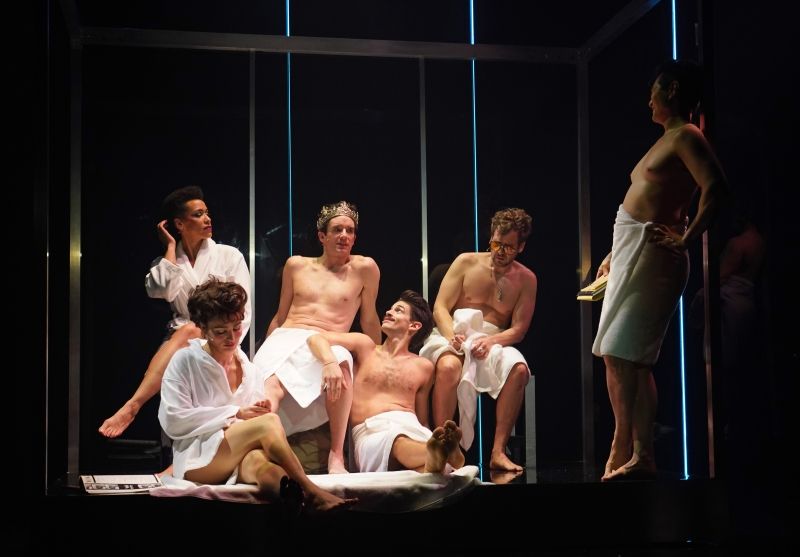
Red Bull Theater’s current Richard II, directed by Craig Baldwin, reimagines Shakespeare’s play as a tale of affluent, stylish, queer 1980s New York. In Richard II, the title character (Urie) becomes in embroiled in a battle for the crown with his cousin Henry Bolingbroke (Grantham Coleman). Just as Forrest and Macready once battled for the support of their audiences in real life, steps away, Urie and Coleman, within the world of Shakespeare, portray a rivalry with themes that reflect on their audiences.
A few blocks uptown from Richard II, another off-Broadway show based on a real-life leader is playing. This is 44 The Obama Musical, straight from successful engagements in Chicago and Los Angeles. The parody musical 44 is currently playing the Daryl Roth Theatre in Union Square.
While former President Barack Obama traveled to New York many times while leading the country, some of his most interesting New York City history happened years before that, when he was a student at Columbia and a young community organizer. One can visit the spots in Morningside Heights, the Upper East Side, Park Slope, and Central Park that Obama spent time in during the 1980s and described in his memoir. That said, those neighborhoods are a jump away from 44 The Obama Musical, so the easiest Obama history spot to visit following a performance of the show would likely be Washington Square Park. In 2007, the then-future President Obama led a rally near the Washington Square Park arch as part of his presidential campaign.
Uptown but still off-Broadway this season was a tell-all play about the early years of Saturday Night Live. Not Ready for Prime Time, which played at the MCC Theater Space, brought to life the original SNL cast members and creator Lorne Michaels on 52nd Street near 10th Avenue. Theatergoers attending Not Ready for Prime Time could take a short walk following their performance and look up at the storied building where SNL has been filmed for 50 years. Since 1975, NBC Studios at 30 Rock in Rockefeller Center has been the home of all Saturday Night Live broadcasts, including those dramatized in Not Ready for Prime Time.

In addition to those three off-Broadway shows that boast interesting related locations nearby, many of Broadway’s current productions are currently happening very close to historic linked places. Perhaps the most obvious is Hell’s Kitchen, where the coming-of-age of teenage Ali is inextricably tied to where she is growing up: Manhattan Plaza, in Hell’s Kitchen. After seeing the Alicia Keys musical at the Shubert on 44th Street, one can travel just a few blocks west and south to 43rd Street and 10th Avenue, and look up at the very building that inspired Keys to write her semi-autobiographical show.
Three current Broadway shows depict the lives of real-life entertainers who spent time performing around the Times Square area on occasion. Buena Vista Social Club, Just in Time, and MJ might not have major plot points related to their artists’ visiting midtown, but one can still relate the events of these shows to historic spots in the area where their central characters spent time.
After experiencing the electric cast of MJ performing Michael Jackson hits from “Beat It” to “Billie Jean” to “Man in the Mirror”, audiences can also stop by the site of Jackson’s first-ever in-store signing event. In 2001, traffic in Times Square came to a standstill as thousands gathered, hoping for a glimpse of the superstar. Jackson signed copies of his new album, Invincible, at the famed Virgin Megastore in Times Square. This was the flagship location for the brand back when the public bought music in person that they could hold. The location in the heart of Times Square was located on the east side of the block, between 45th and 46th Streets. A Forever 21 occupied the space until recently.
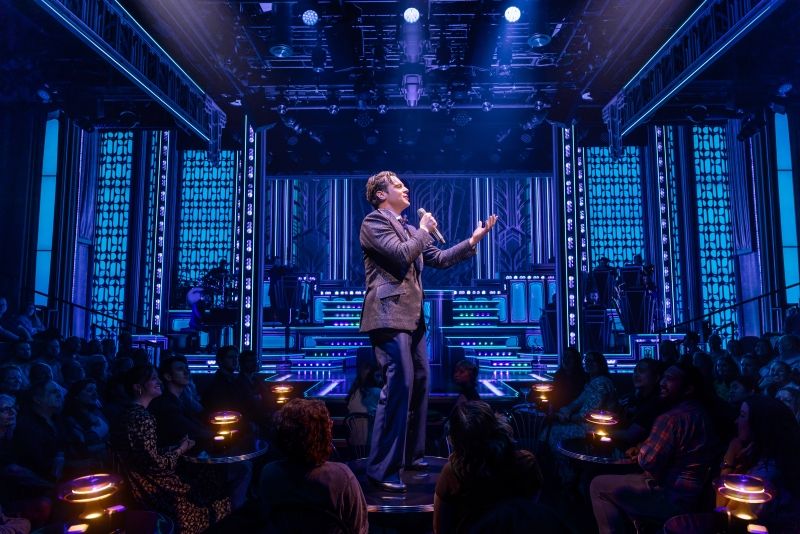
Bobby Darin, the central character of Just in Time, performed frequently at the legendary Copacabana. After taking in Jonathan Groff’s earth-shaking performance as Darin at Circle in the Square, audience members can take a stroll down memory lane (and also up Broadway) to visit one of Darin’s real-life haunts. During its heyday, the Copacabana was located at 10 East 60th Street, now occupied by one of Avra’s restaurants. Darin even recorded an album live at the spot in 1960, including several of his major hits like “Mack the Knife” and “Dream Lover” which can also be heard as sung by Groff in Just in Time.
In 1998, the Buena Vista Social Club presented a renowned concert at Carnegie Hall, just a short walk from where the musical of the same name is playing on 45th Street. The concert inspired the documentary about the group, which eventually led to the musical on Broadway today.
A pivotal scene of The Great Gatsby occurs at the iconic Plaza Hotel. Theatergoers seeing the musical based on the F. Scott Fitzgerald novel can visit that very location for tea or otherwise, following their performance. The location where Daisy and Gatsby’s affair comes to light has been a must-see New York City hotspot since it opened in 1907. While the gilded Plaza was a new destination in the 1920s when the story is set, it is now a century-plus-old hotel and gathering place.
Even farther back in New York City history, Alexander Hamilton didn’t throw away his shot, and his legacy can be experienced all over the island of Manhattan. For those seeing the landmark musical on 46th Street, there are several places one can visit in tandem that will enhance the experience.
The Grange was Hamilton’s home in the early 1800s and is now a museum and visitor experience about the founding father’s life, located in St. Nicholas Park in Hamilton Heights. Alexander Hamilton, Eliza Schuyler Hamilton, and Hercules Mulligan are all buried at Trinity Church, and folks can pay their respects at the grave sites in lower Manhattan, near Wall Street. Fraunces Tavern, a museum and restaurant in the financial district is also a great place to visit that augments the history laid forth in Hamilton; the tavern was a meeting place for several of the founding fathers. The Morris-Jumel Mansion is the oldest standing house in Manhattan and was at different times the home of George Washington and Aaron Burr; Lin-Manuel Miranda actually wrote parts of Hamilton in what was once Burr’s bedroom on the property. Sites in the Manhattan area that are connected to the musical Hamilton are not limited to these; of course one can also cross the Hudson and stand in the area of New Jersey where Hamilton and Burr’s duel took place.
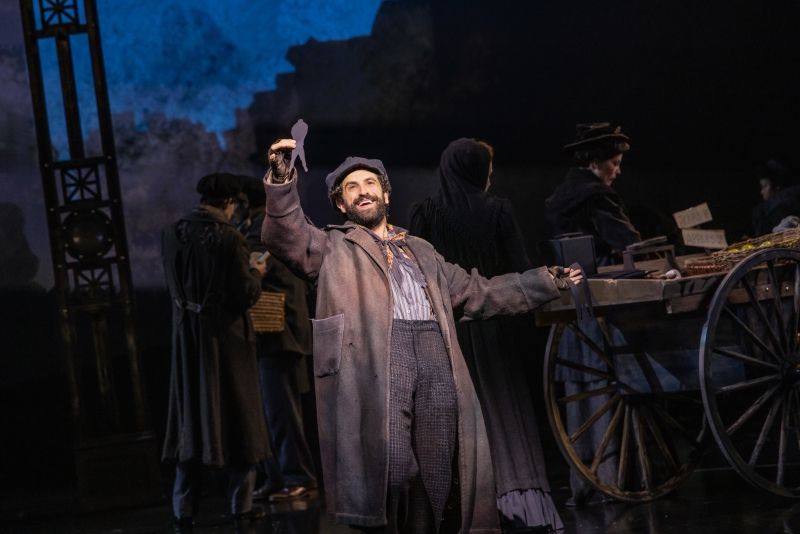
Ragtime, currently playing at Lincoln Center’s Vivian Beaumont Theatre, has many ties to real locations in New York City that are part of the musical’s drama. From Union Square where Emma Goldman speaks to Ellis Island where Tateh and the Little Girl arrive to the heart of Harlem where Coalhouse plays his songs for Sarah, one can map the characters’ lives in many different NYC neighborhoods. At the turn of the 20th century when the story takes place, Lincoln Square, now home to Lincoln Center, was known as San Juan Hill and looked very different. While no major events depicted in Ragtime took place in the immediate vicinity, Harry Houdini, master escapist, did perform in the heart of Times Square (then called Longacre Square). Houdini’s famed straight-jacket escape took place in 1916 near the Palace Theatre, where he was then performing.
The new Broadway play Liberation is a personal tale involving what feminism meant to a group of women in 1970s Ohio. That said, several important events of the women’s liberation movement happened only a quick jaunt from the James Earl Jones Theatre, where Bess Wohl’s play is currently astounding audiences. In the 1910s, multiple women’s suffrage demonstrations took place in Times Square, proclaiming that women should have the right to vote. In 1970, when the play takes place, the Women’s Strike for Equality happened in New York City.
Second-wave feminism, as depicted in Liberation, had begun, and this 1970 demonstration centered around Bryant Park involved thousands of people marching for the equal opportunities that women demanded as part of this new chapter of the movement. The Women’s Strike for Equality in 1970 marked the 50th anniversary of women finally obtaining the right to vote in 1920. Now, 55 years after the Women’s Strike for Equality and 125 years after the ratification of the 19th amendment giving women the right to vote, Liberation speaks to feminist history very close to spots where previous generations of women once raised their voices.
Breaking Broadway alerts by text
Get the biggest stories sent straight to your phone.
Weekly top stories - unsubscribe anytime.
.jpg?format=auto&width=300)



Comments
To post a comment, you must register and login.