


Friends and Collaborators of Stephen Sondheim Who Appear in His Collection at The Library of Congress
Whose names show up in Sondheim's papers and why?
Do you have a burning Broadway question? Dying to know more about an obscure Broadway fact? Broadway historian and self-proclaimed theatre nerd Jennifer Ashley Tepper is here to help with Broadway Deep Dive. BroadwayWorld is accepting questions from theatre fans like you. If you're lucky, your question might be selected as the topic of her next column!
Submit your Broadway question here!
Earlier this year, it was announced that the Library of Congress had acquired the Stephen Sondheim collection. The legendary composer and lyricist passed away in 2021 at the age of 91 after a long and extraordinary career. His collection at the Library of Congress is in the midst of being catalogued, with the boxes that have been processed now available to the public for educational and scholarly purposes.
This summer, I traveled to Washington D.C. and spent several days poring over Sondheim’s lyric drafts, music manuscripts, rewrite notes, brainstorm pages, song list outlines, and more. The collection offers a historic and extensive look at the process of one of the greatest musical theatre writers of all time. For theatre fans who love Sondheim’s musicals or writers interested in seeing renowned technique up close, there is no greater pleasure than spending time in the Sondheim collection. The librarians at the Library of Congress, in particular Senior Music Specialist Mark Horowitz, have done an incredible job archiving the materials.
During his prolific and storied career, Sondheim collaborated with many other artists, from book writers to directors, from actors to musicians. Seeing Sondheim’s regular collaborators, close friends, one-time associates, mentors, and rare connections make appearances in his collection was both moving and illuminating.
So much of Sondheim’s correspondence has been publicly made available already, online and otherwise- but barely any of this has been catalogued in the Library of Congress collection yet. So, the following is not an exploration of correspondence, nor is it meant to highlight all of Sondheim’s most prominent friends and collaborators. Rather, in contrast to the previous two pieces in this series which were largely about Sondheim’s work and process, this article dives into a small number of specific people whose names appear in his papers. For what varied reasons were these folks present, often written in Sondheim’s own hand?
Here are eight of the people (or groups of people) who appear in the Sondheim collection at the Library of Congress:
1. Michael Crawford
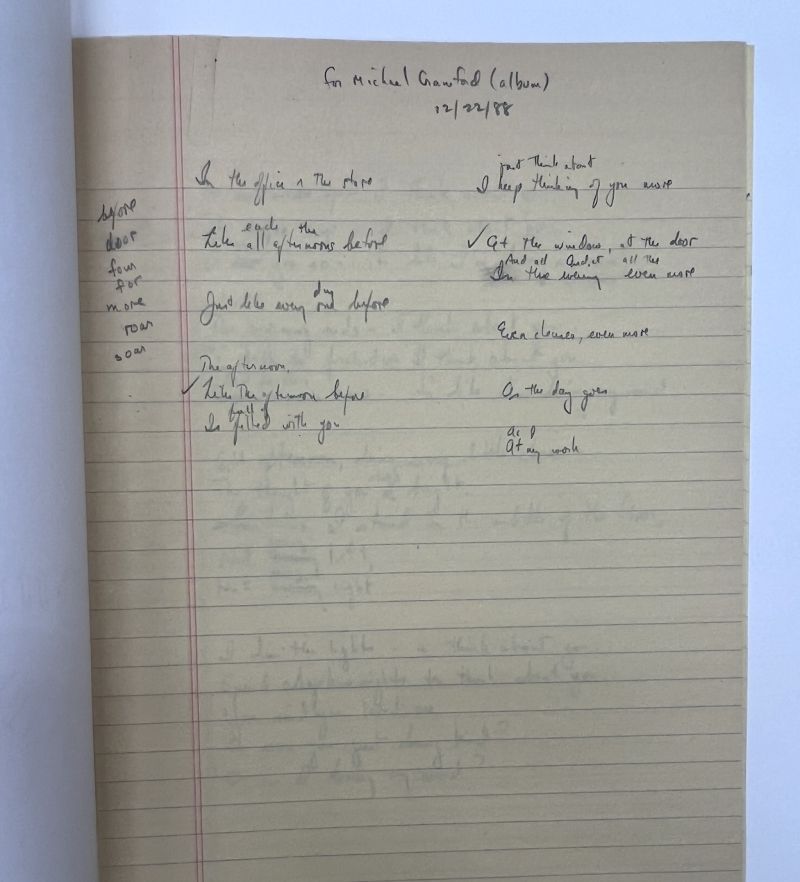
The legendary actor and singer Michael Crawford has recorded many of Stephen Sondheim’s songs over the years. While Crawford has never performed in a Sondheim musical on Broadway—where he is best known for originating the title role in The Phantom of the Opera—he did appear as Hero in the 1966 film adaptation of A Funny Thing Happened on the Way to the Forum.
More than two decades later, immediately following Phantom’s success, Crawford corresponded with Sondheim as he prepared to record “Being Alive” from Company on his second studio album. (His first studio album opened with a West Side Story medley and also included “Not a Day Goes By” from Merrily We Roll Along.) Crawford’s second album, With Love/The Phantom Unmasked capitalized on his Tony Award-winning performance in the Andrew Lloyd Webber musical, with a new take on “The Music of the Night”. Immediately preceding that on the album was Crawford’s interpretation of “Being Alive”.
Any time a major artist recorded a Sondheim song for a studio album, Sondheim displayed a considerable willingness to collaborate on changes. This page from Sondheim’s work book in 1988 shows him working out potential lyric adjustments… but they are not for “Being Alive”, which Crawford recorded verbatim to the original lyric. This sheet shows Sondheim brainstorming and sketching out some new lyrics for “Losing My Mind” from Follies, specifically for Crawford to record a new interpretation. The number, a torch song for the character of Sally in the latter part of Follies, is typically sung by a woman. This is one of several pages where Sondheim thought about a few new lyrics that would be correct for a Michael Crawford version. Sadly, Crawford did not wind up recording the song.
2. Tom Newman
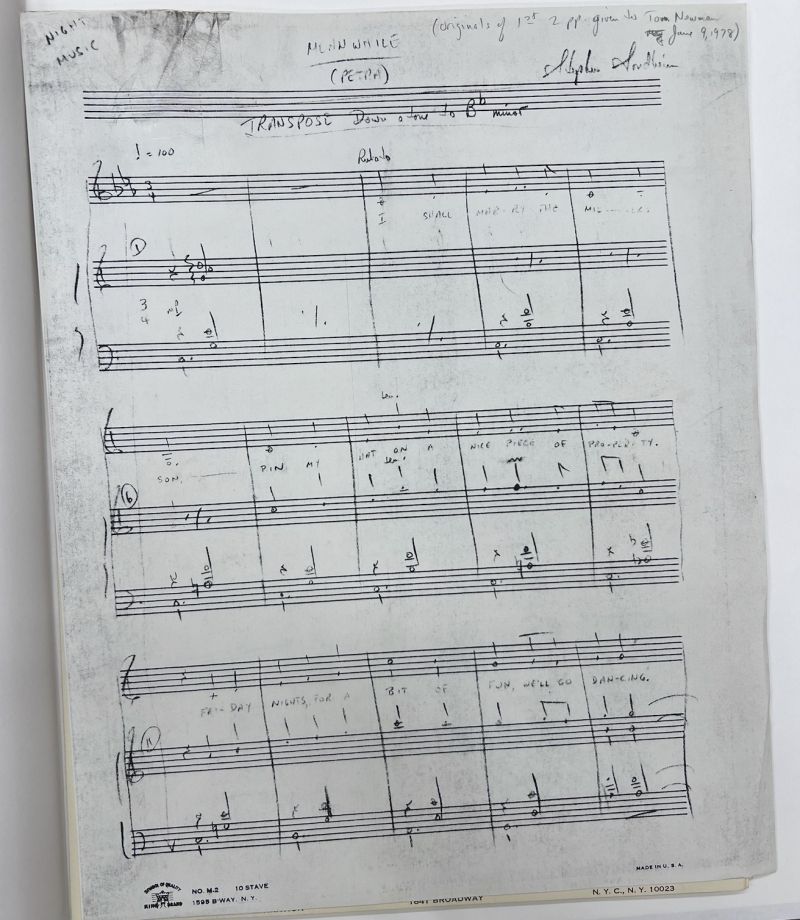
Stephen Sondheim was not only one of the greatest musical theatre writers in history, he was also one of the most dedicated and generous mentors. After receiving his own life-changing guidance under the tutelage of Oscar Hammerstein II, Sondheim took the privilege of nurturing young writers seriously and gave it any energy he could. He lent his time and gave advice to everyone from Jonathan Larson to Jason Robert Brown to Lynn Nottage to Lin-Manuel Miranda. He campaigned ceaselessly for Young Playwrights, Inc., which he founded in 1981 and used to support emerging writers. He sat on panels giving feedback on new musicals and answered a plentiful amount of correspondence from aspiring artists. One example of his generosity involves Tom Newman.
As Sondheim worked on what would become “The Miller’s Son” in his 1973 musical A Little Night Music, he gave it stand-in title “Meanwhile” on this page. A few years later, he xeroxed his original manuscript for his own files and noted that he gave the originals of the first two pages to Tom Newman on June 9, 1978. (It is thus one of the very rare instances of Sondheim sheet music originals not being in the collection.)
Tom Newman is a film composer whose credentials include fifteen Oscar nominations, including for the music of The Shawshank Redemption (1995), Little Women (1995), American Beauty (2000), Finding Nemo (2004), and WALL-E (2009). But back in 1978, when Sondheim was mentoring the then-22-year-old composer, Newman was still trying to find his own way as a writer. Newman’s father was the legendary film composer Alfred Newman, who was nominated for 45 Oscars and won nine times. (The Newmans are the most Oscar-nominated family in history.) Sondheim gave a young Tom Newman help and encouragement, before he ever had his first official film credit.
3. Mandy Patinkin and Bernadette Peters
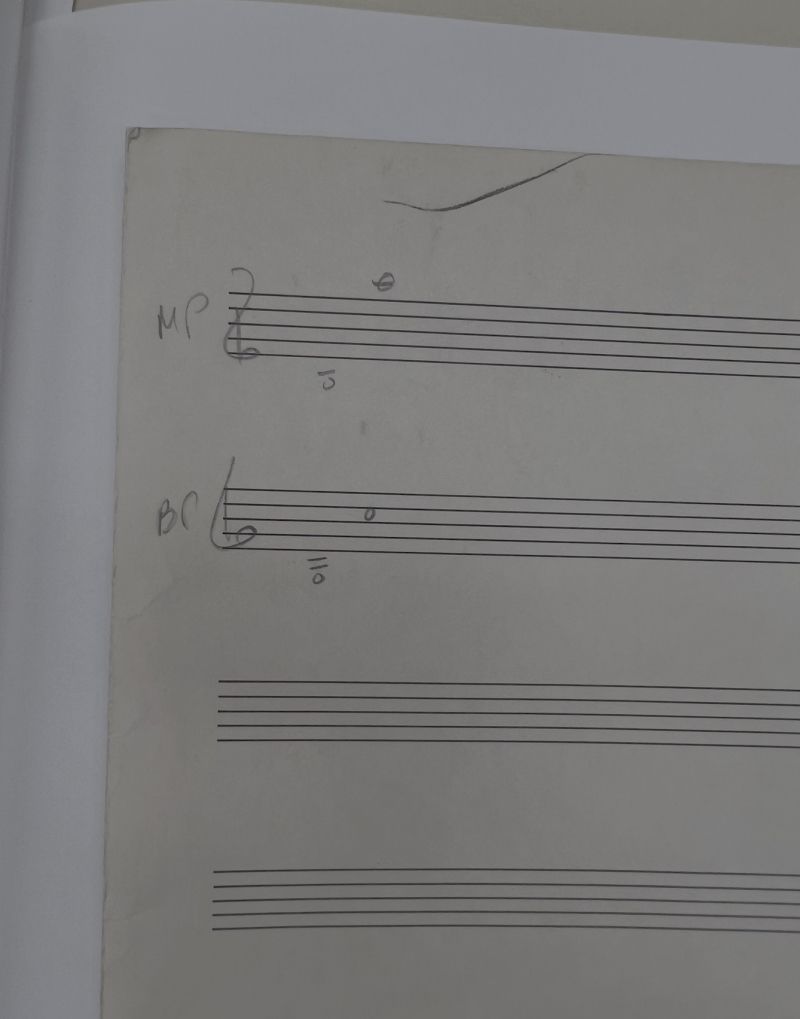
As Stephen Sondheim wrote Sunday in the Park with George (1984), he jotted down the ranges of his two leading actors on his sheet music manuscript page. These unassuming pencil marks led to some of the most indelible musical theatre performances of the 20th century, from Mandy Patinkin’s “Finishing The Hat” to Bernadette Peters’ “Children and Art” to the actors joining together for “Move On”.
4. Jack Eric Williams
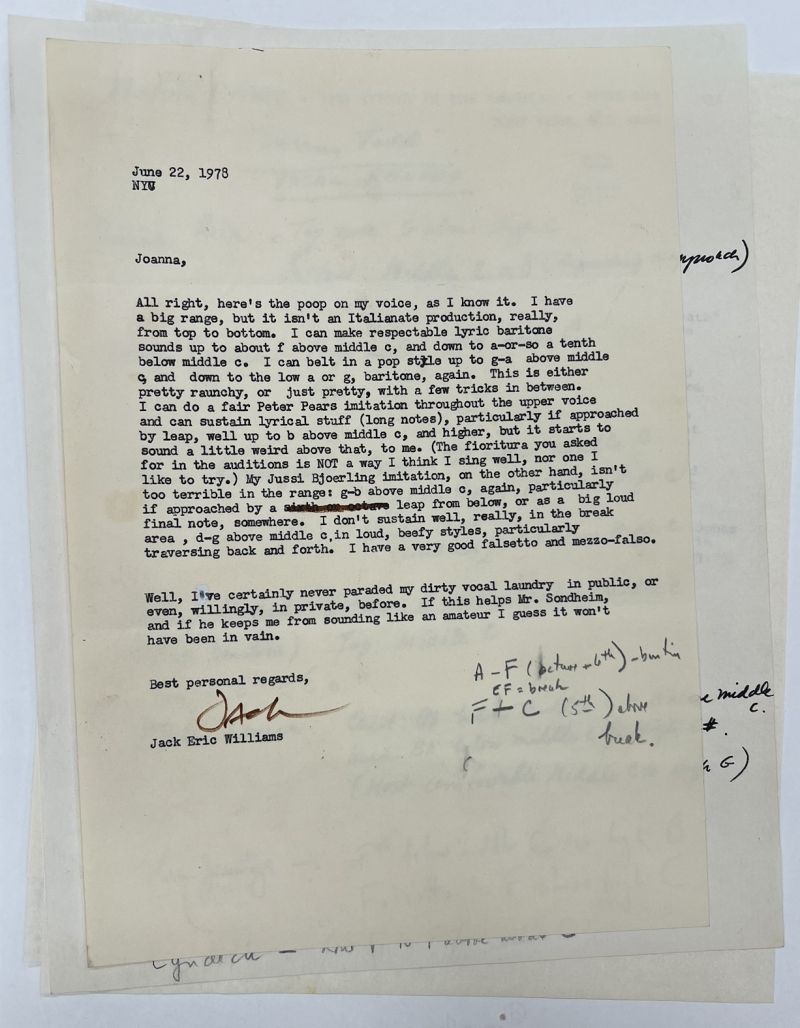
Jack Eric Williams is forever immortalized as the original Beadle in Stephen Sondheim and Hugh Wheeler’s Sweeney Todd. Williams’ booming, villainous cast album performances of “Ladies in Their Sensitivities” and “Parlor Songs” are iconic. Although Williams performed in Sweeney and also in the 1976 Broadway revival of Threepenny Opera, he primarily considered himself a musical theatre writer and creator of varied works for the stage. He passed away in 1994 at the age of 1949.
Williams’ friend and peer William Finn wrote a song about him for his 2001 musical Elegies: A Song Cycle, which consists of remembrances of departed friends and family members. The song “The Ballad of Jack Eric Williams (And Other Three Named Composers)” is a detailed tribute that paints a portrait of an eccentric man, discouraged by the fact that he couldn’t get his musicals produced and his work more widely heard.
While Jack Eric Williams wrote prolifically and received workshops of shows at Playwrights Horizons and the Eugene O’Neill Center, a Public Theater short musical commission, and a production of a musical at the American Music Theater Festival in Philadelphia, he never received the acclaim he and others felt he deserved.
For fans of Williams from his Sweeney performance, his depiction in the Elegies song, or his singular writing that never made it big, it’s delightful to see the man come to life on the page in his letter to casting director Joanna Merlin. Williams wrote in detail about his vocal range, giving Merlin and Sondheim information as Sweeney Todd was being developed. Williams’ unique perspective as a writer certainly contributed to how he expressed his vocal ability here, which in turn impacted how the character of the Beadle was written.
5. The Follies Cast
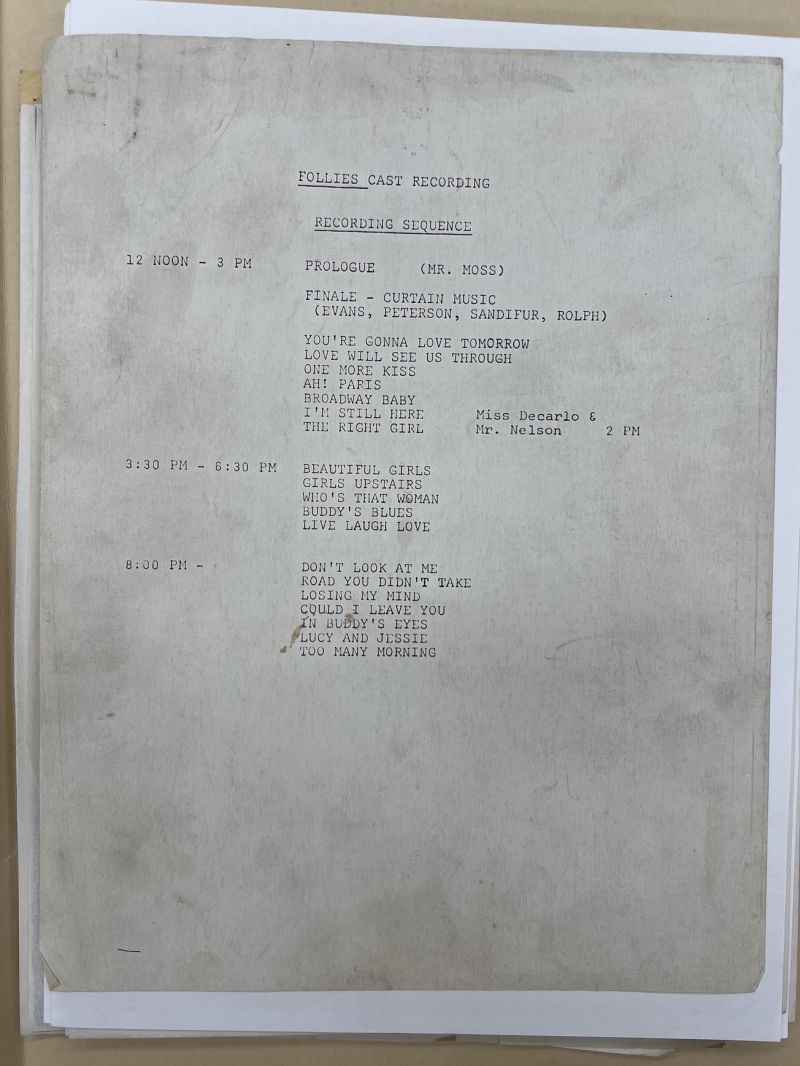
While the recording schedule for the original cast album of Follies might not provide any personal insight, true Follies fans will get a thrill from seeing it. “Miss Decarlo” [sic] and “Mr. Nelson” will arrive at 2pm for “I’m Still Here” and “The Right Girl”… “Too Many Morning” [sic] will probably be recorded in the wee hours of the morning based on this schedule…
The original cast of Follies went into the studio to record the album on the Sunday after they opened on Broadway in 1971. The “studio” in this case was the Hammerstein Ballroom at the Manhattan Center on 34th Street, originally built by Oscar Hammerstein (i) (grandfather of Oscar Hammerstein II) to house operas.
6. Hal and Judy Prince
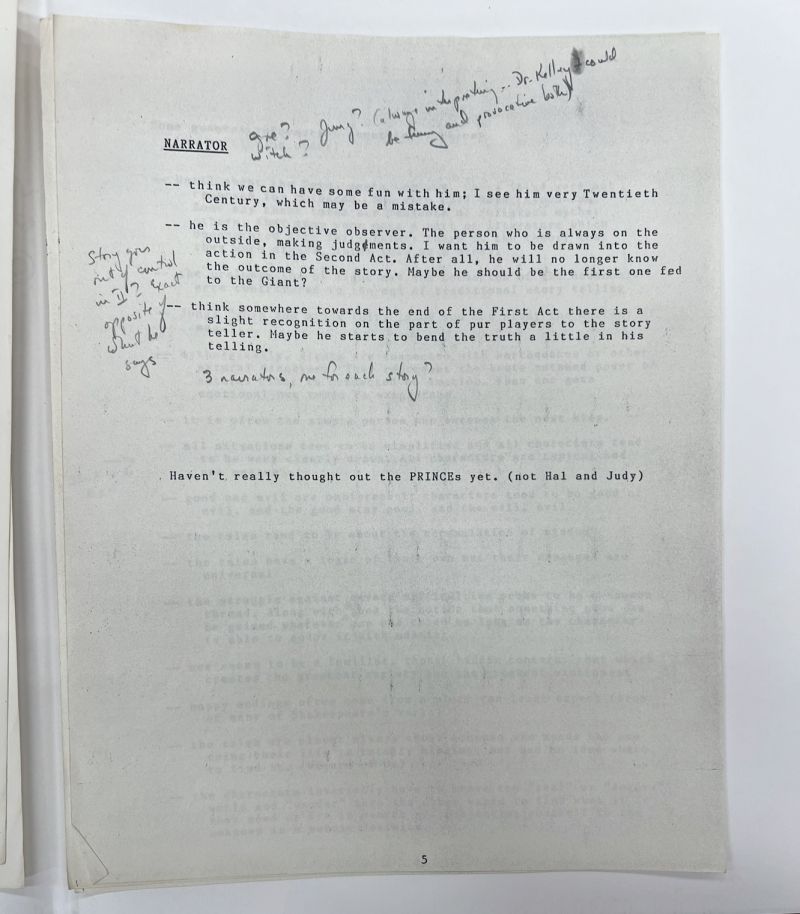
Of course Hal Prince is everywhere in the Stephen Sondheim collection, since the two were close friends and collaborators for many decades. Hal’s wife, Judy Prince, was also a very close friend of Steve’s whose input he sought and valued. Substantial references to both Hal and Judy abound throughout the collection—and throughout any Sondheim history.
Because of this, it was delightful to see this irreverent reference. Here, Sondheim outlined characters as he began to write Into the Woods (1987) with James Lapine. He finished with some ideas about The Narrator and then noted: “Haven’t really thought out the PRINCEs yet. (not Hal and Judy)”
Sondheim’s sense of humor is also on display in the Harold Prince collection that is at the Library of Congress. In one note from Steve to Hal, Sondheim included a clipping from the New York Times where people in job training needed to balance drinking glasses on their heads. Sondheim’s note simply said: “Everybody wants to be you, but nobody understands how… Love, SS”
7. Laurie Anderson
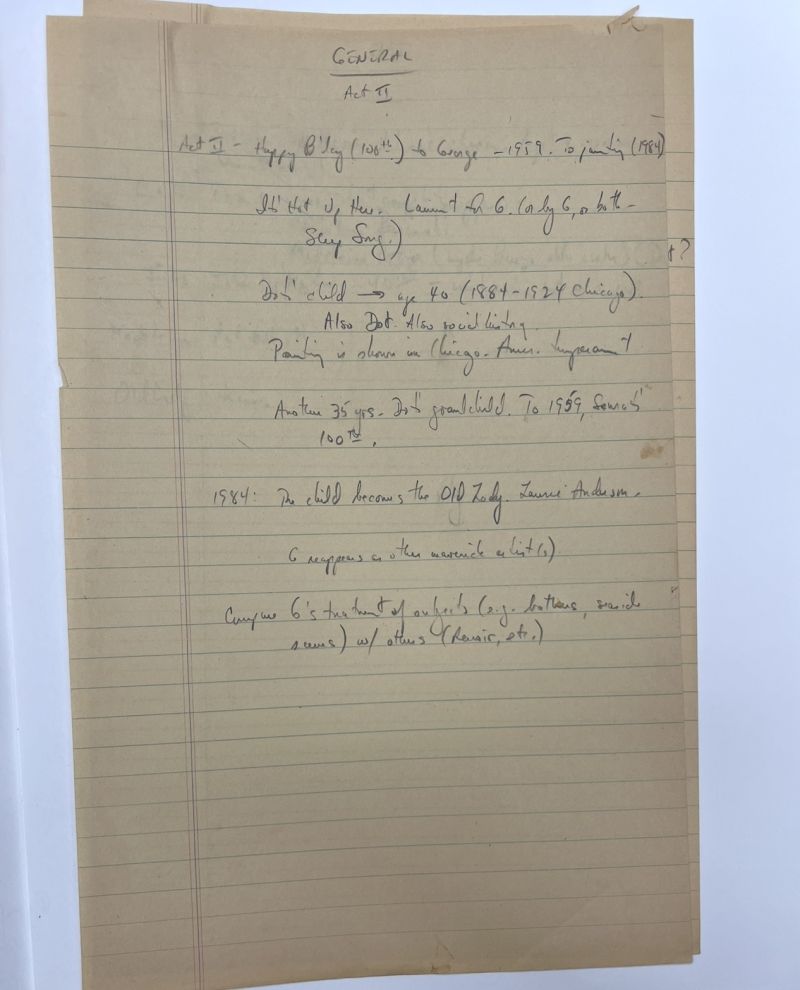
Multimedia artist Laurie Anderson has defied categorization since her earliest years of creating art in the 1960s. Anderson is a pioneer of electronic music, a visual artist, a singer-songwriter, and a performance artist, who has continuously surprised audiences.
In developing Sunday in the Park with George and thinking about act two, Sondheim jotted Anderson’s name down. Anderson actually studied painting when she was young at the Art Institute of Chicago, where A Sunday Afternoon on the Island of La Grande Jatte by Georges Seurat is on display. Sondheim and Lapine visited the painting while creating their musical.
Thinking about Anderson in reference to act two of Sunday makes perfect sense; the ultra-modern art she became known for is exactly what might be seen at a museum in the 1980s alongside a creation by George, the fictional great-grandson of Georges Seurat and Dot who act two is centered on.
8. Marvin Hamlisch
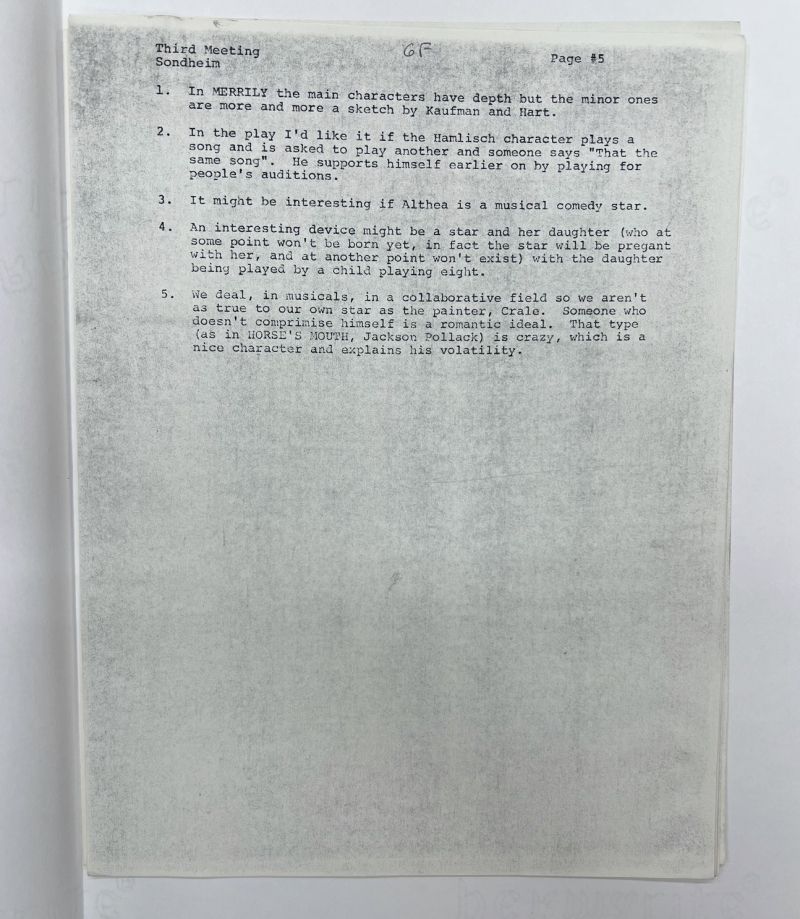
At the end of the Merrily We Roll Along section of the Stephen Sondheim collection, there are about a dozen pages detailing meetings that Sondheim, George Furth, and Hal Prince had to plan out the show when they were first getting started on it. (If you love the fact that these pages come at the end of the Merrily archives as much as I do, you’re definitely going to want to keep reading.)
Since the 1981 musical Merrily We Roll Along is based on the 1934 play of the same name written by George Kaufman and Moss Hart, the creators of the musical first examined the foundation of the play. They discussed which characters to keep and which to lose, which elements to reshape and how, and much more. One interesting aspect of the creative team discussions was which real-life figures they made reference points for the characters of Frank and Mary.
On this particular page, Franklin Shepard is referred to as “the Hamlisch character”, referring to Marvin Hamlisch. While Hamlisch was one writer who inspired the character of Frank, it shouldn’t be assumed that this reference holds great weight. In the course of their early, pre-production meetings, Sondheim, Prince, and Furth also referenced all of the following writers of musicals as containing aspects of the character of Frank: John Kander, Henry Mancini, Leonard Bernstein, George Gershwin, and Frank Loesser—plus, playwright Thornton Wilder. In shaping the character of Mary Flynn, real figures including Dorothy Parker and Joan Didion were discussed.
Sondheim was oft quoted sharing that, while writing Merrily, he was inspired by his early years as a writer as well as the show business coming-of-age of his friends including Prince as well as Mary Rodgers. In the collection, one gets a glimpse at how other real-life peers shaped early conversations about the Merrily characters as they developed as well.
Read Part 1 and Part 2.
With thanks to Rick Pappas, Mark Horowitz, and the Library of Congress.
All images (© 2025) and the music and lyrics of Stephen Sondheim are reproduced with the permission of the Stephen Sondheim Trust. All rights reserved.




Comments
To post a comment, you must register and login.