


Exclusive: John Doyle Looks Back on Reimagining THE COLOR PURPLE and Casting Cynthia Erivo in Excerpt from New Book
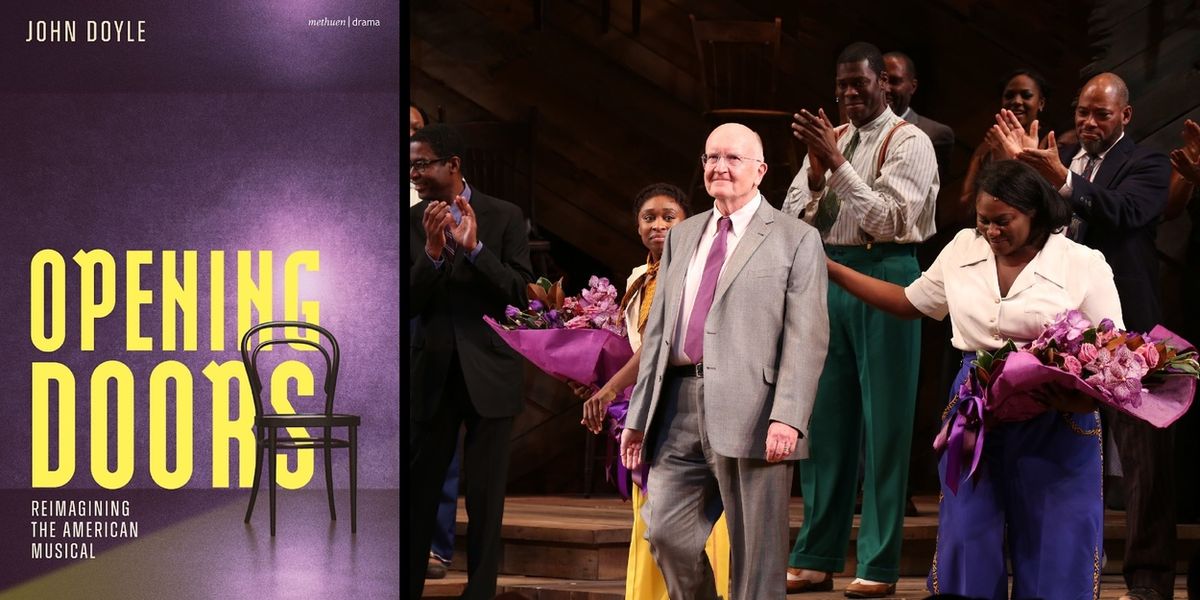
Doyle's book, Opening Doors: Reimagining the American Musical, is now available where books are sold.
 Click for Tickets!
Director John Doyle is an unlikely revolutionary. Described by critics as 'the saviour of the Broadway musical', the 'amazing Mr Musicals' and 'the man who changed the face of the American musical', his name alone has become synonymous with a style of reinvention that has opened doors to what commercial musical theatre can be in the 21st century.
In his first book, Opening Doors: Reimagining the American Musical, Doyle reflects on the 50-year theatrical journey taken by a boy who never dreamt it could happen to him. Through simply working at his craft and trying to earn a living he gained a reputation for thinking outside of the box and is credited with helping create a new art form – that of actor-musician led musical theatre.
From the Highlands of Scotland to prestigious regional theatres and Broadway, he has achieved multiple Tony Awards thanks to revolutionary productions of Sweeney Todd, Company and The Color Purple. This reflective yet practical book tracks a rich and celebrated journey in theatre from one of its most important and recognized contemporary artists.
BroadwayWorld is very excited to bring you an exclusive excerpt from the new book, which you can purchase today!
I did all I could to get out of doing The Color Purple at the Chocolate Factory. I tried simply saying “No”, which made the tenacious David Babani even more determined. Broadway producer, Scott Sanders, was also involved and remained hopeful that I would accept, so I tried being too expensive. They offered what I asked for. So, I took a look into myself because there was a strong part of me that was attracted to doing it. I had been through Liverpool and all that it entailed. I had helped set up new methods of recruitment, and made inroads into changing the racial profile of the audience there. I had helped drive that co-production with Talawa Theatre Company, and changed our casting processes to ensure that actors of colour started playing leading roles, not just the diminutive ones. The Arts Council of Great Britain asked me to advise other companies on similar processes. I had cast the role of Jesus Christ as a Black man, certainly nearer authenticity than the white pastel-clad figure with the long fair hair that dominated my childhood Bible. I did attend the University of Georgia in the 1970s, not so very long after desegregation.
Athens was only a very short distance from Putnam County, Georgia, where Alice Walker was raised and where Celie’s story is told. I had been, after all, the only white guy on the bus! So, after a lot of thought, I took the plunge and, rightly or wrongly, I said “Yes” to directing a revival of The Color Purple.
The original Broadway run of the musical opened in the same season as our revival of Sweeney Todd. It was a big show, the antithesis of our modest, intimate offering. So many Broadway shows start big, often a knee-jerk reaction to audience expectation as I indicated in a previous chapter. Gary Griffin, who directed that first production, is a very fine director and we later worked alongside each other up at the beautiful Stratford Theatre Festival in Stratford, Ontario. I can only imagine the pressure he was under to put as many bells and whistles as possible into that original production. It was highly successful and had a respectable Broadway run, followed by national tours.
Scott Sanders had been its original producer, along with the legendary Oprah Winfrey. I sense that one of the reasons they were taking an interest in my doing it in London is because they would have been familiar with my reputation for stripping away the bells and whistles. If they were going to bring the show back to Broadway, particularly so soon, it really needed to be artistically contrasting and of a different scale. Perhaps even less expensive? I was also to design the set, and working in the Chocolate Factory space certainly determines the scale of your production. The theatre is small, and I believe most effective when not overwhelmed by large set pieces. I hope this gives me a moment to write about my predilection toward telling stories using very little.
My work is often called minimalist, though I myself have never used that word. I like to visually support the story whilst getting out of the audience’s way.
I wonder if there is any connection between my childhood and my adult need for simplicity? My parents, like so many people of their generation, filled their tiny home with a lot of “stuff”. The glass and china ornaments were all very lovely, but even as a child I remember thinking that if I ever had my own home it wouldn’t have all that clutter. So, that need to declutter goes into my work. I go through a number of mechanisms to simplify things in the rehearsal room.
Going all the way back to Liverpool days I’ve often had a large cardboard box in the corner of the room where all the “cut” props and costumes go. I invite actors to discard things into the box if they feel they no longer need them, whether it be a prop or a costume piece. Actors have been known to climb into the box! It’s a fun method of focussing on what is really necessary, what, indeed, is “essential”.
Alex Gemignani made a wonderful visual collage of all the elements I cut from Sweeney Todd. It hung backstage at the O’Neill Theatre. Anyway, I was determined this production of The Color Purple would be visually simple, and of course in typical British fashion, the budget didn’t allow for anything more!
There was a bleached wooden floor, again with the audience seated on three sides. As you would see if you followed through my work, I like a wooden floor, the less sophisticated and the rougher the better! When I redesigned the space at Classic Stage, I had the entire floor of the acting space clad in reclaimed wood from an old Brooklyn building. Sweeney had a grey wooden floor, with a light box under it so that light, sometimes white, sometimes red, could seep through the boards. I like my homes to have wooden floors, most Scottish churches have naked floorboards, and the floor upon which the black piano sat was black wooden floorboards, until they were covered up by the inevitable 1960s fixation with wall-to-wall carpeting. The set of The Color Purple had a wooden back wall, in the same planking as the floor, and hanging on the wall were twelve plain chairs of the type that can hold your Bible in the little container at the back, known of course as bible-back chairs. The chairs hung on pegs on the wall, in the same way that the religious Shaker families hung their chairs on the walls of their worship spaces. It was also reminiscent of something you might see in rural parts of American Southern States, where chairs are hung on the outside porch walls of some poorer shack-like homes.
Again I acknowledge there are chairs in so many of the images I create. The black Victorian chairs in Sweeney, the single stool in Pacific Overtures. In the eleven o’clock number in The Color Purple Celie sings, “Got my chair when my body can’t hold out”.1 That lyric is really why the chairs are there, to support her.
The style of chair changed for the New York transfer, but more of that later. I didn’t know what props we would use, I seldom do before rehearsals begin, but I did know there wouldn’t be many. I’ve worked with some terrific prop departments in many theatres and before we start, I apologetically forewarn them that they may have to provide things that will eventually get cut – just like that birthday cake in Company or that baby in Chalk Circle. This will be no negative reflection on them or their excellent work. However, the props that last the course will be the appropriate props for how we are going to tell the story. My reputation for having a theatrical surgical scalpel goes ahead of me, so these artists usually know what to expect. I hope that none of them take it personally.
Now, the casting. It took a lot of searching for artists with the vocal skills that we needed, but I’m delighted to say that the pool of available people had grown, thanks to drama schools at long last having changed their attitudes. More actors of colour are being trained for the theatre, perhaps not yet in equal proportion, but certainly with significant moves forward. The score of the musical needed great singers. Catherine Jayes was my Musical Supervisor again and we were delighted with how the cast came together. The role of Shug Avery was to be played by the tremendously talented Nicola Hughes, who had headlined many West End shows. Her casting created a “star” precedent for how that role would be cast in the future. We had to find a Celie, the central character whose journey it is. It’s an enormous role, hardly ever offstage, and a big sing. I clearly remember it was a rainy Thursday afternoon and we were auditioning in the rehearsal room at the theatre. A young woman came in, small of stature and with a wonderful smile. Having trained at the renowned Royal Academy of Dramatic Art, she had been building a healthy resume. We spoke for a bit, had a laugh or two, and then – she sang! I couldn’t quite believe it. I’ve experienced a few memorable auditions during my career, but this was extraordinary. We had to get this girl to play the role. Luckily she said yes! Her name was – Cynthia Erivo.
Cynthia was a wonderful Celie, in every way. She had great success with the role in London, but when we took it to New York, things truly went stellar for her. It was the launch of a remarkable career. We still see each other, and for all the success that she so greatly deserves, for all that it has changed for her in her life, she remains that lovely girl with the big smile who I first met on that rainy Thursday.
Excerpted from Opening Doors: Reimagining the American Musical by John Doyle. Copyright © John Doyle, 2026. Published by Methuen Drama/Bloomsbury Publishing
Photo Credit: Walter McBride / WM Photos
Prefer BroadwayWorld in Google Search?
Add us as a preferred source so our stories show up more often in Top Stories and Google’s AI answers — for you.
Sign up for all the news on the Fall season, discounts & more...
.jpg?format=auto&width=300)
.png?format=auto&width=365)




