


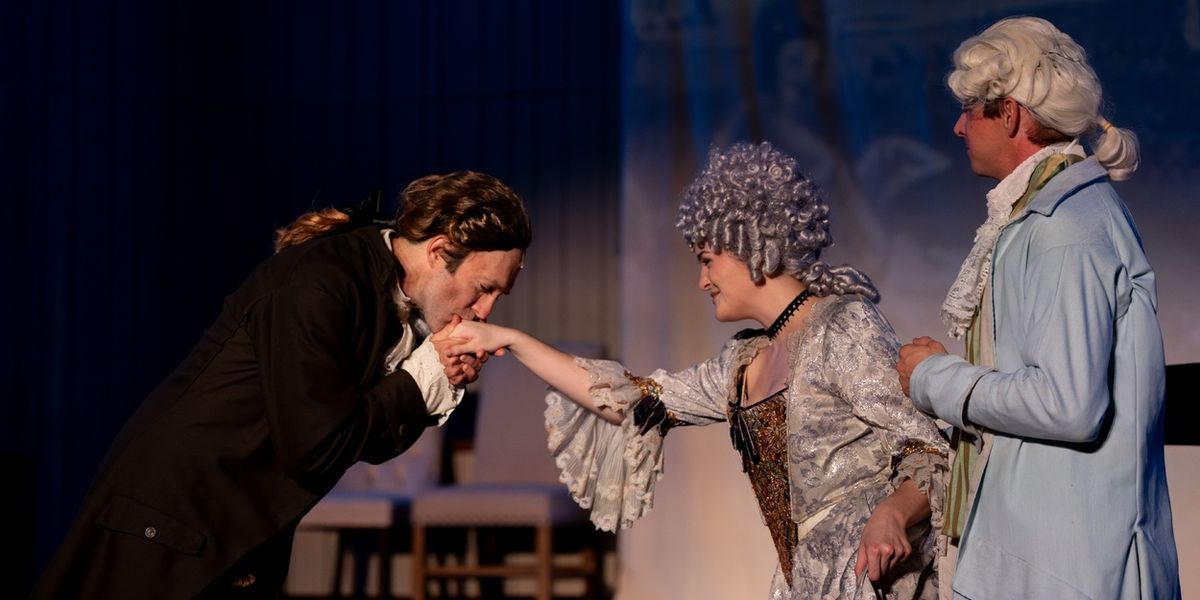
Amadeus is a very rich, poetic, highly philosophical play, with lots of music and moving parts. There’s a great deal emotional heavy lifting, so be ready to become immersed in (as well as inspired by) this intense world the cast and crew has created. It’s pretty epic, so don’t miss it, as it only runs one more weekend at ICT Rep!
The play Amadeus was written by Peter Shaffer. Inspired by Alexander Pushkin’s short play, Mozart and Salieri, which was written in 1830, Pushkin’s play was also used in as the libretto for Nikolai Rimsky-Korsakov’s 1897 Opera Mozart and Salieri. Shaffer’s play was first performed in 1979 in London. It then moved to the Broadhurst Theatre on Broadway in December of 1980, starring Ian McKellen as Salieri, Tim Curry as Mozart, and Jane Seymour as Constanze. Amadeus won the 1981 Tony Award for Best Play and the 1981 Drama Desk Award for Outstanding New Play. The reader may also be familiar with the 1984 film version of the same name.
Amadeus give us a glimpse into the fictional lives of Wolfgang Amadeus Mozart, a brilliant but foolish, socially coarse, and inept court composer who is unable to find steady work, and Antonio Salieri, a mediocre composer who rises to the much coveted role of Austrian Imperial Kapellmeister at the court of Joseph II, the Holy Roman Emperor of the Hapsburg Monarchy in Vienna. Salieri becomes incredibly jealous of Mozart’s talent, and works to find ways to thwart Mozart’s path to success. I’d like to point out that several critics warn Shaffer’s account is not historically accurate. Amadeus includes a tapestry of Mozart’s works, with some featuring quite prominently as plot points, including The Marriage of Figaro, Don Giovanni, The Magic Flute, and Requiem.
Director Dr. Julie Longhofer keeps the proceedings tight for this multi-setting behemoth, which ranges from large crowd scenes to Salieri’s lengthy monologues. Dr. Stan Longhofer’s Scenic Design for Amadeus is quite simple but very effective. An ENORMOUS muslin sheet has been draped in the center of the stage, with two somewhat smaller sheets draped on either side, onto which projections of period illustrations are cast. The scene locations are always very well defined, usually with clever chair placement, or a few key set pieces. Lighting design by WSU Assistant Professor Jamison Rhoads also keeps these acting locations well defined, as well as creating lots of atmosphere. There’s quite a bit of luxurious costume and wig work in this production. Dr. Julie Longhofer’s costumes are full of rich brocades, and satins; the women’s gowns are sumptuous, and the menswear is equally lush. Julia Faust’s wigs rise to meet the costumes; some piled high with curls, others showing the destitution of its wearer.
The live music was provided by Alan Held, Music Director, who is also the Director of Opera at WSU. Held put together a great team to bring the live music to the stage. Dr Judith Lynn Stillman arranged the live choral pieces, and Dr. Warren Kim, Assistant Professor of Piano at WSU, accompanied the singers live on stage. The live singers are all students in the WSU Opera Program. In most productions of Amadeus, the music used is all pre-recorded, so it’s a treat to experience some of this music live. Kirk Longhofer does splendid work here, keeping the balance between live music, mics, and background music, as well as providing great musical additions to the work.
There are some delightful performances in Amadeus, beginning with Matt Purdom as the arch Vinticello #1, throwing shade like he was born to do. Sterling College grad Bryson Brownlee, with his mellifluous voice, turns in a refined performance as Freemason Baron Gottfried van Swieten. Local theatre veterans Shaun-Michael Morse and JR Hurst make appearances as well. Morse plays Emperor Joseph II with ease, commanding the stage, dressed in a gorgeous, all white military outfit that elevated his already imperial status. Hurst is Count Franz Orsini-Rosenberg, a serious, court savvy man who oversteps his bounds with the Emperor by nixing a performance of The Marriage of Figaro because it had a ballet in its final act.
The ever delightful Chelsea Penner takes on the role of Mozart’s wife, Constanze. Portrayed as a woman of loose morals, Penner’s character grows from a frivolous child to a serious woman, worried about the future of her family as it becomes clear to her Mozart cannot earn enough money to support them. Penner’s Constanze turns on a dime, moving from delightful to tragic in the blink of an eye as she burns all the letters Mozart’s father Leopold had sent him just to stay warm.
Local Actor/Set Designer Lyle Valentine plays Wolfgang Amadeus Mozart, the world famous composer. Valentine’s Mozart moves from a beautiful free spirited creative, to an absolutely broken man, unable to earn a living and support a family. Watching Valentine travel through his decline to an utter breakdown was incredibly moving, and his work with both Penner and Proctor was poignant.
The entire program begins and ends with Antonio Salieri, played by WSU Alumni Cody Proctor. He graduated from WSU with a BFA in Theatre Performance, and is now making a living as an actor in Chicago, working most notably at the Goodman, and the Illinois Shakespeare Festival. Proctor delivers a mighty performance as Salieri, a man who battles with God as he works to destroy his talented competition, Mozart. Salieri has some massive monologues, and appears in most every scene. From the Invocation to the final monologue of Confession and Absolution, it is so satisfying to watch the depth of Proctor’s performances, seeing ideas dance across his face before he even speaks. Proctor has some of the best philosophical lines as he waged his war with God, all the while destroying Mozart’s life, and it’s well worth the price of admission to watch his Salieri wage war with Mozart, himself, and God.
You only have a few more nights to see this awesome piece of theatre. The show runs Friday, October 17 to Sunday, October 19, 2025 in Oliver Place at 2512 N. Oliver. Curtain is at 7:30 p.m. on Friday and Saturday, with a 2:00 p.m. matinee on Sunday. Tickets start at $40, and discounted seats are available for seniors, veterans, those under 30, and students; ticket prices are inclusive of all taxes and fees. Tickets can be purchased on the ICTRep website at https://ICTRep.org
Photo Credit: Kyle Woods Photography


Reader Reviews
To post a comment, you must register and login.