


Review: MUSEUM OF AUSTERITY, Young Vic
Imperfect but important, this chamber of horrors is profoundly moving.
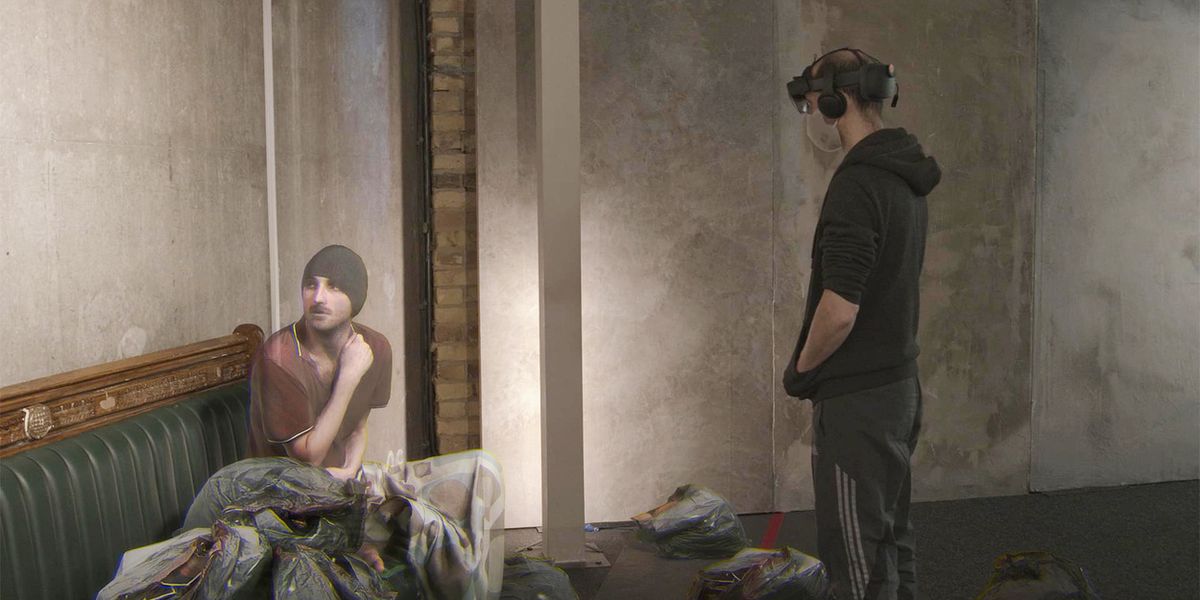
 There are many museums dedicated to disaster, but Museum of Austerity is one in which the exhibits are victims of our own government's fiscal policies. revived at the Young Vic, is a cool, technologically-slick indictment, a moral subpoena served directly to your eyeballs through augmented-reality headsets. Grimmer than a midwinter funeral, the show is misnamed and flawed but serves as a salient reminder of how man’s inhumanity to man never ceases to beggar the imagination.
First, a bit of history. After the 2010 UK general election, the Conservatives and Liberal Democrats looked deep into each other’s eyes, tied the knot and became a ruling coalition. Their unashamed cure-all for the post-2008 crash deficit was austerity: a programme of cuts framed as sadly unpleasant but utterly necessary medicine.
Prime Minister David Cameron reassured us that “we’re all in this together.” His deputy Nick Clegg declared that there was “no alternative to some very painful cuts.” Chancellor George Osborne called it “the unavoidable emergency.” History, naturally, filed all of these statements under “yeah, right”.
Directed by theatre/XR director Sacha Wares and created by Wares and Disability News Service editor John Pring, this collaboration between the Young Vic, ETT, Trial and Error Studio and National Theatre resurrects its 2021 incarnation. Four years ago, it was a finalist in the XR History Awards, nominated for Best Digital Innovation at the UK Theatre Awards and won International Documentary Festival Amsterdam (IDFA) Best Immersive Production. It returns to London just as the present government again has the disabled in their sights.
The format resembles an art installation crossed with a tribunal. Recordings of interviews from friends and relatives are coldly fused to the silently accusing holograms of real people failed by the state. You walk between digital apparitions: individuals whose lives were destroyed not by disease, war, or natural disaster but by the bureaucratic creativity of a government on a mission bonded to political desire expressed through spreadsheets.
The AR images bloom into the room with eerie intimacy. Each figure stands before you with the quiet force of a witness statement, their stories a reckoning with policies that were sold to the public with cheery slogans like Osborne’s “the age of austerity.”
The creators resist overt melodrama. Before the unvarnished words of the nearest and dearest are heard, Gareth Fry introduces each interview with a related sound, for example the pleading whines of a homeless man's hungry dog or the bang-bang-banging on a door by ambulance workers about to discover an empty fridge, a pile of unused toilet paper rolls and an emaciated corpse.
Instead, this is a display of forensic clarity, recounting deaths linked to benefit sanctions, cuts to disability support, and administrative cruelty wielded with the serene detachment only a civil service form letter can provide. At one point, you half-expect a DWP official to materialise beside the holograms and whisper, “We’re not monsters. We were just following orders.”
What’s striking is how performatively solemn and obvious the goreless horror all is. The only seating in the room is provided by padded green benches identical to those used in the House of Commons; in this one-sided commentary on this tragic episode, this is Wares and Pring’s mawkish attempt for us to experience the situation as the MPs of the time did. Some informal recollections — either in retrospect or contemporary — from those closest to the decision makers and button pushers would have created a deeper experience.
The deliberate bleakness is in contrast to the gung-ho attitude of the official soundbites which pepper the interviews. Austerity, after all, was introduced with the rhetorical flourish of moral necessity. Cameron, in his characteristic head-boy optimism, declared: “If we don’t deal with this debt, we will be paying the price for decades.” And here, in Museum of Austerity, the price tag reads: “Benefits withdrawn. Lives extinguished. Responsibility pending.”
Across the way, in the main room’s Bengal Tiger at The Baghdad Zoo, the characters wander around a post-9/11 Iraq haunted by their actions and those now in the afterlife; meanwhile the air is filled with existentialist banter and eloquent pleas to God to explain the cruelties laid bare all around. There’s none of that here.
The show ends, but the policies haven’t. Museum of Austerity looks over its shoulder to the past but quietly gestures to the present, where the current Labour government continues to chip away at disability support, particularly through the Personal Independence Payment (PIP) system. Assessment hurdles have multiplied, eligibility has tightened and proposals keep surfacing to “modernise” (read: reduce) payouts. It’s austerity by administrative stealth, a sequel nobody asked for and yet one the state seems determined to stage. "Plus ça change" would not have been an inadequate title for this event.
The AR technology works well if somewhat below its capabilities. It doesn’t recreate panoramic virtual vistas in the same way as Eclipso’s immersive tour of the Coloseum and neither has it been designed to be as interactive as the pulsating In Pursuit Of Repetitive Beats. It also fails to create an enveloping atmosphere in the same way as Kagami, the AR-powered Ryuichi Sakamoto concert seen at the Roundhouse. Instead, the tech is chiefly deployed by Wares to reveal a 3D image of each victim of austerity as we approach and to trigger the accompanying audio.
And as for the name? A museum is a place where sanitised relics of the past are on display so we can drag the unwilling to see them on rainy Sunday afternoons. A mausoleum is where we go to remember those who made their mark on those they left behind (whether they aimed to or not). Museum of Austerity bills itself as the former but functions unmistakably as the latter: a marble-cold monument to lives trimmed, clipped, and finally erased by government policy masquerading as fiscal responsibility.
Call it a museum if it makes the Arts Council more relaxed, but what we’re really walking through is a civic tomb lit by lanterns of rage. Museums preserve. Mausoleums memorialise. This show angrily mourns.
And the most damning thing? The mausoleum metaphor fits because austerity wasn’t some accidental tragedy. There are no garbled messages or misinterpreted commands to blame. You don’t get a crypt this full without a plan, a spreadsheet and a grudging public acceptance of the unfolding tragedy. The production doesn’t need melodrama to make its case. The architecture of the piece - minimal, reverential, cold - tells you what you’re standing in. You’re not in a gallery. You’re in a hall of state-sponsored murders.
Museum of Austerity continues until 16 January 2026.
Photo credit: Ellie Kurttz






Reader Reviews
To post a comment, you must register and login.