


Review: BBC PROMS: FOLK SONGS AND DANCES, Royal Albert Hall
English folk music finds its moment in the spotlight

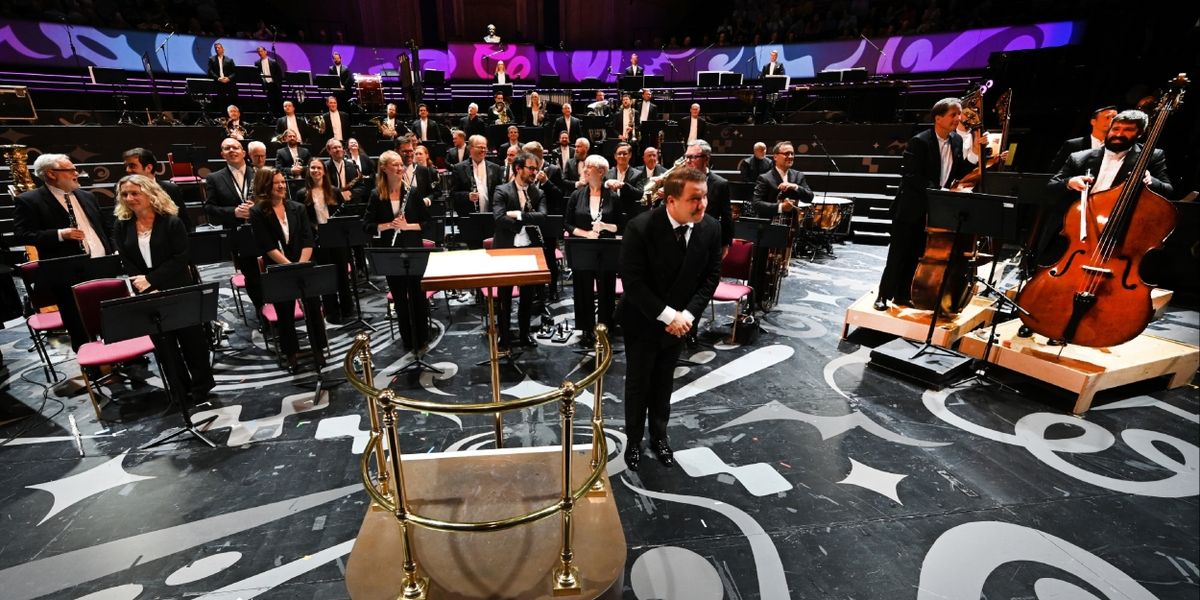
 Originally planned to be the second concert at this year's Proms reuniting Sir Simon Rattle with the London Symphony Orchestra, this morning's intriguing programme of Folk Songs and Dances is now conducted by Ryan Bancroft following Rattle's indisposition.
The orchestra is shorn of its upper and middle string sections for this intriguing and contrasting programme, placing English composers and their folk-song arrangements centre stage. Also included in the line-up is Gunther Schuller's trombone concerto, Eine kleine Posaunenmusik, which showcases a virtuoso performance from Peter Moore as soloist.
Ralph Vaughan Williams's English Folk Song Suite is well-known as an arrangement for brass bands, and consists of three movements using nine folk song melodies. Two marches, the first allowing the woodwind to dominate "Seventeen Come Sunday" and then acting as counterpoint to the brass in "Dives and Lazarus", the second fusing "Blow Away The Morning Dew" with "High Germany", are split by an affecting intermezzo ("My Bonny Boy" and "Green Rushes").
.jpeg)
In the Schuller piece, making its Proms debut, the playfulness of the brass section is clear in a 'call and response' section with the soloist, and a more ethereal tone is achieved by the inclusion of piano and harp. It is fused throughout with echoes of jazz and allows the soloist to explore different mutes to achieve high, low, deep and rich sounds. Moore received the most rapturous ovation and treated us to a solo performance of traditional folk piece Barbara Allen as encore.
Sir Michael Tippett's Triumph (derived from his large scale oratorio The Mask of Time) also makes its Proms debut. It takes the oratorio's sixth movement, itself inspired by the poem The Triumph of Life by Shelley, and arranges it for concert, particularly for a large range of percussion. The xylophone in particular gets a lively workout alongside some dramatic interactions from the woodwind section.
The programme closes with work from two of the greatest English composers and arrangers of the early 20th century. Malcolm Arnold had an eclectic career including ballet, choral music, concertos and music for brass and wind bands. His English Dances comprise two sets of music inspired by folk tunes and dances, and it is the first set we hear in today's concert. As with the Tippett piece, Arnold's work is heavily dependent on a range of percussion (including cymbal, glockenspiel, side drum and tubular bells), while allowing the melodies to shine through.
.jpeg)
Finally, Percy Grainger's work returns us to the folk song space, including perhaps his best-loved arrangement, Country Gardens, beloved of Morris troupes across the land, his early work Lads of Wamphray, inspired by a ballad penned by Sir Walter Scott, and Lincolnshire Posy, his masterwork inspired by six very different sources, including the lively "Lord Melbourne" and the uneasy "Ruffold Park Poachers", with its brass solo.
It could be assumed that under Rattle this programme would sound very different, but Bancroft (principal conductor of the BBC National Orchestra of Wales) is an accomplished trumpet player as well as having a long interest in percussion, and it shows in this concert, with his care and attention for the orchestra and good nature in taking the numerous bows.
A mid-morning treat with diverse sounds and unbridled ambition, especially for those with a brass band heart and an ear for something that strays off the traditional classical music path.
The BBC Proms season continues until 13 September 2025.
Photo credit: Chris Christodoulo





Reader Reviews
To post a comment, you must register and login.