


Review: UNCLE VANYA at Shakespeare Theatre Company
Superb acting in a first rate production of Chekhov classic.
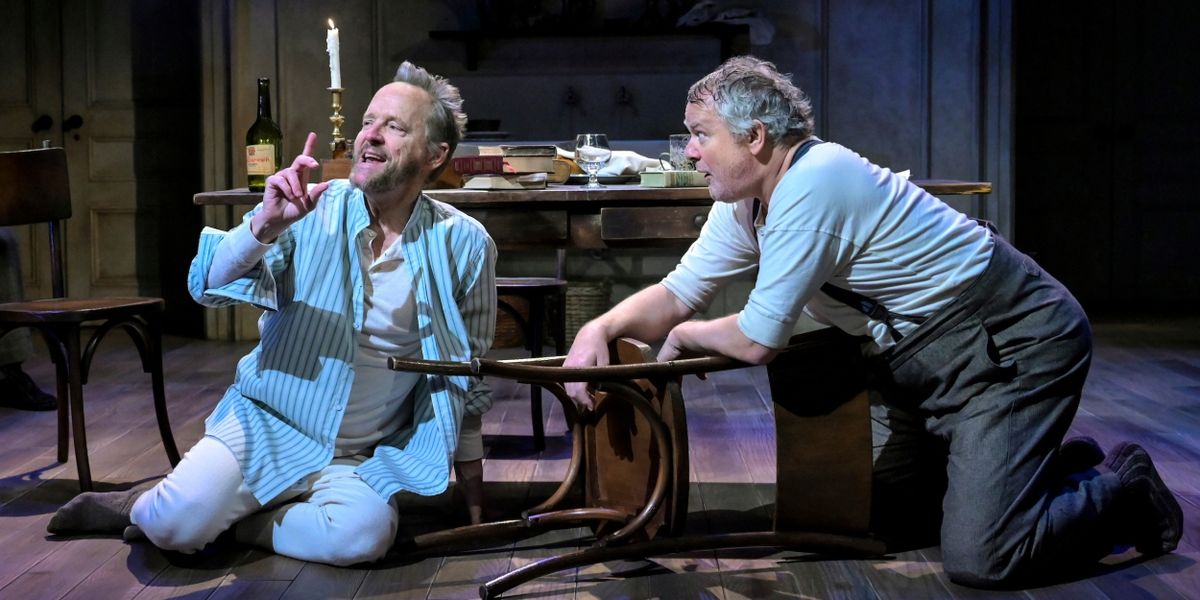
Devotees of Downton Abbey may be be surprised when Hugh Bonneville pops up as title character in the Shakespeare Theatre Company’s first rate staging of Anton Chekhov’s Uncle Vanya.
Minus the haughty grandeur of the elegant Lord Grantham, his Vanya emerges, surprisingly, from under a rug - disheveled, displaced and more than a little disaffected in the crumbling country mansion that is the setting for the 125-year old play that seems as fresh and immediate as ever in the adaptation by Conor McPherson, crisply directed by artistic director Simon Godwin.
Vanya’s clothes are crumpled and askew, he’s got schmutz on his pants and has withering distain for the commotion all around him, mostly caused by his brother-in-law, a full-of-himself professor who has brought his young new wife to live there with him.
Properly speaking, this is not the audience’s first glimpse of Bonneville for the evening. He, like the other members os the distinguished cast, spent the 20 minutes or so before the play begins walking up to the thrust stage through the audience, sitting to put on his shoes, chatting with those in the front row, greeting his fellow thespians, checking the bulletin board amid a stage cluttered with chairs and props yet to be set properly and a wardrobe rack or two.
Under a square of fluorescent lights, it replicates the backstage experience of a play’s run-through, with none of the actors hiding their profession as they gather to begin embodying this great play.
And when the words of Chekhov begin, still under the blaze of that harsh lighting, it would seem that Godwin is showing how it is the actors alone who create this theatrical magic.
Particularly in an early scene between Bonneville and another familiar actor from TV and film, John Benjamin Hickey, the tone, timing, facial expressions and body movement conjured by the two men so embody these characters that they transport audiences to a different time and place.
And subtly behind them, the lighting becomes more subdued, the surroundings settled to complete the picture — a backstage to front of stage transformation led by the sheer power of the acting.
And it involves others around them as well. A wonderful exchange between two denizens of this house from Nancy Robinette and Craig Wallace demonstrate the level of talent these two top D.C. based actors have given us for years.
Alongside them are strong New York actors who have been a part of this co-production with the Berkeley Repertory Theatre when it played in California, drawing plenty of acclaim. They include Ito Aghayere, who shakes up the mansion with her allure, Tom Nelis as the amusingly conceited professor and Melanie Field as Vanya’s niece Sonya, a central cog who keeps the household together.
Like everyone else, Sonya is driven by an underlying yearning for, in her case for the doctor Hickey so ably plays. But he’s smitten with Yelena, as played by Aghayere.
Vanya’s had a thing for Yelena as well, but it’s only a part of a generalized malaise caused by missed opportunities, age, boredom and rage.
Chekhov’s works are often full of this kind of ennui, with unrequited love and complicated romantic triangles or even trapezoids. But they remain vivid on the stage because they hit a human nerve that endures with every generation.
Uncle Vanya, you may say, was ahead of its time, in part by creating a doctor character who speaks so eloquently about conservation and the preservation of forests — was this one of theater’s first ecologists?
More immediately is the drama that builds to a second act crescendo, where the pompous professor counters a call for compassion with the necessity of practicality — pretty much defining the era of DOGE that’s decimating the city. And the opening night audience held its breath in recognition as the moment was reached.
Chekhov couldn’t decide whether “Vanya” was a comedy or a drama so, like the prestige series that use that terrible term “dramedy,” there are high points of each, with hilarity rising at times from moments without dialogue, and underlying pathos in all that remains unfulfilled.
“Vanya” does all the things great theater can do - give a lift with laughter, speak to the dire moments of the day, and provide deeper consideration and empathy.
And it doesn’t solely happen with dialogue. Chekhov’s plays sometimes defy words and rely on sound effects. It’s perfect then, to have scenes occasionally preceded by cello performed at different points in the audience by Kina Kantor, who also serves as a kind of stage manager or narrator to start the rehearsal that shifts into a play, reading stage direction and introducing characters.
When playing cello, she’s lit overhead by Jen Schreiver, whose lighting of Robert Brill’s set indicates the depth of the mansion by showing light from unseen windows. Not only does she nail the lightning of a sudden storm (with sound designer Darron L. West), she hints at autumn colors with a slight red tint.
In a moment where “Vanya” seems to be alive again — as in Andrew Scott’s one-man interpretation on Broadway — this is a version that shouldn’t be missed.
Photo credit: Kevin Berne / Berkeley Repertory Theatre.
Uncle Vanya continues through April 20 at the Shakespeare Theatre Company’s Harmon Hall, 610 F St NW.
|
GARBO: EL ACTOR QUE SAVÓ AL MUNDO (Garbo: The Actor Who Saved The World) GALA Hispanic Theatre (9/03-9/27) |

|
Coming to America: An Immigrant Cabaret ExPats Theatre (9/30-10/18) |

|
Stonewall's Bust The Writers Center (10/09-10/25) |

|
The Dinner Detective Murder Mystery Dinner Show The Dinner Detective Washington DC (9/26-9/26) |

|
ArmEvents presents: An Evening of Elegance & Virtuosity Live Concert F. Scott Fitzgerald Theatre (9/12-9/12) |

|
The Fruits of Our Labor Arena Stage at the Mead Center for American Theater (9/10-11/01) |

|
Ma Rainey's Black Bottom Round House Theatre (9/09-10/11) |

|
Brontë Sister House Party Van Ness Main Street (8/14-9/12) |

|
7th Street Echo Mosaic Theater Company (3/25-4/18) |

|
Pippin The Bowie Playhouse (9/18-10/03) |
Reader Reviews
To post a comment, you must register and login.