


Review: PILOBOLUS: OTHER WORLDS COLLECTION at Strathmore
Their stop at the Music Center at Strathmore on March 5th explored 5 pieces from their repertoire that transcended location and time.
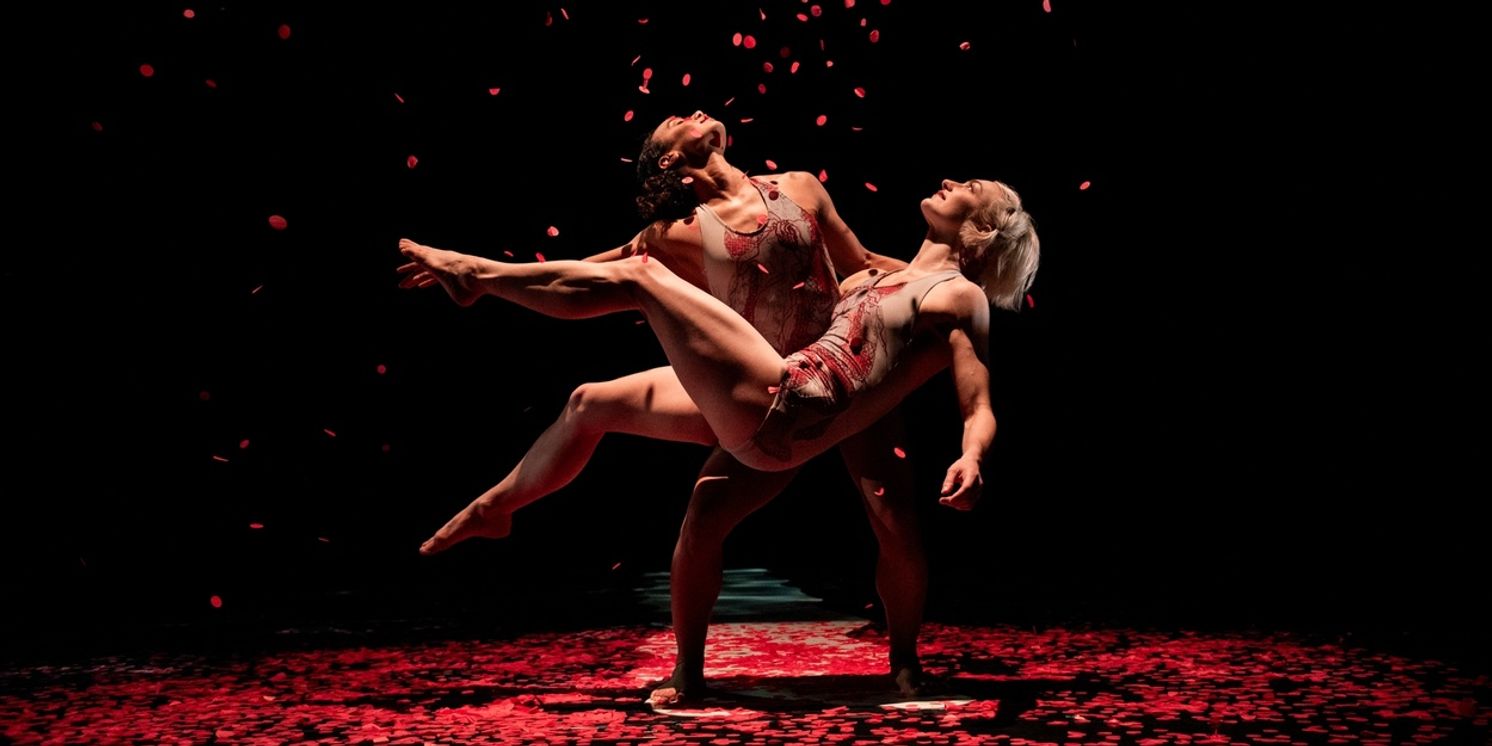

The world-renowned, revolutionary dance company Pilobolus is traversing the US once again with a tour of their Other Worlds Collection, which celebrates space in all its forms. Their stop at the Music Center at Strathmore on March 5th explored 5 pieces from their repertoire that transcended location and time.
The program opened with “Particle Zoo,” a delightful frenzy of a quartet that was always somewhere between a loving embrace and a hostile tackle, mirroring the frenzy of being in community. The dancers rebounded off of each other with incredible, hapless speed and force as they tried to make sense of their place in the dance together. They explored the space and each other in dizzying codas and relays, running, jumping, lifting, pushing, and pulling, truly particles colliding, expanding, and contracting. There was exquisite duality to the piece, in moments homoerotic with clasped hands and touching foreheads, and in others toxically masculine with swinging arms and falls mirroring a fight. Their white slacks and bare chests were a stylish take on a dancer's nude, but if that’s the only thing they’re wearing, the dancers should be assured that the garment is constructed for their level of activity. One of their pants ripped in the middle at some point in all the action, distracting slightly from the movement yet not breaking his stride.
The hot-blooded action cooled to a somber flow with “Bloodlines,” a heavier, more bodily and exploratory piece conveying the cycle of dependency within matriarchal roles. It was a women’s duet with lots of entanglement and contortion of their bodies. Set to jarring sonic compositions, they hit every disquieting beat with mechanical accuracy yet organic flow, holding each other with the weight and discomfort of being bonded to another person through their life cycle and the strength it takes to care for someone who has cared for you. The dance itself felt poignant and powerful, but the contrast in tones with the playful first piece made one question its placement in the program.
The show's trajectory picked up again with “Flight,” a jovial, aspirational, innocent piece detailing humanity’s fascination with being airborne. The dance had a lot more pantomime and prop work, with stagnant cotton clouds, flying paper airplanes, and on-the-nose pilot outfits. The active planes were more interesting, as they were manned by the dancers and contributed to the arcs of action, and the clouds could have been done without. The electrical wires that had been sitting center stage also came into play, as the second act of the piece had a dancer rearrange the clouds, bring out electric fans, and eventually lie down, which must have obstructed some of the view for the closer rows. The placement and props seemed to build to an obvious reveal before it came in the form of an iridescent, spectral cape that floated in the breeze. The cape was dazzling, but really the only thing that was blown away, and the piece was a little too short to be a showstopper.
After intermission, the solo “Pseudopodia” was a fun and flexible tumble that really examined unique movement. Soloist Hannah Kinkman flipped and crawled, as the name implies, to traverse the stage in arcs that almost resembled the continuous loop of a Möbius strip. She and the stage were bathed in a burning red and backed by urgent percussion that commanded attention to her contortions.
The finale was a centennial anniversary piece commissioned by the Martha Graham Dance Company, titled “Lamentation Variations.” Dancers were draped in uncanny tubes of fabric, which they used to conceal and manipulate their shape. The original film of Martha Graham’s “Lamentation” was projected across their uncanny forms before they broke into their own haunting adaptation. They interpreted jerky, staccato movements of bodies wracked by sobs, and clawing, dragging limbs weighted by grief. The dance was painfully raw, simultaneously lonely and in conversation with itself: a collective mourning as opposed to a singular one.
Pilobus’s Other Worlds Collection transported the Strathmore for one night only, but you can follow the tour at the link below.
Runtime: 2 hours with one 15-minute intermission
Photo credit: Jason Hudson
Reader Reviews
Videos