


A Stellar Cast Tells a Captivating WINTER'S TALE at the Stratford Festival
The Shakespearean tragicomedy offers extremes in the dramatic and comedic to great effect
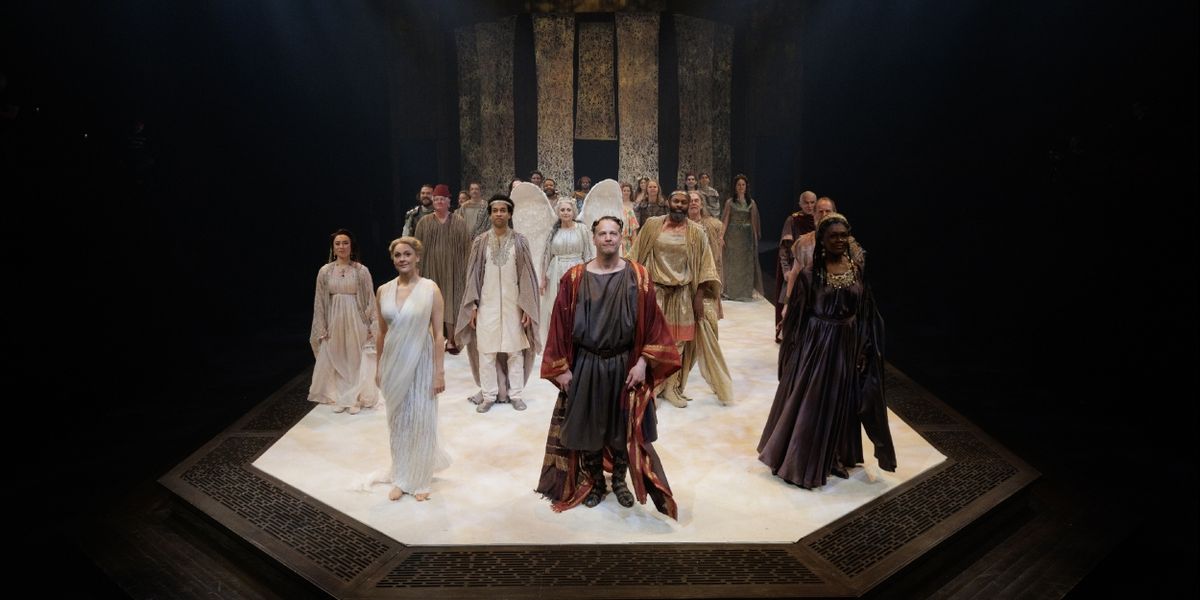
Opening Week at the Stratford Festival continued Friday night with a lively production of THE WINTER’S TALE at the Tom Patterson Theatre. Presented at the Festival for the first time in 15 years, and directed by Artistic Director Antoni Cimolino, this beloved Shakespearean tragicomedy boasts an excellent cast that offers powerful performances.
Set in Sicily and Bohemia – two starkly contrasting locations, THE WINTER’S TALE begins with Leontes, King of Sicily (Graham Abbey) rapidly descending into a jealous paranoia after his wife Hermione (Sara Topham) is in his mind, too quickly successful in convincing Polixenes, King of Bohemia (Andre Sills) to stay and visit for another day. Even though there is no evidence supporting it whatsoever, Leontes becomes convinced his wife has been unfaithful and maddened with jealousy, he calls for her imprisonment. He also orders his advisor Camillo (Tom Rooney) to poison Polixenes. Camillo chooses to defect rather than go through with this. Hermione’s innocence is eventually confirmed by an Oracle, but not before she and her young son have both died, and her newborn daughter has been abandoned in the wilderness (by Leontes’ order). Leontes is left trapped in his shame and sorrow for 16 years (who doesn’t love a time jump) and when these years have passed, we are introduced to a slew of new characters in Bohemia. His grown up daughter, Perdita (Marissa Orjalo), raised by a Shepherd (Tom McCamus) after being found as a baby by him and his son (Christo Graham), Perdita’s love interest, none other than Polixenes’ son Florizel (Austin Eckert), and a trickster and thief, Autolycus (a delightful Geraint Wyn Davies) who stirs up some trouble and also proves to be quite helpful.
The 16 year ‘time jump’ is a fun device that allows this initially dark play to move into a comedy. The transition into the more light and colourful happenings of Bohemia would not have been enough to do this. Time needed to pass as well. Leontes’ actions are horrific, and quite frankly, unforgivable. Some analysis has indicated that perhaps the character has paranoid schizophrenia or some other ailment to explain his behaviour. Graham Abbey’s performance is grounded more in the toxic masculinity that has proven to be so dangerous in today’s society. We see him react viscerally to perceived slights by Hermione. As he witnesses a friendly, innocent conversation between her and the friend he had encouraged her to speak to, we see Leontes literally absorb the first hint of jealousy as if it is a blow to his chest. His ability to reason quickly decompensates from there. Whether his thinking is affected by mental illness or not, the actions he jumps into are not excused or justified and the outcome is so awful that it literally takes a miracle for him to receive some sense of absolution.
Giving an equally passionate performance is Yanna McIntosh as Hermione’s loyal friend, Paulina. Despite Leontes’ power and influence, she is loud and steadfast when she speaks against the King in support of her friend. McIntosh actually portrayed Hermione in the 2010 Stratford production of this play and it must be almost cathartic 15 years later, to be her defender. This production’s Hermione, Sara Topham gives a heartbreaking performance – the stakes of which remain present throughout the course of the play.
Something notable about THE WINTER’S TALE in particular is that it features characters who speak truth to power and stand up to the King because their morals and principles require it – often at great risk to their own wellbeing or standing. Hermione stands unwavering in her truth, Paulina is unafraid to confront and challenge the King and express her righteous rage for what he has done, Camillo abandons his position and his home to do the right thing, etc. To witness characters ignore a hierarchy and step out of line against someone who has the power to ruin their lives, is immediately inspiring to witness and feels incredibly relevant in this day and age.
But enough with the drama. This play also has some delightful comedic moments as we transition into Bohemia. Tom McCamus’ Old Shepherd is instantly endearing as he discovers baby Perdita, and Christo Graham is hilarious as his somewhat dimwitted son. Geraint Wyn Davies’ Autolycus is a joy, and in fact had his own surprise cheering section on Opening Night. And from a rousing game of bocce to ridiculous disguises, André Sills and Tom Rooney are a fun pair as Polixenes and Camillo.
The lively and colourful Bohemia is truly a needed escape from the darkness of Sicily, and from lively music and dance to fun character moments, this entire ensemble does well to bring this world to life. Particular standouts are the lively (and comedically phallic) “gallimaufry of gambols" - a dance of satyrs, a gorgeous ribbon dance that would require much skill from the ensemble, and the very pleasant lute playing by Josh Johnston as the Musician Shepherd.
Costumes by Francesca Callow are wonderful – ranging from gorgeous garments worn by Lucy Peacock as Time, and by the effervescent Marissa Orjalo as Perdita, to (intentionally) ridiculous in the case of whatever it is Autolycus first shows up in. A colourful costume worn by Autolycus later in the play also conveniently beckons in Pride month, so that’s an added bonus.
Set design by Douglas Paraschuk is simple but pleasing – with long hanging shrouds of lace casting stunning shadows across the stage. The now 5 year old new and improved Tom Patterson Theatre truly is a magical space and it suits this production well (and vice versa).
With stellar performances both dramatic and comedic, this production of THE WINTER’S TALE is a great success.
THE WINTER’S TALE continues in Repertory at the Tim Patterson Theatre until September 27th.
PHOTO CREDIT: David Hou
Sign up for all the news on the Fall season, discounts & more...
|
Moonstruck Comedy Bar (10/09-10/30) |
|
Fred Penner: The Hero In You Young People's Theatre (3/06-3/20) |
|
HYPROV Is Back in Fredericton! A Night of Hypnosis, Improv & Comedy HYPROV Is Back in Fredericton! A Night of Hypnosis, Improv & Comedy (11/17-11/17) |
|
Sex in the '80s Canadian Stage (1/16-2/07) |

|
TIK TOK BOOM Presents: Tik Tok Boo! Comedy Bar Danforth (10/31-10/31) |
|
Grand Soft Day Young People's Theatre (4/24-5/02) |
|
The Happily Ever After Actors Wychwood Theatre (11/07-11/08) |
|
LA BOHEME Terminal Theatre (11/27-11/29) |

|
The Plague Outliers Theatre Collective (11/17-11/29) |
|
Mistletoe & Mistakes The Moonlight Lounge at TacoTaco (12/06-12/06) |
