


Review: Powerstories Theatre Presents Liz Duffy Adams' WITCH HUNT at Stageworks
Closes July 20th!
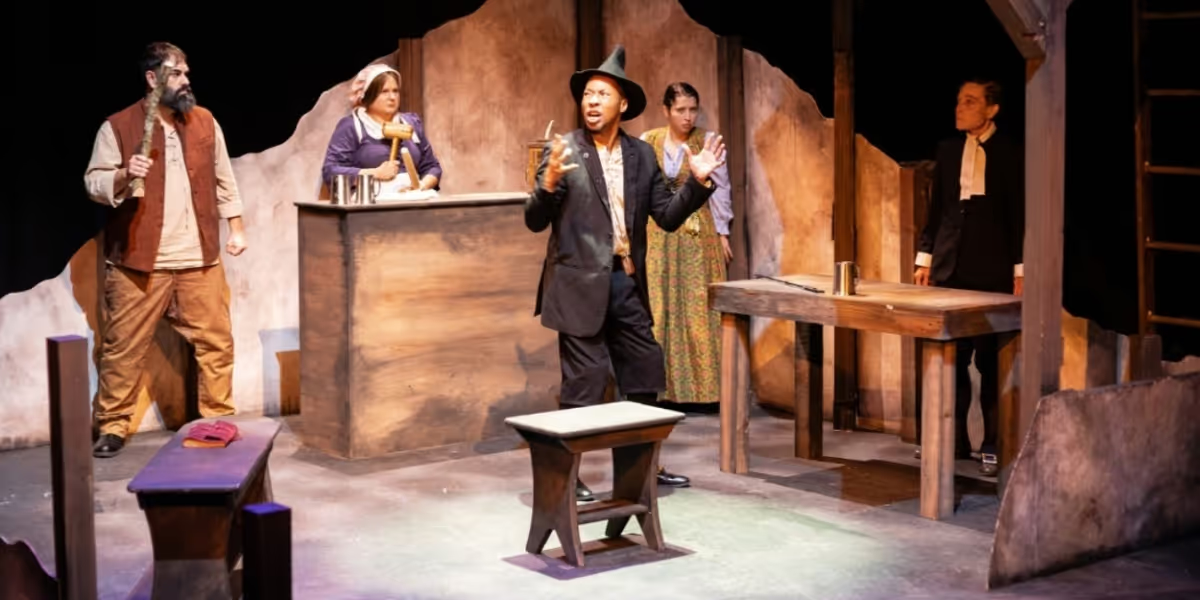
We hear the phrase “witch hunt” so often that it has now become a cliché. Whenever a politician is floundering or on the wrong side of an investigation, he or she pulls that old “witch hunt” phrase out of a hat to try to save themselves. It doesn’t even matter the person’s political leanings. Republicans have often invoked the term, as when Richard Nixon pointed his finger at the Watergate investigation, labeling it a “witch hunt,” or when Casper Weinberger chided investigators with the term during the Iran-Contra scandal of the 1980s. And you would not be able to stand up if you took a sip of a Drunk Witch cocktail every time the current President has uttered the words “witch hunt.”
But the political left uses it as well. For instance, in the late 1990s, during the Monica Lewinsky affair that involved President Clinton, James Carville ranted on CNN that “this is not a prosecution…this is a witch hunt!”
It is commonly thought that much of the modern use of the phrase stems from Arthur Miller’s 1953 classic, The Crucible. But twenty years earlier, in 1930, Iowa Representative Christian Ramseyer used it to bemoan a congressional special committee to investigate communist activities. George Orwell used it in the 1930s when writing about the persecution of revolutionaries during the Spanish Civil War, and the New York Times even cited the term about Trotskyist protestors in Russia (then called the USSR).
So, when playwright Liz Duffy Adams changed the title of her 2013 play “A Discourse on the Wonders of the Invisible World” to the more palatable “Witch Hunt,” it makes perfect sense. Any play with “Discourse” in its title may be a hard sell to anyone outside of academia, but stamp a show with “Witch Hunt,” and you’ll get people from all walks of life to sit up at attention.
Liz Duffy Adams’ engaging play, Witch Hunt, A Discourse on the Wonders of the Invisible World takes place a decade after the events of The Crucible. Abigail Williams is at the heart of it, ten years older and (hopefully) wiser. She had disappeared for a decade but suddenly shows up at a tavern run by her one-time friend in witchcraft, Mercy Lewis. Abigail is wanting to depart the colonies forever, but she wants to put the past finger-pointing events in Salem in perspective. Mercy and townspeople like Judah and the Reverend Peck are horrified by Abigail’s recent doubts and her questioning of the motives of the Salem trials, and accuse her of witchery. A trial takes place and, using Cotton Mather’s guide to finding witches as found in his 1893 book, Wonders of the Invisible World, aims to punish the unredeemed. But who should show up to the events…but a mystery man. Who is it? It’s not inappropriate to quote SNL’s Church Lady here: “Could it be…SATAN?!”
I had the pleasure of attending the Powerstories production of Witch Hunt, performed at the Stageworks Theatre in Channelside. It’s a show that probes what we know about the Salem Witch Trials as well as Arthur Miller’s famed play. It makes us question why Mr. Miller would change the real life Abigail Williams. In his play, she is a 17-year-old temptress/seductress of John Proctor with a chip on her shoulder; in reality, she was 11 years old and John Proctor was 60. The play probes the interesting query, why were the powers that be so ready to punish and kill their fellow townsfolk based on the words and actions of a group of prepubescent girls?
As for the play itself, although quite talky, it’s also potent, powerful stuff and wonderfully wicked at times. Although fairly slow going at the start, it’s jostled to life by some of our area’s best actors. It makes us reexamine the events of the Crucible while it still stands on its own merit.
That said, I wonder how someone unfamiliar with The Crucible will find it. In the audience on the night I attended, several audience members stared at the stage awestruck, totally immersed in the story. On the other hand, other attendees seemed disengaged, including some who didn’t wait until Intermission to use the restroom (Act 1’s not that long; this isn't The Iceman Cometh) and one woman a couple of rows away who was scrolling on her phone the whole time. They obviously never took my drama class because, when I teach audience etiquette, two of the rules are 1) wait until Intermission to use the restroom because otherwise it will distract the audience as well as the actors onstage, and 2) DON’T BE ON YOUR PHONES DURING A PLAY! I wondered if these individuals had no prior knowledge of The Crucible or the Salem Witch Trials and were totally lost; still, they would have failed the Audience Etiquette unit of my theatre class.
As Abigail Williams, Megan Phillips comes across quite natural, not theatrical; you get glimpses of the real person, not the caricature. We certainly never sense the “villainous” temptress that she was painted as in her past, which seems to be by design. Abigail, in the original Crucible, always comes across as a wronged vixen, retaliating by Proctor’s snub for her (and his love for his wife) by targeting him and the ones he loves. But that was mostly Arthur Miller’s concoction. In Witch Hunt, Abigail takes back her name and the reality of the circumstances. She was treated like a prophet when she led so many people to their deaths long ago but now, washing away that past and ready to move on, she’s looked at as a monster by those trapped by fear of the "invisible world." Ms. Phillips plays into this just right.
As Mercy Lewis, Holly Marie Weber is quite strong as a woman who has never put away what happened in the past; she hangs onto it, still, no matter how horrifying or how many people had died due the accusations. And young Riley Calahan, a freshman at the Pinellas County Center for the Performing Arts, is a welcomed find as Rebekkah. She truly shines in a macabre tale she tells in Act 1, showcasing a winning monologue and the true art of storytelling. Her best moment comes near the end, the revulsion on her face when she hears of a much older man who wants her, a young girl, as his wife. The look she gives says more than any words can.
Kevin Tydlaska makes for a solid Judah, the representation of the desperate patriarchal society; he—bearded and the epitome of a man’s, man’s world—turns into a villain of sorts (but it’s the society that allows for this attitude that’s the true villain).
Roxanne Fay, one of our area’s finest performers, is stunning as the Reverend Peck, resembling the odd pairing of Cillian Murphy and Jackie Earle Haley. She’s mesmerizing, as the character becomes the Judge Danforth, the inquisitor, of this play. (Peck can adjudicate justice but cannot give Communion, which is quite an interesting quandary for a reverend.) There’s a moment when Ms. Fay says the word “respect” and it spits out of her mouth as if she just uttered the nastiest cuss word imaginable. When Peck says that “theatre is the devil’s playground,” we find it quite ironic because theatre is the ultimate playground for the likes of the incredible Ms. Fay.
Best of all is Theron (T.R) Butler as John Fox, a mysterious man and perhaps a sly devil. We never know what he’s going to do next, in movement or dialogue. He’s like a Puritan Puck. He plays into the devil aspects without taking away the humanity, which is what the play underscores, as stated by one character at one point: “We are not devils—we are people too.” Extraordinary work.
Wonderful direction by Clareann Despain, who guides this fine cast. Costumes (by Lindsay Ellis) rightly show the differences between the characters (the more urbane Abigail versus the drab Puritans). John Millsap’s set—multi-leved, with the wooden planks of a tavern with red hot flames in the fireplace, underscored by CJ Marshall’s lighting design—has a Jan Steen feel to it. My only qualm here is that one of the planks blocks any actor sitting at the table for those audience members unlucky enough to be sitting at the right side of the House.
Witch Hunt is not some cut-and-dry drama where we easily know the heroes and villains (like much of the original Crucible). This makes us think, makes us reflect. We can’t deny the truth when a character says, “The invisible world holds such powerful sway.” It makes us question what really happened and maybe our own limitations when it comes to dealing with this “invisible world.” We are a society based on knee-jerkism rather than insight, and we like to punish rather than redeem; that’s really at the heart of Witch Hunt. Who are the real devils in our world? Those that think they are possessed or those who use these alleged possessions for political, financial or personal purposes? Maybe it all comes down to that age-old statement, a revamping of Walt Kelly’s famous phrase, pertinent now more than ever: “We have met the devil and he is us.”
Witch Hunt is a solid opening show for the 25th season of Powerstories Theatre, a company that keeps proving why they are so necessary to our area. For a quarter of a century they have been a go-to theatre company for stories featuring women and girls, and here’s a toast to the next 25 years! Their production of WITCH HUNT finishes its run at Stageworks on July 20th.
|
Conscience Powerstories Theatre @Stageworks Theatre (8/14-8/16) |

|
The Last Unicorn The Tampa Fringe Theatre (8/13-8/23) |

|
R.U.R. (Rossum's Universal Robots) Carrollwood Cultural Center (8/22-8/23) |

|
Big Fish Eight O'Clock Theatre (4/30-5/09) |
|
The Rocky Horror Picture Show Spooktacular Tour with Patricia Quinn Straz Center Ferguson Hall (10/22-10/22) |

|
St. Pete Country Fest – Friday Vinoy Park (11/20-11/20) |

|
Rush at Hard Rock Live Hard Rock Live (11/05-11/06) |

|
The Gods of Comedy Carrollwood Players Theatre (8/14-8/30) |
|
Nocturne The Off-Central Players (9/25-9/26) |
|
Wicked Straz Center [Carol Morsani Hall] (2/03-2/28) |
Reader Reviews
To post a comment, you must register and login.