


Review: BJØRNOV TAR DET PIANO at Chat Noir
A Masterclass in Deceptive Simplicity.
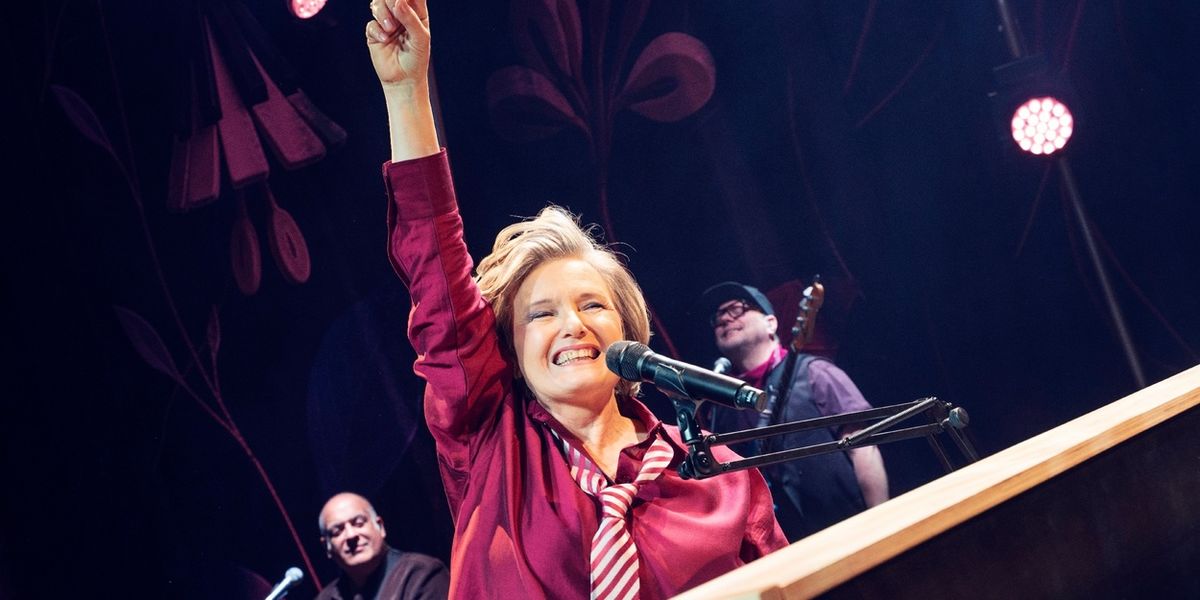
 There's a particular kind of magic that happens when an artist stops performing and starts confessing. When the carefully constructed wall between entertainer and audience dissolves, and what remains is simply a human being at a piano, wrestling with memory, mortality, and the magnificent absurdity of survival. Ingrid Bjørnov's "Bjørnov Tar Det Piano" is that rare theatrical experience where simplicity becomes profundity, where childlike melodies carry the weight of a lifetime, and where a small auditorium in Oslo transforms into something closer to a safeplace.
For international readers unfamiliar with Ingrid Bjørnov's remarkable career, context is essential. Born in 1963, Bjørnov burst onto the Norwegian music scene as a teenager, forming the pop duo Dollie (later Dollie de Luxe) with childhood friend Benedicte Adrian. Their debut album won the prestigious Spellemannprisen in 1980, and in 1984, they represented Norway at the Eurovision Song Contest with their self-penned song "Lenge leve livet" (Long Live Life), finishing 17th.
But it is perhaps for "Which Witch" that Bjørnov deserves international recognition—and sympathy. Co-composed with Adrian, this ambitious rock opera premiered at the Bergen International Festival in 1987 before reaching London's West End in 1992, where it ran for 76 performances at the Piccadilly Theatre. Based on the infamous witch-hunting manual Malleus Maleficarum, the musical told the tragic story of Maria, a young Italian woman accused of witchcraft in sixteenth-century Germany.
The London critics were merciless, with one infamously declaring it "the second worst West End musical of all time." Yet the music itself was undeniably, beautifully powerful—compelling enough that "Which Witch" has since been performed 142 times in concert versions across nine countries, selling over 110,000 albums and drawing nearly 276,000 audience members. Sometimes fate and fortune diverge. And if every person who'd expressed an opinion about that show had actually seen it, it would have run for ten years at least.
Since then, Bjørnov has established herself as one of Norway's most versatile musical talents: composer, musical director, arranger, satirist, and performer, with a career spanning over four decades. She possesses considerable satirical talent—the combination of intellectual wit and musical mastery creates a unique voice that's earned her the title "Norway's leading humor pianist." Her lyrics deal with "humorous everyday considerations"—mundane moments elevated through whimsy and linguistic playfulness, finding the absurd in the ordinary while creating modern folk pop with a friendly analog twist. For musical theatre readers, it's worth noting that she translated the ABBA musical "Mamma Mia" into Norwegian—one of the finest translations I've witnessed—but more on that later.
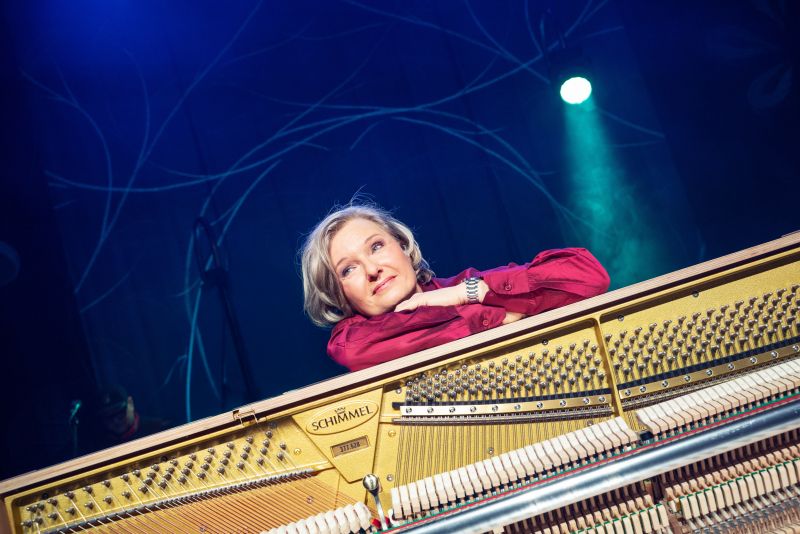
In Norwegian, "tar det piano" is an expression meaning "taking it easy" or "calming down"—literally "take it piano," referencing the musical dynamic marking for soft or quiet. But Bjørnov doesn't just take it easy; she takes THE piano, commandeering the instrument with as much authority as ever. Well, almost. In one seemigly improvised moment, she removed two piano keys to demonstrate MIDI (Musical Instrument Digital Interface) to the audience, only to discover that keys are considerably easier to remove than to reinstall. What followed was several minutes of Bjørnov wrestling with her instrument like a mechanic who's just realized they've lost a crucial bolt, all to thunderous laughter and applause. It was the perfect metaphor for the show itself: sometimes the most educational moments are the ones where everything goes slightly wrong, and Bjørnov has the confidence to let us watch her figure it out in real time.
At one point in the evening, Bjørnov confesses that being on this stage (like her garden) is her safe haven. The small venue transforms into a collective shelter where Bjørnov's vulnerabilities become our own, where her piano serves as both anchor and compass. We're not just watching someone perform in their safe space—we're invited to inhabit it with her.
The deception of simplicity
What makes this show utterly transcendent is Bjørnov's masterful deployment of musical deception. Her melodies are disarmingly simple—almost childlike in their directness. Your first instinct is to dismiss them as elementary, but she always has some melodic trick up her sleeve, and when the lyrics arrive, you realize you've been brilliantly ambushed.
She uses Gershwin's "Rhapsody in Blue" as a recurring metaphor throughout the evening—specifically, the fact that she knows the opening. Just the opening. For Bjørnov, this becomes a stand-in for all of life's unfinished business, the bucket list items we've started but never completed. It's both self-deprecating and profound: we're all walking around with half-learned Rhapsodies in our heads, convinced that someday we'll get around to mastering the rest.
Bjørnov has certainly had her share of unfinished melodies. Between songs, she dares to be startlingly personal, shifting from the absurdities of online marketplace transactions to her husband's love of his car trailer to the arcane complexities of bridge financing. The mundane mixed with the meaningful in ways that feel bracingly honest. Nostalgia runs through the evening like a golden thread, but Bjørnov wields it with characteristic ambivalence. Her writing constantly toggles between mourning decades long gone and celebrating that they're finally behind her. It's nostalgia with a double edge: she'll conjure the past with such tenderness you ache for it, then pivot and remind you why those times needed to end. Are we longing for what we've lost, or relieved to have survived it? Bjørnov refuses to choose, and in that refusal, she captures something essential—the ability to hold contradictory emotions simultaneously, to be sentimental and pragmatic in the same breath.
Where the melodies walk in a straight line, the text dances in spirals. She'll sing about something as mundane as gardening or their small vintage "out of order" motorboat with a tune you could hum after one hearing, but the lyrical architecture reveals itself as baroque—layered with really good rhymes.
The refreshing restraint
In an era where too many comedians feel compelled to use their platform as a political pulpit—lecturing audiences about whom to support, the dangers of war, climate change, and every other crisis demanding our attention—Bjørnov's approach feels like a breath of fresh air. She acknowledges these issues exist, nodding to the weight of the world beyond the stage, but deliberately chooses not to make them the focus of her evening.
This isn't avoidance or apathy; it's artistic wisdom. Bjørnov understands that sometimes the most radical thing a performer can do is resist the temptation to solve the world's problems from behind a microphone. Instead, she offers something equally valuable but far rarer: permission to simply be human for a few hours. To laugh at car trailers and broken motorboats. To grieve quietly for a mother's fading memory. To celebrate survival without attaching a manifesto to it.
It's a relief, frankly. In Bjørnov's hands, comedy and music return to their essential function—not as vehicles for ideology, but as tools for connection, catharsis, and the gentle excavation of shared humanity.
The heartbreak
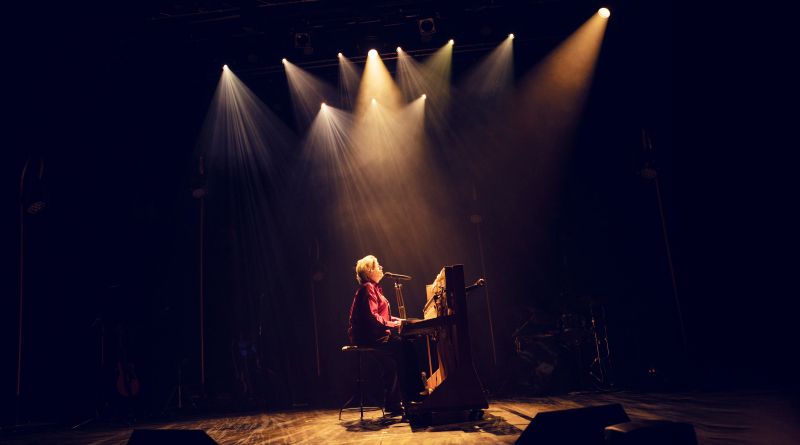
But it's when she addresses her mother's dementia that the evening shifts into something almost unbearably poignant. She follows this vulnerable confession with her own Norwegian translation of "Slipping Through My Fingers" from Mamma Mia—a song she adapted years ago. In its original context, it's about a mother watching her daughter grow up too quickly. Performed here, in the shadow of what she's just shared about her mother's condition, it becomes something else entirely: a meditation on memory, loss, and the cruel reversal of watching a parent slip away. The translation she crafted years ago now haunts her with new meaning, and she doesn't shy away from that irony. She leans into it.
The triumph
And then there's her eleven o'clock number—"Now"—a country-western inflected celebration that serves as the emotional crescendo of the evening. With roots planted firmly in Nashville soil but branches reaching toward something distinctly Norwegian, "Now" is Bjørnov's triumph song: a declaration that she's come through the fire and emerged not just intact, but grateful. It's about the radical act of being present, of choosing joy in the immediate moment despite everything that's come before.
What makes the performance of "Now" so devastating is that Bjørnov herself seems almost overwhelmed by it. You can see her fighting through the emotion, her voice catching slightly, her composure threatening to break. She's not performing grief or triumph—she's experiencing it, live, in front of us. In a one-person show ostensibly about the performer's own life, this kind of raw honesty is exactly what we need. Too many solo shows are exercises in careful self-mythology; Bjørnov gives us something messier and infinitely more valuable: the truth, even when it threatens to undo her.
Throughout it all, there's the improvisation—or what appears to be improvisation. This is where Bjørnov reveals herself as not just a musician but an illusionist of the highest order, most likely with good help from director Mattias Carlsson. She creates such a convincing impression of making everything up on the spot that you'd swear she's discovering the words at the exact moment they leave her lips.
The effect is intoxicating. You feel like you're witnessing the creative process in real time, like she's been let backstage into her brain's green room. Of course, this is craft masquerading as casualness—you don't win six comedy awards by winging it—but the illusion is so complete, so generous, that you don't care. She makes you feel like her collaborator rather than her audience.
When she appears with her top-notch band—Javed Kurd on guitar, Rino Johannessen on bass, and Ole Petter Chylie on drums—the simplicity of her piano arrangements takes on new dimensions. The band doesn't complicate; they illuminate. They understand their role is to serve the architecture of Bjørnov's vision, adding color and texture while never obscuring the fundamental truth: this is a woman and her piano engaged in a decades long conversation.
"Bjørnov Tar Det Piano" is that rare show that works on every level simultaneously. Surface-level viewers will have a delightful evening of catchy tunes and clever humor. More attentive audiences will recognize they're watching a philosophical treatise on identity, aging, creativity, and survival delivered through the Trojan horse of entertainment. The nostalgia alone—simultaneously mourning and celebrating the decades that shaped her—could fuel a doctoral thesis.
This is Ingrid Bjørnov at the absolute peak of her powers: deceptively simple, seemingly spontaneous, vulnerable when it matters most, and utterly, devastatingly brilliant. In her safe haven at Chat Noir, she's welcomed us in.
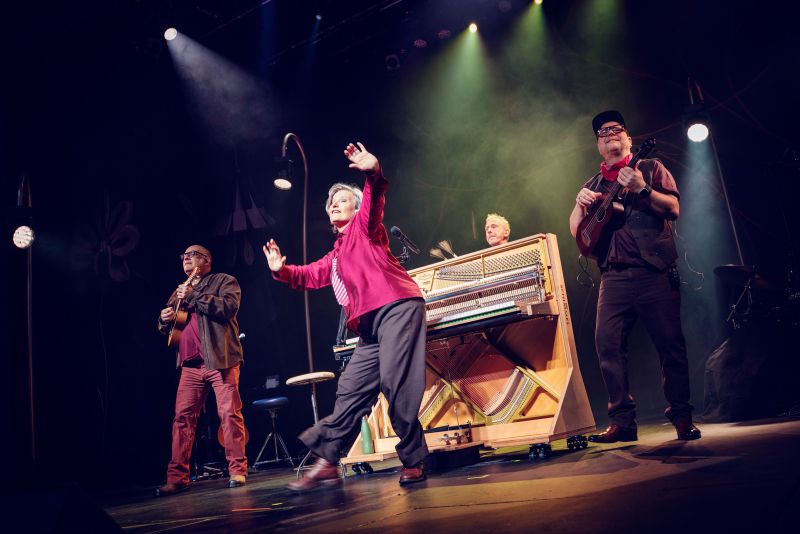
Ingrid bjørnov: Artist/piano
Javed Kurd: Guitar
Rino johannessen: Bass
Ole Petter Chylie: Drums
Mattias Carlsson: Director/Producer
Alf Ove Fremmersvik: Stage design & lighting design
Bodvar tornes: Sound design
Cårejånni enderud: Costume design
Lisa Back: Project Manager/Stage Manager
Lisbeth Wiberg Olsen: Manager/producer
Tore S. Myklebust: Producer
Få Broadway-nyheter på WhatsApp
Få de siste oppdateringene, nyhetene og eksklusivt innhold direkte i appen.

|
|
BJØRN & BJARTE, DEN TØFFE & DEN SARTE Brygga Kultursal (12/04-12/04) |
|
|
Darling West: Lights – Juleturné 2026 // Haubitz Hall Haubitz Hall (12/09-12/09) |

|
The Norwegian Opry Grieghallen, Griegsalen (1/16-1/16) |
|
|
Sigvart Dagsland - Det er makt i de foldede hender - Salmekonsert Vanse Kirke (11/07-11/07) |
|
|
Sigvart Dagsland - Det er makt i de foldede hender - Salmekonsert Tønsberg Domkirke (11/06-11/06) |

|
Night of Soul Grieghallen, Peer Gynt Salen (2/20-2/20) |
|
|
Sigvart Dagsland - Det er makt i de foldede hender - Salmekonsert Gand Kirke (11/08-11/08) |

|
IN MEMORY OF ELVIS GOSPEL MED PAAL FLAATA OG BOGAFJELL GOSPELKOR St. Petri Kirke (10/30-10/30) |

|
Markens lille grøde – det e her æ høre tel (førr fan)! Teatersalen - Narvik Kulturhus (9/23-9/23) |

|
Brunello vs Barolo - Ekstrasmaking Bergenhus Snekkerbrakken (10/27-10/27) |

Reader Reviews
To post a comment, you must register and login.