


Review: MISS SAIGON at Göteborgs Operan
Miss Saigon: A Timeless Tragedy Whose Urgency Only Deepens
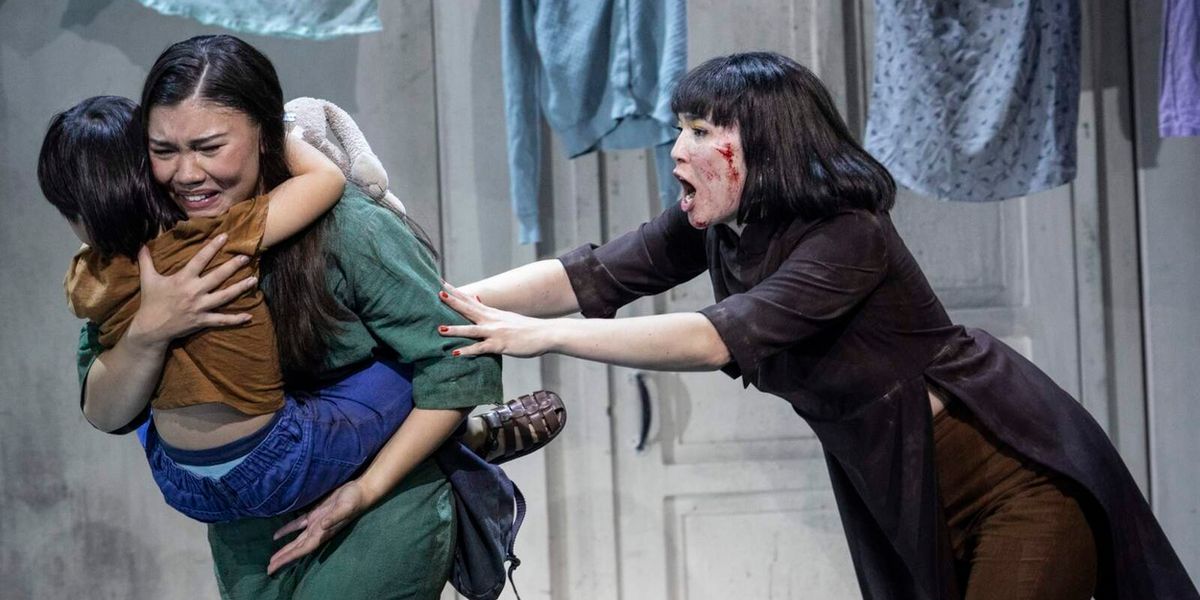
For decades, Miss Saigon has occupied contested terrain within the musical theater canon—championed by some as an essential work, scrutinized by others for perpetuating orientalist narratives and reductive stereotypes. Since its recent West End and Broadway revivals, these accusations have intensified, with critics deploying terms like "problematic" and "racially stereotypical" as decisive judgments. I acknowledge these critiques deserve engagement rather than dismissal, yet I find them insufficient when confronting productions that genuinely commit to cultural authenticity and historical precision—standards this staging achieves where others have failed entirely.
Beyond the discourse surrounding representation, Miss Saigon remains what it has always been: an unflinching examination of how war annihilates individual lives, leaving behind only grief, trauma, and impossible moral choices. The narrative's contemporary resonance has only sharpened—not because it exploits suffering, but because it refuses the comfort of looking away. We watch it now against the backdrop of Ukraine's ongoing devastation, the Mediterranean's mounting death toll, and Europe's cyclical debates about who deserves refuge and who must be turned back to drown.
For Swedish audiences, this should carry particular weight. Sweden welcomed thousands of Vietnamese refugees in the late 1970s and early 1980s—many arriving as "boat people" fleeing the same chaos depicted onstage. Those who survived the journey found sanctuary here, becoming part of Sweden's transformation into one of Europe's most multicultural societies. Yet today's Sweden grapples with its own contradictions: a nation that once prided itself on humanitarian leadership now debates border restrictions, integration failures, and the limits of compassion. The "bui-doi" of Miss Saigon—abandoned Amerasian children stigmatized in both their parents' cultures—find uncomfortable contemporary parallels in children born to Swedish residents and foreign nationals, caught between bureaucratic categories that determine their right to remain.
The musical doesn't offer easy answers to these tensions. Instead, it insists we confront an enduring truth: that geopolitical decisions made in comfortable rooms create human consequences that ripple across generations, that promises of sanctuary ring hollow when asylum becomes contingent on political convenience, and that the children born of war deserve more than our selective memory. This remains urgently relevant theater—not despite its problematic origins, but because it holds up a mirror to hypocrisies we would prefer not to examine.
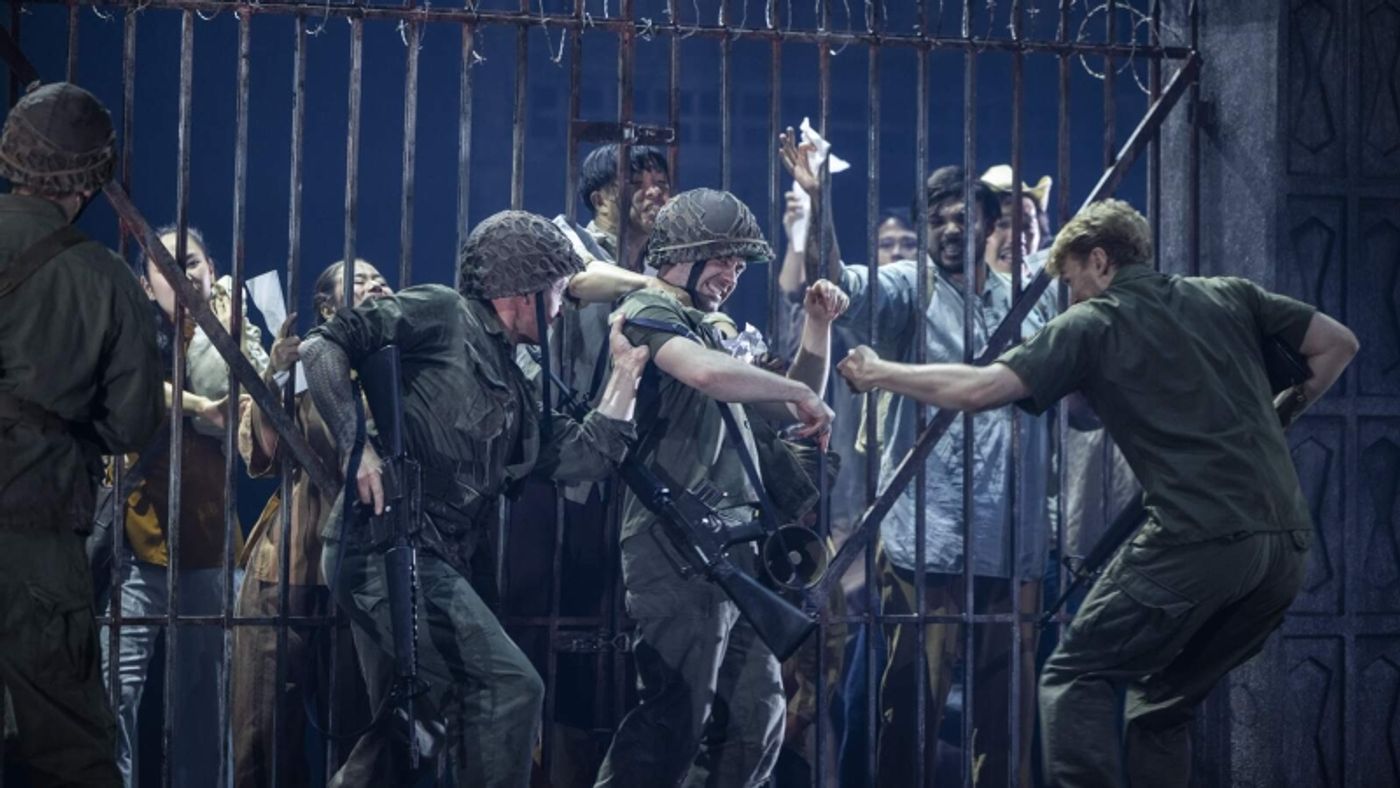
Claude-Michel Schönberg and Alain Boublil, collaborating with lyricist Richard Maltby Jr., constructed their narrative framework atop Giacomo Puccini's 1904 opera "Madama Butterfly"—itself based on David Belasco's play derived from John Luther Long's short story. Like Puccini's opera, Miss Saigon chronicles the doomed romance between an Asian woman and a Western man who ultimately abandons her, with devastating consequences. Yet where Butterfly unfolds in Meiji-era Nagasaki, Schönberg and Boublil transplant the essential tragedy to Saigon in April 1975, as the city teeters on the precipice of collapse.
Chris (Matias Steen Hauge), a disillusioned American Marine, encounters Kim (Feline Andersson), a Vietnamese orphan coerced into sex work at Dreamland, a brothel overseen by the gleefully amoral Engineer (John Browning). Amid the chaos of America's ignominious retreat, the lovers are violently separated. Three years later, Chris—now living in Bangkok with his American wife Ellen (Karin Mårtenson Ghods)—learns through his former comrade John (Arvid Assarsson) that Kim survived, bearing his son Tam. The child belongs to the "bui-doi"—literally "dust of life"—Amerasian children abandoned as living evidence of an unpopular war, stigmatized in both cultures. The Engineer, having escaped with Kim and Tam, perceives the boy as currency, his passport to the mythologized prosperity of America.
Performances That Transcend Archetype
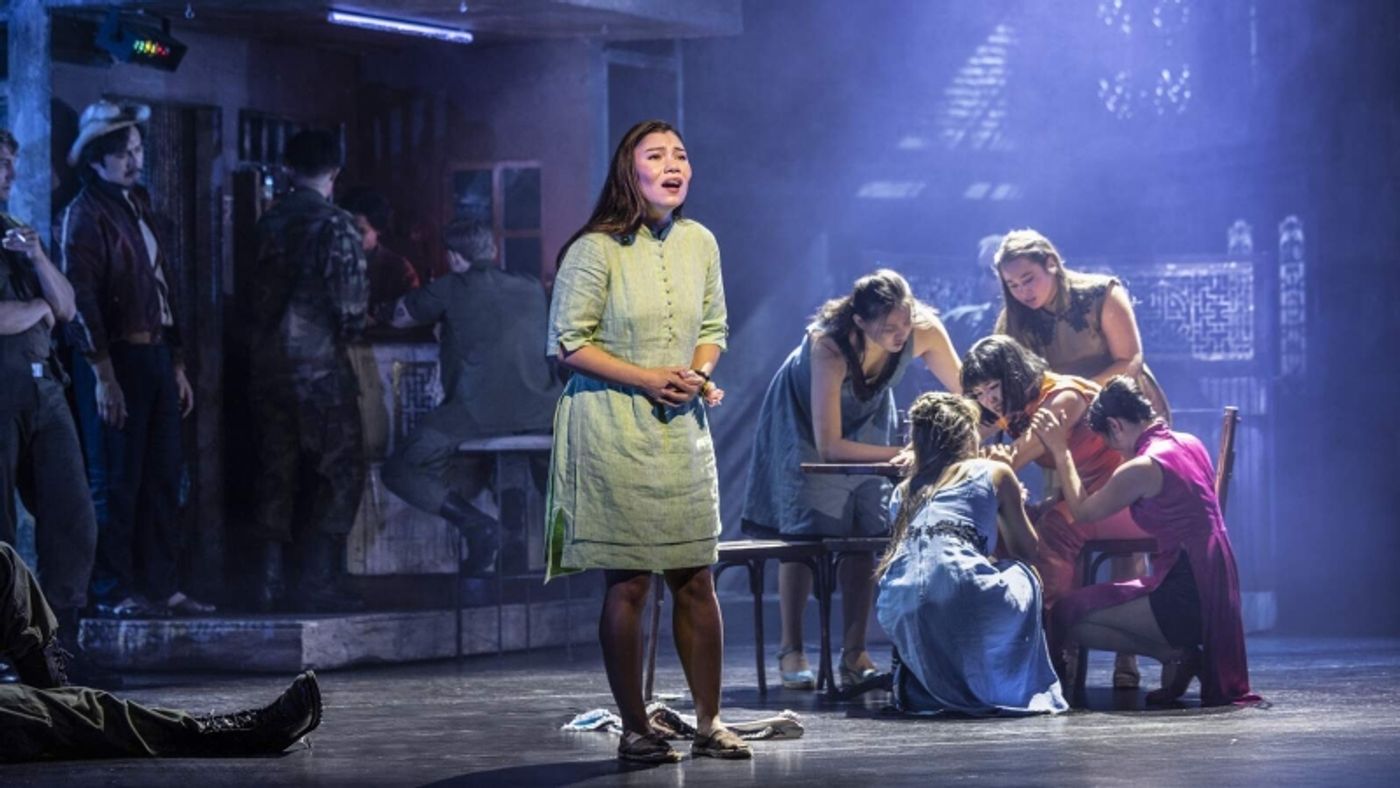
The ensemble's unified excellence begins with Feline Andersson, whose Kim anchors the production with devastating authenticity. Andersson understands that Kim's power lies not in suffering displayed but in strength concealed—she reveals a character who survives not despite her trauma but through fierce, calculated resilience. Vocally, Andersson navigates terrain few performers can traverse with such assurance: her voice becomes an instrument of transformation, shifting seamlessly between anguished vulnerability and steely determination, between maternal warmth and unbending will. This is not a performance that solicits sympathy through passive suffering; Andersson demands something far more uncomfortable from her audience—complicity, recognition, and unflinching attention to what war does to those who cannot escape it.
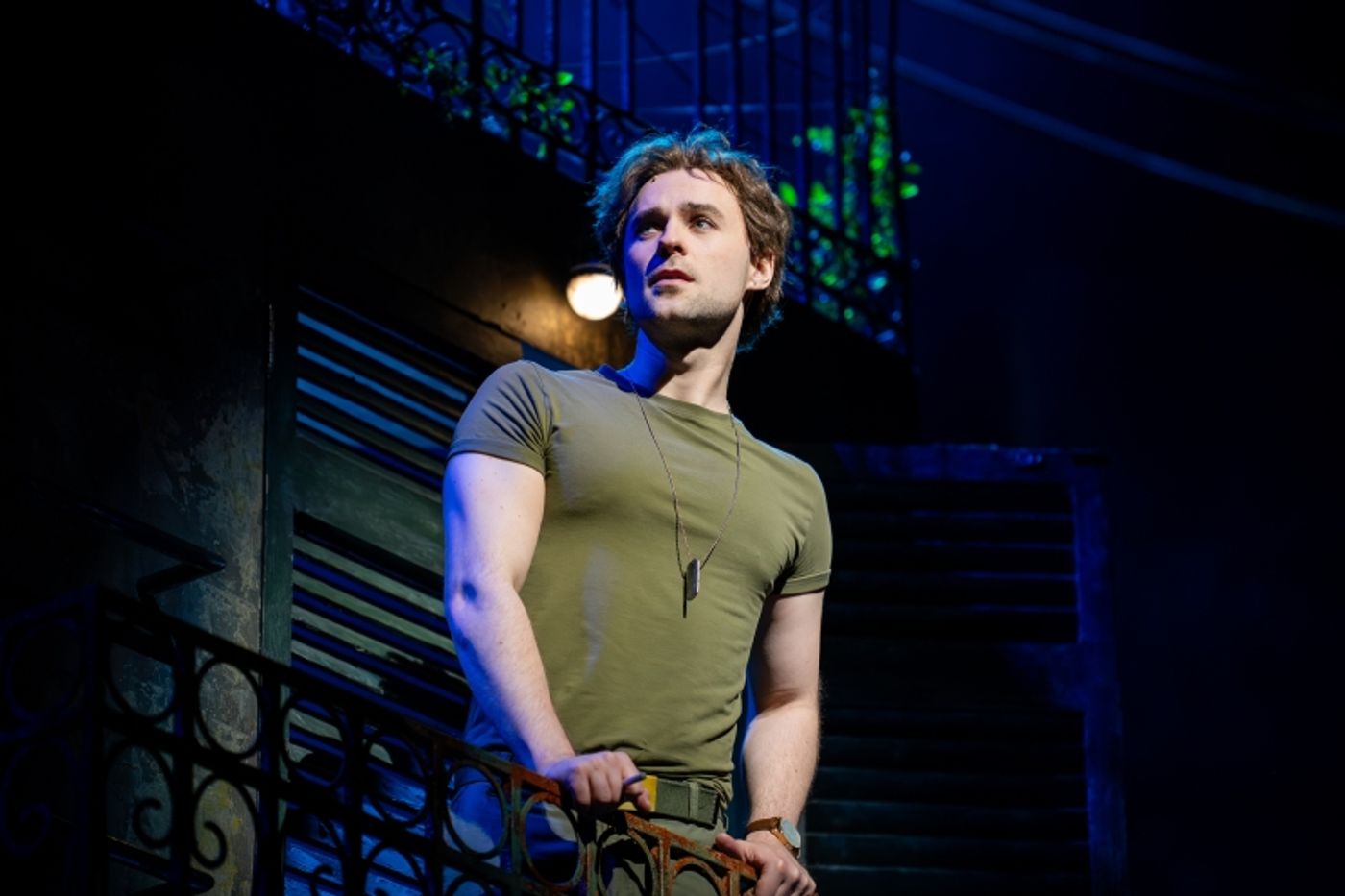
Matias Steen Hauge's portrayal of Chris is refreshingly grounded compared to previous productions. He eschews the tall, curly-haired hero archetype that has grown clichéd over the years, instead bringing striking originality and emotional depth to the role at Gothenburg Opera—one of Scandinavia's premier international musical theatre venues.Hauge presents a sensitive, deeply traumatized soldier who discovers fleeting happiness in Saigon's final days. His rendition of "Why God, Why?" begins with tender, beautiful tenor tones before building into a powerful, angst-ridden cry—a performance that demonstrates both vocal mastery and profound emotional range. What makes this achievement even more impressive is that this was Hauge's debut in the role, stepping in for the usual Chris, Timothy Garnham. As any understudy knows, the first performance before an audience is also the first time working with the full set and orchestra—a daunting task under any circumstances. Yet Hauge rose to the challenge with remarkable assurance, delivering an outstandingly authentic and deeply human performance worthy of the highest international standards. Bravo!
John Browning delivers the production's most theatrically audacious performance as The Engineer. He possesses no loyalty to nation, ideology, or person—only to his own continuation. He sings with great diction and power, often almost sailing on the phrases. I was especially impresses with is version of "If you Want to Die in Bed" and "The American Dream" from satirical spectacle into genuinely disturbing commentary on how American mythology consumes those who believe its promises. We're simultaneously seduced and repelled, laughing and recoiling in the same breath.
A Supporting Ensemble of Distinct Voices
The supporting cast claim their moments with assured authority. Natalie Chua's rendition of "The Movie in My Mind" excavates the psychology of dissociation—how the mind constructs fantasies not as escape but as survival mechanism. Arvid Assarsson's "Bui Doi," opening the second act, carries profound moral gravity as he confronts audiences with America's abandoned children, demanding we acknowledge the human cost of geopolitical decisions made in air-conditioned rooms thousands of miles from their consequences. His metallic timbre voice is a powerhouse, and he commands the song with bravour.
Alistair So plays Thuy with righteous fury and intensity. As Kim's betrothed—a commissar in the new regime—he represents not villainy but a parallel tragedy: a man watching the woman promised to him choose her occupier's memory over their shared culture. So's classical vocal power and physical intensity create a character who reverberates beyond his limited stage time.
Karin Mårtenson Ghods inherits perhaps the production's most thankless assignment: Ellen, the "other woman" blocking our protagonists' reunion. Across multiple revisions—from "Her or Me" through "Now That I've Seen Her" to the current "Maybe"—the creative team has struggled to grant Ellen comparable emotional legitimacy. That difficulty is itself revealing: the structure demands we view Ellen as obstacle, yet she is perhaps the only major character acting entirely in good faith, trying to build something stable from the wreckage others created. Ghods searches "Maybe" for every available layer, revealing Ellen's own devastation, her moral confusion, her attempt to extend compassion while recognizing its inadequacy. Her voice is emotionally transparent and transforms what could register as self-pity into genuine reckoning. She doesn't ask us to choose sides; she asks us to recognize that there are no good choices left, only different registers of loss.
The production's true revelation lies in its multinational ensemble—artists from Sweden, Norway, the UK, to name a few who perform with such unified precision that national boundaries dissolve entirely. This isn't diversity as mere gesture; it's a deliberate choice that deepens the musical's exploration of displacement and cultural collision.
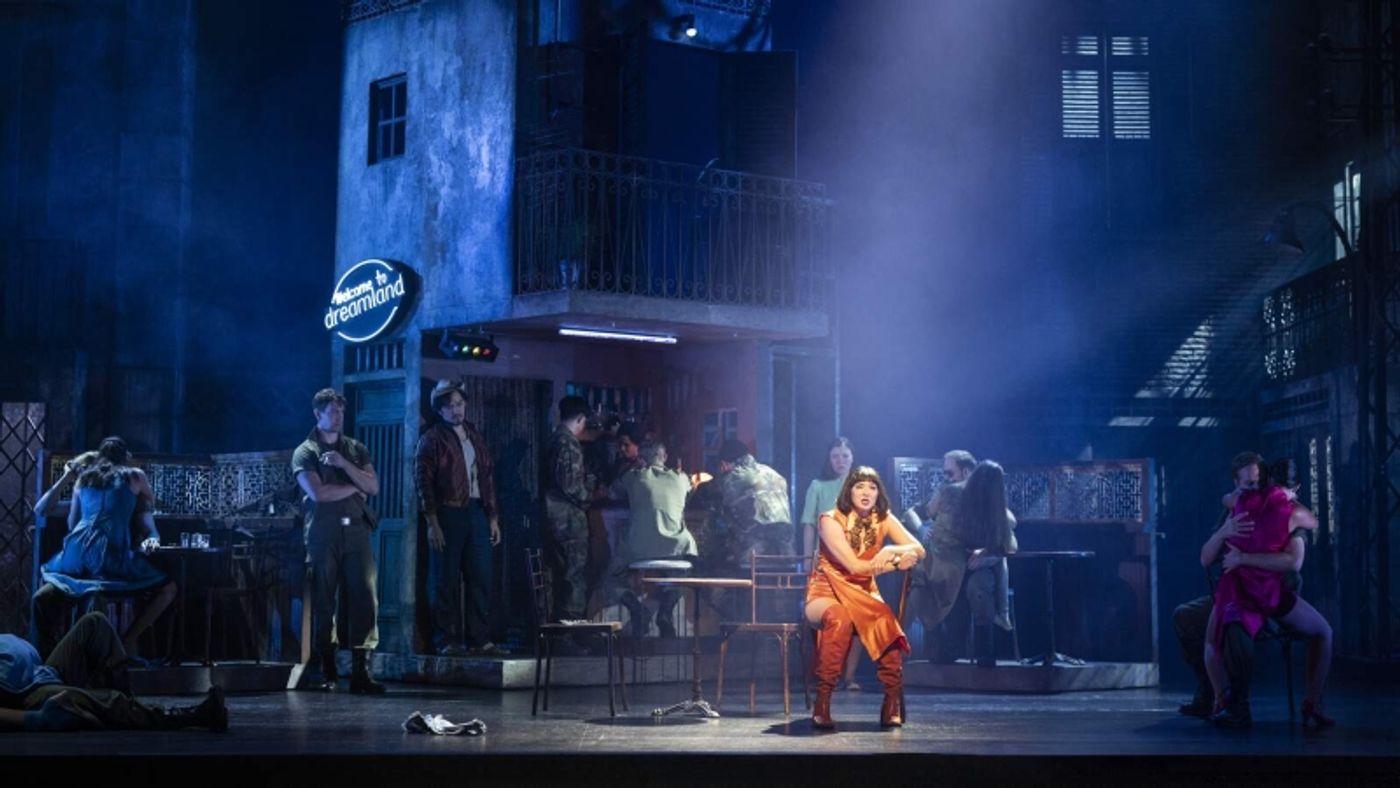
Vocally, they operate as one formidable instrument. The harmonies in "The Heat is On in Saigon" crackle with dangerous energy, while "The Morning of the Dragon" carries genuine ceremonial weight. The choreography demands equal rigor—watch them during the fall of Saigon sequence, each performer maintaining individual panic while contributing to collective chaos. They shift seamlessly between the sexualized vocabulary of Dreamland, the militant discipline of soldiers, and the flowing grace of Vietnamese tradition.
What makes this ensemble exceptional is how their varied origins illuminate the story itself. Performers who've navigated linguistic and cultural barriers, who understand adaptation and displacement firsthand, bring authentic resonance when portraying refugees, soldiers, and civilians caught between colliding worlds. The result transforms Miss Saigon from star vehicle into genuine ensemble theater, where every performer onstage shares equal responsibility for the production's devastating impact.
Directorial Choices That Clarify and Complicate
As this is an import of the Norwegian 2023 Production little has changed, except for this being an Opera house, it is sung with the original English lyrics, and the orchestra is nine members larger than in Oslo. Director Guy Unsworth and his creative collaborators have made interpretive decisions that sharpen both narrative clarity and thematic complexity. The production's most indelible images achieve their power through restraint rather than spectacle: Kim's final act of protection for Tam strips away melodrama to reveal the calculus of maternal love pushed beyond all boundaries; the Act One finale's boat sequence captures panic and chaos while maintaining emotional legibility; "The American Dream" explodes into hallucinatory grotesque, a fever-dream exposé of capitalism's seductions and betrayals rendered as nightmare carnival.
Even elemental choices resonate symbolically. The recurring balloon motif—representing love in one context, becoming memorial in another—demonstrates sophisticated visual storytelling that trusts audiences to construct meaning through accumulation rather than explanation.
Design Rooted in Historical Materiality
Where the original production employed fabric-dominated scenography as impressionistic canvas, David Woodhead's designs pursue tactile authenticity. The sets feel inhabited rather than decorative, grounding the narrative in recognizable physical reality rather than theatrical abstraction. While London's large-scale productions often deploy elaborate automation and mechanical spectacle, this production's power derives from cohesion—every design element serving the same interpretive vision rather than competing for attention.
Jean Chan's costume designs similarly reject orientalist pastiche for period-specific accuracy. Her work honors the historical setting while allowing performers' physicality and emotional truth to remain primary—the costumes serve character rather than overwhelming it.
Orchestral Authenticity as Ethical Commitment
Miss Saigon's score deliberately incorporates Vietnamese đàn nguyệt (moon lute), gamelan-inspired Indonesian textures, Japanese shamisen, and shakuhachi bamboo flutes—instruments conspicuously absent from late-1980s Western pop music vocabulary. These choices transcend mere sonic exoticism; they represent an ethical commitment to cultural specificity, rejecting homogenized "Asian" sounds for instruments rooted in particular traditions. The orchestration doesn't merely evoke Vietnam—it insists that Vietnam possesses its own sonic identity deserving respectful representation.
Musical director, Joakim Hallin and conductor Christoffer Nobin navigates the 24-piece orchestra through the score's demanding shifts with confidence and nuance, honoring William David Brohn's orchestrations—crafted by a master arranger no longer alive to hear his work performed. That this production not only utilizes Brohn's full orchestral palette in addition to expanding it to the orechastral sound I haven't heard since the original London version demonstrates respect for the composer's intentions and is very welcomed.
Conclusion: Art's Obligation to Bear Witness
While I wrote about the Norwegian production that "I can count on one hand the Norwegian-produced musicals that have achieved this level of emotional and intellectual engagement —this is the same rarity in Sweden, where musical theatre have had a far bigger place in culture than in in my native land. Sweden is leaps and bounds ahead, both with having big hits, running for years, while also the number of productions produced each year. It is a testament that there is an audience for them. Generally speaking Sweden also have a larger talent pool to choose from than Norway, even though we are in a very different place now than 30 years ago due to better education. Since I praised the Norwegian production, it is no revaltion that I love this production of Miss Saigon even more. I recommend this without reservation to anyone seeking musical theatre that transcends entertainment to become soul searching.
While the narrative remains fictional, it casts shadows from historical atrocities we would prefer to forget: America's abandonment of allies and children, the instrumentalization of women's bodies in wartime, the mythology of the "American Dream" that promises salvation while delivering exploitation. These themes haven't diminished in relevance—if anything, our current moment of resurgent nationalism, anti-immigrant hysteria, and endless distant wars makes Miss Saigon's critique more urgent, not less.
.png?format=auto&width=1400) The production doesn't resolve the legitimate questions about representation and authorship that follow this musical. But it demonstrates that when performed with cultural intelligence, historical respect, and emotional honesty, Miss Saigon transcends its problematic elements to achieve something essential: it refuses to let us forget that wars fought in our names destroy individual lives with absolute finality, and that we bear moral responsibility for those we leave behind. That remains a truth worth staging, worth witnessing, and worth carrying with us long after the final curtain falls, and the text about 35.000 Vietnamize fled to Sweden, some of them even played in this production.
The production doesn't resolve the legitimate questions about representation and authorship that follow this musical. But it demonstrates that when performed with cultural intelligence, historical respect, and emotional honesty, Miss Saigon transcends its problematic elements to achieve something essential: it refuses to let us forget that wars fought in our names destroy individual lives with absolute finality, and that we bear moral responsibility for those we leave behind. That remains a truth worth staging, worth witnessing, and worth carrying with us long after the final curtain falls, and the text about 35.000 Vietnamize fled to Sweden, some of them even played in this production.
Conductor And Musical Director Joakim Hallin
Conductors Christoffer Nobin, Martyna Szymczak
Director Guy Unsworth
Set Design David Woodhead
Costume Design Jean Chan
Lighting Design Matt Haskins
Choreography Cressida Carré
Sound Designer Avgoustos Psillas (Audio Craft Scandinavia)
Assistant Sound Designer Peter Ebbesson (Audio Craft Scandinavia)
Mask Design Tiiu Luht
CAST
Kim Feline Andersson
Chris Matias Steen Hauge (Normally played by Timothy Granham)
Engineer John Browning (Normally played by Eu Jin Hwang )
John Arvid Assarsson
Ellen Karin Mårtenson Ghods
Thuy Alistair So
Gigi Natalie Chua
Tam Pontus Bremholm, Louis Linusson, Gabriel Melo, Mia Terese Yasuda
Ensemble
Jesper Blomberg, Albin Boudrée, John Browning, Julia Carlström, Fanny Dan Tomter, Sonny Enell, Anton Engström, Julia Forssell, Tord Hansson, Martine Hattestad Kveli, Lars Hjertner, Bao André Nguyen, Andrea Rymoen, Evelina Schilling, Robert Sillberg, Carl Sohlberg , Oscar Sundling Wallin, Lea Undall, Vivian Wrang
Extras
Danny Eriksson, Catherine Gillo Nilsson, Teri-Anne Grumstedt-Lee, Lukitawesa Lukitawesa, Kerstin Nguyen, My Nässlander Örninge, Evelina Segerlund, Claudia Svensson, Trung Thoong, Yuta Yasuda
Child Extras
Agnes Landin Nordin, Julia Linderholm, Zoey Magnussen, Matilda Svanström, Joar Thoong, Ruibo Zhao
Få Broadway-nyheter på WhatsApp
Få de senaste uppdateringarna, nyheterna och exklusivt innehåll direkt i appen.


|
DJUNGELBOKEN - THE MUSICAL Arena Skövde (2/26-2/26) |

|
LOKALHISTORISKT FÖREDRAG: Tung industri och lätt textilhantverk Dunkers Kulturhus Konsertsalen (11/04-11/04) |

|
KARL-BERTIL JONSSONS JULAFTON TEMPELRIDDAREN (10/17-12/19) |

|
Luca Ravenna - Flamingo Teatro Comunale (2/13-2/13) |
|
|
Djungelboken The Musical Göta Lejon (10/11-1/02) |

|
Storseans med Martin Ohlson Kungsbacka Teater (10/17-10/17) |

|
TROLLKARLEN FRÅN OZ SUNDSTAAULAN (3/07-3/07) |

|
Sagan om ringen, Hobbit och Maktens ringar - livekonsert Forum Oskarshamn (3/09-3/09) |
|
|
Foredrag med Nils Villemoes - Hvor går udviklingen hen, mens vi sover? Portalen (9/28-9/28) |
|
LOKALHISTORISKT FÖREDRAG: Uppropens historia Dunkers Kulturhus Konsertsalen (9/02-9/02) |
Reader Reviews
To post a comment, you must register and login.