Weiming Wang on the Benefits of World Building with Strangers
"That unity—this feeling that a group of strangers could build a world together—was unlike anything I had experienced before.”
Written by: Tom White
All forms of the Arts exist because of the symbiotic relationship that is creativity and awareness. Quite simply, unless the public is aware of an artistic creation it cannot resonate, impact, or educate as is the intent of all such undertakings. When said creation is fortunate to have someone of both an artistic and a marketing mindset, someone like producer Weiming Wang, the chance of success is exponentially greater. Either as a creative director or as a producer, he’s a potent and insightful collaborator who possesses a sense of what connects with an audience on a level which seems to border on omniscience.
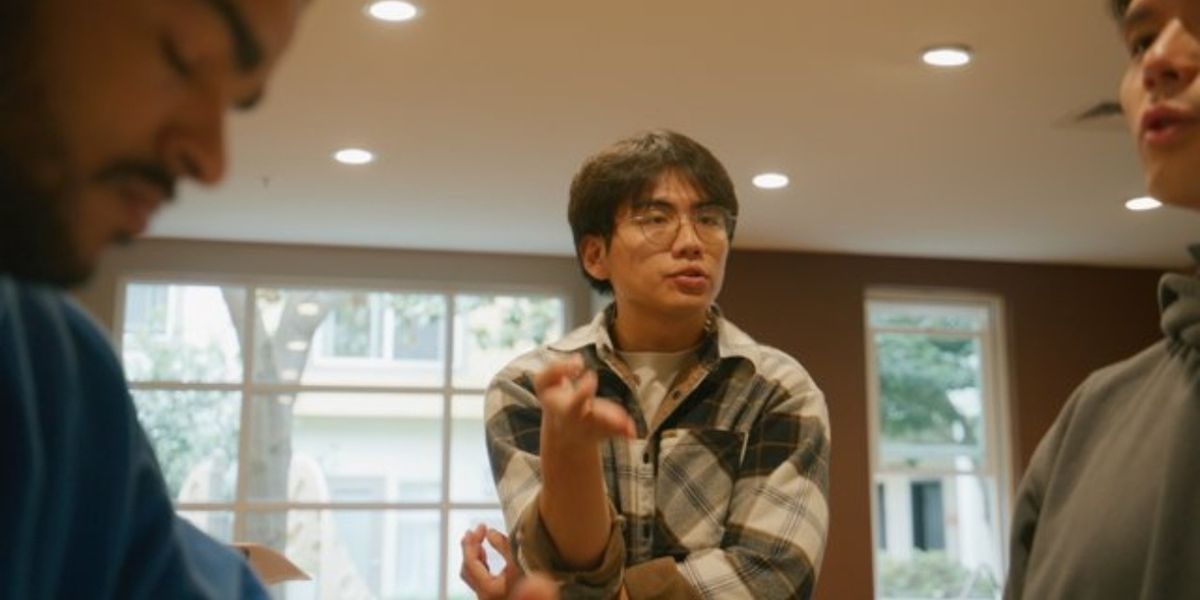
Wang is boisterous when discussing the art of storytelling through film, television, and online. This does not originate from a place of celebrity or ego but instead from the allure of the connection that takes place, both on-camera and behind the scenes. He confides, “I often think back to my very first experience on a set as a PA. What struck me most was how collaborative filmmaking is. I watched the boom operator leaning forward just a little to catch a softer line, the DP squinting into the monitor to adjust a highlight, the gaffer quickly flagging off a reflection, and the actors stepping into emotional truth on cue. Everyone had a different job, a different specialty, but all those fragmented pieces suddenly aligned the moment the camera rolled. That unity—this feeling that a group of strangers could build a world together—was unlike anything I had experienced before.”
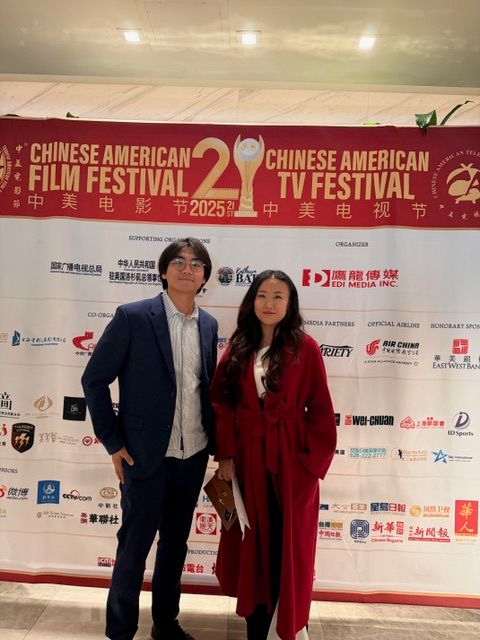
Director Alex Zajicek’s Sorry We’re Dead is a remarkable film which seeks to defy boundaries. Blending comedy and drama in a story where one woman is pinned between the establishment and tech bros on a panicked mission, the filmmaking style spans adventure to animation and numerous points in between. Awards from the Seattle Asian American Film Festival, Royal Starr Film Festival, and others attest to the public’s fascination with this unique film. While the final form of Sorry We’re Dead is the result of seen an unseen artists, like composer Eli Crews (known for his work on the multiple Oscar Award Winning Film Everything Everywhere All at Once), a crucial component of its success occurred after the final version of it was locked. Wang was responsible for leading the film’s post-production marketing strategy and national festival run.
After completion, he organized and executed the entire promotional and distribution campaign, coordinating submissions and publicity across over thirty U.S. film festivals—including the Seattle Asian American Film Festival, Orlando Film Festival, and Prison City Film Festival, where the film won Best Picture of the Year. His strategic planning and execution allowed the film to achieve both artistic acclaim and measurable audience reach, demonstrating how an independent project can balance creative integrity with market adaptability. This crucial contribution is something Mr. Weiming has executed many times for films such as the Manhattan Film Festival Award Winning Becoming Vera, the Boston LGBTQ+ Film Festival (an Oscar Qualifier) American Double Joy, and many more.
His expansive knowledge base comes from Wang’s experience in the massive Chinese film market. Working alongside many of the most successful and respected producers of China’s film industry, he gained a deep insight into the full workflow of film marketing and distribution—including trailer design, materials packaging, positioning, audience segmentation, and rollout timing. The country’s mammoth population allows for a diverse array of interests and tastes which can be attracted to gain momentum for a film. Wang points to the importance of his experience there in establishing a deep understanding of: how marketing messages convert into audience action, how content must be structured to perform well across different platforms, and how promotional materials should be planned from the script stage.
For feature films, where the line between storytelling and marketing is extremely thin—and where 20–30% of the script is engineered specifically for traffic acquisition—this expertise is rare and incredibly valuable. The profound impact of Wang’s tactics can be seen in Sorry We’re Dead as he describes, “During early development, Director Alex Zajicek and I had several in-depth discussions about how the film’s tone would influence our marketing and distribution strategy. The core debate centered on which emotional perspective of ADHD should lead the film’s public identity. Alex wanted to prioritize the internal world of an ADHD individual—the confusion, misalignment, and emotional exhaustion that come from constantly feeling out of sync with others. His focus was on portraying the subjective experience authentically and poetically. I approached the tone from a market-driven perspective. Based on current audience trends—especially in a difficult economic climate—viewers are increasingly resistant to content that feels heavy, depressive, or emotionally draining. I argued that the film would be more marketable if we foregrounded the charming, unpredictable, and quirky behaviors of the protagonist as observed from a third-person point of view. This tone is easier to promote in trailers, posters, and festival pitches because it creates immediate appeal before leading audiences into deeper emotional layers.”
.jpg?format=auto&width=1400)
Recently, Wang has found himself exploring the new format of vertical dramas. Incredibly popular with younger audiences, this type of entertainment delivery pushes back on many long-held concepts regarding story and character development. Projects like this provided Mr. Weiming the opportunity to work with talent like DGA Award Winning Director Tara Motamedi (on ReelShort’s Someone Loved is Never Lost, 22 million views) and on megahits like Got pregnant with my ex-boss’s baby (also on ReelShort) which has accumulated a massive 385 million views to become one of the most-watched vertical dramas of the year. The producer finds great fulfillment in being part of the innovation of this new platform and seeing the opinions of his fellow filmmakers change.
He professes, “One of the biggest rewards has come from watching highly trained directors from places like USC, AFI, and Chapman shift from skepticism to mastery. At first, they could not understand why a dramatic climax should happen at 22 seconds instead of minute 5, or why an emotional beat needed a sharper visual cue to become ‘ad-cuttable’. But over time—after I broke down the data, shared case studies, restructured beats, and re-mapped key motions—they started saying things like: ‘I see why this twist has to land before the paywall.’, ‘If we adjust the blocking here, we can make it a stronger thumbnail moment.’, or ‘Let’s build a micro-hook at the end of this beat to increase completion rate.’ Watching these directors adapt their cinematic vocabulary to the language of vertical storytelling was incredibly rewarding. They didn’t lose their artistry—they expanded it.”
A recent collaborative study saw the collaboration of several vertical platforms to assess who the core demographic is. Surprisingly, the primary viewers were women aged 35–65, living in midwestern or middle-American regions, many of them full-time homemakers. It was an overpowering moment for Wang who remarks, “It immediately reminded me of Francesca from The Bridges of Madison County—a woman quietly carrying an unspoken loneliness, bound by responsibilities and invisible emotional confinement. That was the moment I formed my own philosophy about vertical dramas: our mission is to give every ‘Francesca’ trapped in her private cage a chance to meet her own ‘Robert Kincaid.’ Verticals are not just entertainment—they are emotional oxygen for people who rarely feel seen. Producing vertical dramas challenges me to think compassionately and strategically at the same time.”
Photo credit: Weiming Wang