Exclusive: For Bernard Telsey, Casting the WICKED Movie Was an Art of Collaboration
The casting director is behind Broadway shows like Hamilton and the stage and screen versions of Wicked.
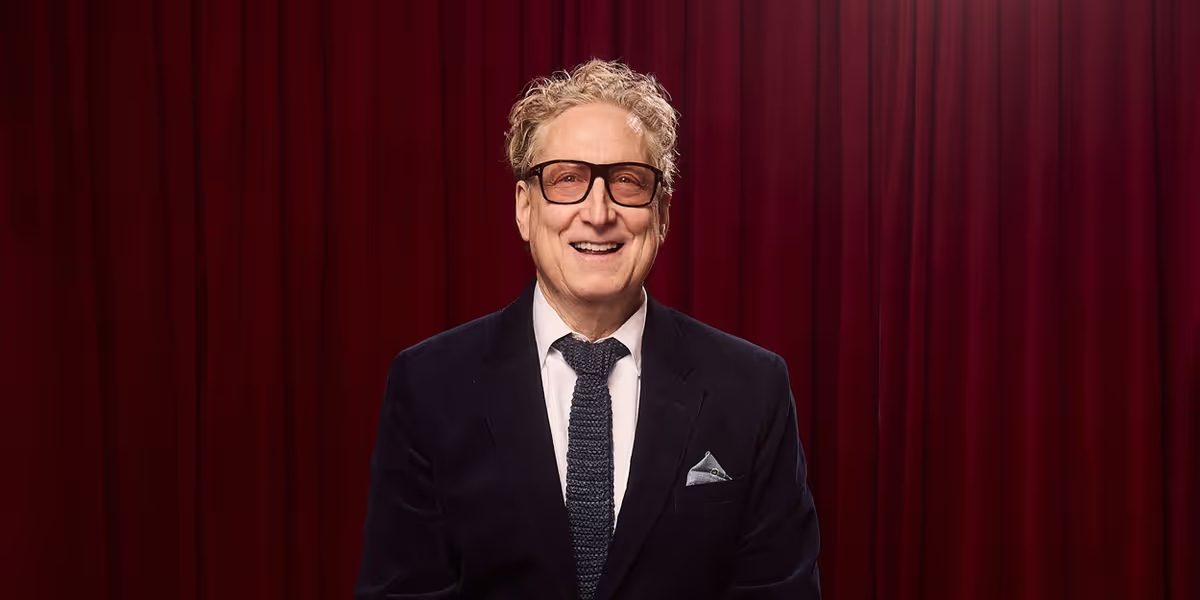
If there were a wizard of casting, it might just be Bernard Telsey. The casting director, along with his eponymous office, has had a hand in creating some of the most iconic acting ensembles in Modern Stage and screen history. The casts for Broadway musicals like Hamilton and TV shows like Only Murders in the Building and The Gilded Age have all been assembled by him and his team.
Indeed, it would be hard to find a theater or moviegoer who isn't familiar with some project touched by his hand. This is particularly true in the current zeitgeist, with the fruit of his labors on the two-part Wicked movie dominating pop culture. Though Ariana Grande and Cynthia Erivo have remained front and center, it was Telsey, along with co-Casting Director Tiffany Little Canfield, director Jon M. Chu, and producer Marc Platt, who began work to create movie magic more than four years ago.
But Telsey doesn't take all the credit. It's the art of the process, and of collaboration that makes it all come together, he says. Now, the casting field is being recognized by the prestigious Academy of Motion Picture Arts and Sciences at the 2026 Academy Awards. 2025 marks the first year of the new Casting category, and Telsey, along with nine other casting directors, has made the shortlist for this inaugural year.
Ahead of the nominations, BroadwayWorld spoke to the casting director about his work on the pair of blockbuster films, his reaction to making it on the shortlist, and how he hopes the new Oscars category will change the way people understand the work of casting directors everywhere.
This interview has been condensed for clarity and length.
Congratulations on Wicked making the shortlist for the Casting category at the Academy Awards. What does that achievement feel like for you and your team?
I'm so happy that so many of the crafts made it on the shortlist, having been working with them on the movie portion for the last four years. Wicked has been in the casting family here since the second reading, which is almost 24 years ago. It's so amazing that it's even happening for the industry and for the profession of casting. To be included is like a dream come true.
It’s kind of famous now that Ariana Grande and Cynthia Erivo hadn’t met and didn’t do a chemistry read before accepting the roles. They have since become such an iconic duo. How often do you see that happen in casting, where a significant casting decision takes place without a chemistry read and then pays off to such an extent as this?
I think this has really paid off. Extremely. I think it's also that the material is about a friendship that pays off. You're following this story of this deep, deep friendship and then to see two artists who that happened to, is what's making it, I think, so popular and so recognizable. But it's like Katharine Hepburn and Spencer Tracy. [After] that first movie that the two of them did, not only the studio, but the audience responded to that at such a high level that it was like, “Let's do it again.” There are a lot of iconic ones, but I think in our modern history, it's been a man and a woman. A love event or whatnot. And to have it be about two women and to see that chemistry is just phenomenal.
We all felt it just from their individual auditions and, Jon Chu being such a genius, would edit the auditions together so we could watch them side by side. You just saw so many similarities in the way they both work. They're both great listeners as actors, and so much about film acting is listening and… allowing what someone else is saying affect you. I think we all see the results in that in the film, but we saw it in their auditions, even reading with Tiffany [Little Canfield], who’s the other casting director.
After a movie is made based on a stage production, some viewers new to the material may see those portrayals as the definitive version of the characters because that’s all they know. How does the release of a film adaptation of a stage show affect how you and your team approach future castings of the characters on the stage?
In the 24 years, anytime somebody came into Wicked [for] one of those two roles [and was] maybe a little different or stood out as being a little special, it always affects the next one and the next one. Not that anyone's going to try to copy anything Ariana or Cynthia did, but they are living beings in the portrayal of Elphaba and Galinda, and that information is going to be brought into whoever's auditioning now.
You're affected so much by what you see Idina Menzel and Kristin Chenoweth do, or Shoshana Bean and Megan Hilty. I could go on and on about people who have made such a huge impression doing those two roles. Wicked's been around so long [that] we're seeing people now and get cast who were nine years old when it first came out… and they're all making choices based on what they've seen and who they've heard do it.
I think, just like the past women affected how Ariana and Cynthia approached the roles, people now will be affected by the way that Cynthia and Ariana have played the part.
In the first movie, of course, there were wonderful cameos from Wicked veterans, most notably Kristin Chenoweth and Idina Menzel. But there have been others as well, some who have played the characters in international productions. Why was it important to bring in those names that have played a part in Wicked’s history onstage?
Idina and Kristin are iconic [and] created the roles. Even 23 years later, they're still working performers who are Broadway icons even to this day, so we had to find a place for them. That was Marc Platt, Jon Chu, and Stephen Schwartz [who said] “We have to write a spot for them to both be in.” The rest was just coincidental.
When we were in London, Tiffany and I were seeing the day players in the small parts. We're seeing actors that we're watching on the West End or that we know from other projects... who were journeymen actors, and we like them, [so] why wouldn't we bring them in to audition?
One of the original Galindas (Alice Fearn) plays Galinda's mom. We had a lot of that. And that wasn't about “Let's do that for the audience,” as it was "Those are great performers." And what a nice thing that Jon loves them, and everyone who's working on the movie loves them. It just so happens they were part of the original company.
I want to ask you about the Oscars Casting category. I know there was a lot of work done behind-the-scenes to make this happen. What was your involvement in the process of working to have casting recognized as a major award category at the Academy?
As casting directors, we were already regular members of the Academy. We became our own branch in 2013, and I was lucky enough to be one of the inaugural governors representing the branch. There were three of us, DAVID RUBIN and Lora Kennedy. Our job as governors is to give back to the Academy and educate or share what it is the casting contributions are in a movie. We work with all creative people who are all part of the board of directors, so people knew who we were. And then, a bunch of years later, after one of our members, Lynn Stalmaster, was able to get an honorary Oscar, it just felt like the time was right.
And then there were three new governors, Debra Zane, Richard Hicks, and Kim Taylor-Coleman, who were the president governors, and they drove it home as far as approaching the Academy. It seems like a no-brainer, but like anything, change is change.
But the Academy was so incredibly supportive. And the BAFTAs, a few years earlier, had a category, and the Emmys have a category. We wanted to do it for our profession, to be recognized as one of the many members who are part of the creative team. I thank everyone at the Academy for listening and encouraging us, and everyone for having the patience. Obviously, people go, "Why did it take so long?" And my answer is “It happened.” And what doesn’t take long?
How do you hope this changes the way casting is talked about?
What I hope will happen is two things. One, that people who really have an eye or an interest in this can now realize, “Oh, there is a profession. It's a real job.” In my own office, I've watched over the years [as] people really want to go into casting. It wasn't just people who gave up acting or gave up directing. It was [those who] wanted to go into casting [and] started following that. I think the visibility of an Oscar... is going to make people take it really, really seriously as a potential job, and that's only going to expand the profession.
They're going to understand that it is a job and a craft and they're artists. Every casting director I’ve met… they're real artists. They're thinking and watching the wonderful talent of actors on a daily, hourly basis. There's a real art to trying to figure out who can be right for what role and getting to collaborate with directors, writers, and producers. I'm hopeful that the more that's written about it and the more that's seen, is that people realize what's behind it.
What is the most rewarding part of the process? Is it seeing the final product or something else along the way?
The most nerve-wracking is watching the final product because you've been away from it for so long. But the most rewarding thing, to me, is that true collaboration with whoever we're working with at the moment: the director, the producer, or the writer. And it changes depending on the kind of project it is. But that collaboration where you're actually able to contribute an idea and a suggestion, and you watch it happen.
When Tiffany and I got hired to do Wicked, of course, you're going to put [Ariana and Cynthia] on a list. It's our job to know who the well-known pop stars, the well-known actresses, the well-known musical theater [performers are.] So, of course, both of those women are on the list. But that's not how they got hired.
They got hired because of the casting process. Because there was an audition process, because they were in the room with one of us, because they were seen by Jon and Marc, because they got direction. Those are the most rewarding moments. Not that I did it, but that the casting, the action of doing the job that we're talking about, is what got them the job. They contributed to the process because it's their talent that got them the job. We contributed to the process. Jon contributed to the process. But the process is what made it happen. And that is what is most rewarding because I love what actors do.
People always say, "How do you sit in auditions all day long and hear the same material all the time?" And it's because you might get it right. There's always only one person to play the part. There are amazing auditions and there are so many great people, but it's always only one that you actually move forward with. And to be part of that and know it came from an idea or an audition is a thrill. I love it.
Photo Credit: Benjamin Rivera
Sign up for all the news on the Fall season, discounts & more...
.jpg?format=auto&width=300)