
Within and Outside the Existing System with Yixin Wang
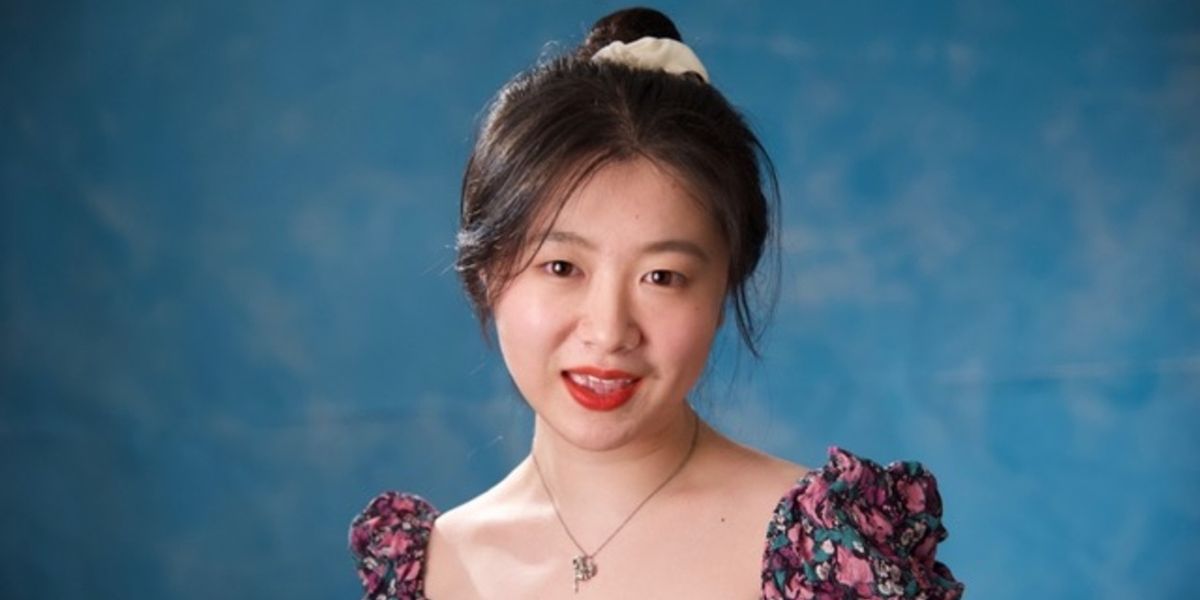
Yixin Wang’s original works have a cross-cultural appeal which speaks profoundly to various parts of the world.
Written by Winston Scott
The term artist has been stripped of much of its meaning through overuse. There are many who practice and perform the arts but few who truly envision and undertake a trajectory that defines them as an original artist. Yixin Wang is one exception to this. Establishing herself as an actress bent on creative exploration rather than following the more common path, her performances often incorporate acting, music, and dance to communicate deep emotional and social concepts. In her estimation, the pursuit of a less traditional approach is a strength rather than a hindrance. Yixin professes, “While many actors follow a traditional path in theater, television, and film, my interdisciplinary route has been intentional and strategically designed. Rather than seeing it as a deviation, I view it as an expansion of what an acting career can be in today’s global performance landscape. It is true that a non-traditional path can present challenges. The industry often prefers clearly defined categories, and my work—at the intersection of acting, movement, and immersive performance—does not always fit neatly into one box. However, this hybridity is deliberate. It allows me to cultivate a distinct artistic voice rather than compete solely within a conventional and highly saturated track.”
Whales in the Bathtub is a prime example of what makes Yixin Wang such a unique and powerful artist. Presented as a part of The Poetry Electric, curated by seven-time Emmy Award–Winner William Electric Black, this piece by Yixin chronicles a young woman’s psychological and physical struggle toward self-liberation. The title functions as a metaphor for the absurdity of containing immense power within restrictive structures—like placing a whale inside a bathtub—while also suggesting the latent force required to rupture confinement. Inspired by the prolonged lockdowns in Shanghai where some communities were quarantined for over 60 days, Whales in the Bathtub visualizes confinement not as abstract politics, but as a lived physical experience. On the surface it is a taped woman escaping a taped box but this simplistic surface wraps around an underlying meditation on control, docility, inherited silence, and the primal instinct toward freedom. This piece foregrounds movement over text, maximizing sensory impact while minimizing spoken language. Originally created as a thirteen-minute immersive multimedia solo performance, Whales in the Bathtub was later adapted into a condensed 10-minute version for presentation at La MaMa. From roaming free to confinement and the attempts to escape bondage, this is a visceral performance which physically manifests the refusal to accept oppressive subjugation by institutionalized powers. While being void of cultural or political orientation, the universal determination for freedom speaks to all who experience Whales in the Bathtub, presenting the possibility for liberation as entry into a more complex and ambiguous reality rather than simply triumphant resolution.
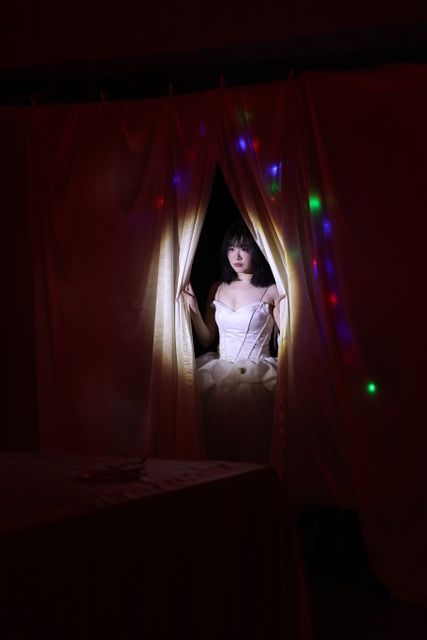
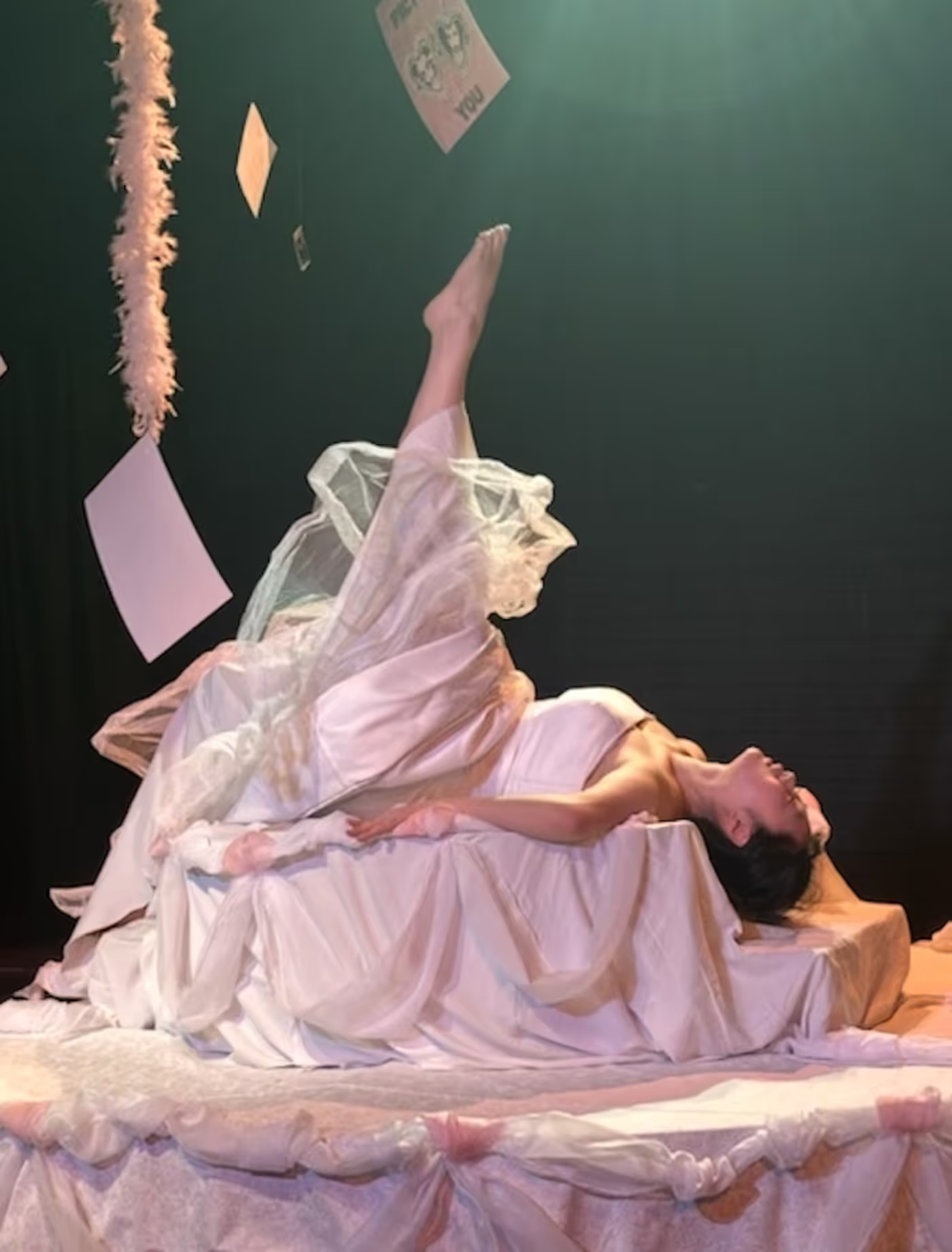
Internationally acclaimed choreographer, scholar, and cultural leader Mark DeGarmo has long admired Ms. Wang’s innovative work and included her original production Are You the Last Slice? as a part of the Mark Degarmo Social Change Salon live-stream event in April of 2025. A statement on the dichotomous state of marriage in present-day, Yixin’s performance uses physical movement—breath, climbing, falling, trembling, resisting—to communicate emotional states rather than relying on long dialogue. A wedding cake represents consumption: not only of food, but of images, ideals, and people. The audience’s participation is intentional. By helping to dress the bride and celebrate her, they become part of the system the piece critiques. While in the beginning, the production aesthetic is intentionally beautiful: soft white tones, elegant costuming, celebratory music, and projection design, it gradually fractures to reveal darker layers underneath. This contrast between elegance and collapse is central to the experience. Throughout the three movements that make up Are You the Last Slice?, Ms. Wang utilizes embodied storytelling to translate abstract themes such as identity, conformity, sacrifice, and collective responsibility, into something physically visible and emotionally immediate. The audience does not just watch the story, they experience their own position within it. The piece was also presented at the Actors Company in Los Angeles.
By design, Yixin Wang’s original works have a cross-cultural appeal which speaks profoundly to various parts of the world. Subtle variations have even provided for these to be presented in a new context. Endless Vow, a reworking of the essence of Are You the Last Slice? was presented at the Czong Institute for Contemporary Art (CICA) in Gimpo, Korea under the leadership of Founder and President of CICA Museum Czong Ho Kim. The installation centered on the wedding dress Wang previously wore in the LA performance of Are You the Last Slice? with the installation’s three-week run being kicked off with a weekend long live interactive performance. Originally pristine, the dress was allowed to degrade over multiple performances to reflect how vows, love, and ideals often begin in purity but gradually change under pressure and reality. The backside of the dress was painted red to indicate a dark and perhaps menacing component that is often hidden. The performance began like a wedding ceremony with the host welcoming the audience as “guests” and asking them to reflect on love and happiness. These audience members wrote or drew their thoughts on sticky notes. When it was time for the bride to appear, she was missing. The host “found” her outside, asleep under a bush — symbolizing innocence and unformed identity. The bride (played by Yixin) was then brought into the exhibition room where the ceremony slowly transformed. Instead of celebrating marriage, the ritual became a lesson on how to be a “perfect woman”: how to wash dishes, hold a baby, and behave gracefully. The audience was invited to place their sticky notes onto the dress and even apply makeup to the bride. Through these simple visual actions of a dress, sticky notes, repetition, and red paint — the work examines how social expectations shape identity, how love can become ritualized pressure, and how sacrifice is often hidden behind beauty. It invites audiences to reflect on the vows we inherit and the systems that quietly define who we are supposed to become. It’s reassuring to know that in both the U.S. and Beijing presentations, there was an overwhelming compulsion by the audience to come to the rescue of the bride. Despite cultural differences, the instinct to protect and rescue was almost identical. The core emotion of empathy was activated in both contexts.
 Yixin Wang finds herself learning alongside different audiences through such performances. Straddling the cultural divide is an inherent position for her as she divulges, “From an early stage in my career, I understood that I did not want to work within a single cultural framework. As a Chinese artist, I carry a background shaped by tradition, restraint, and social structure. At the same time, my artistic voice naturally questions systems, examines identity, and explores collective responsibility. I recognized that to fully develop this voice, I needed to be in a place where experimentation, interdisciplinary practice, and authorship are encouraged on a professional level. The United States offers a unique ecosystem for that. It is not only a global center for film, theater, and performance, it is also a cultural crossroads. As a professional artist working across acting, movement, and immersive performance, I require a space that allows hybridity. In the U.S., cross-cultural narratives are not peripheral; they are part of the mainstream artistic dialogue. Being here has also sharpened my understanding of what I contribute. I am not simply working as an actor within an existing system; I am bringing a perspective shaped by Eastern cultural consciousness into Western performance contexts. That duality allows me to create work that resonates across borders. It gives my practice both specificity and universality.”
Photo Credit: Yixin Wang