


Which Broadway Theatres Have Housed the Most (and Least) Tony-Winning Shows?
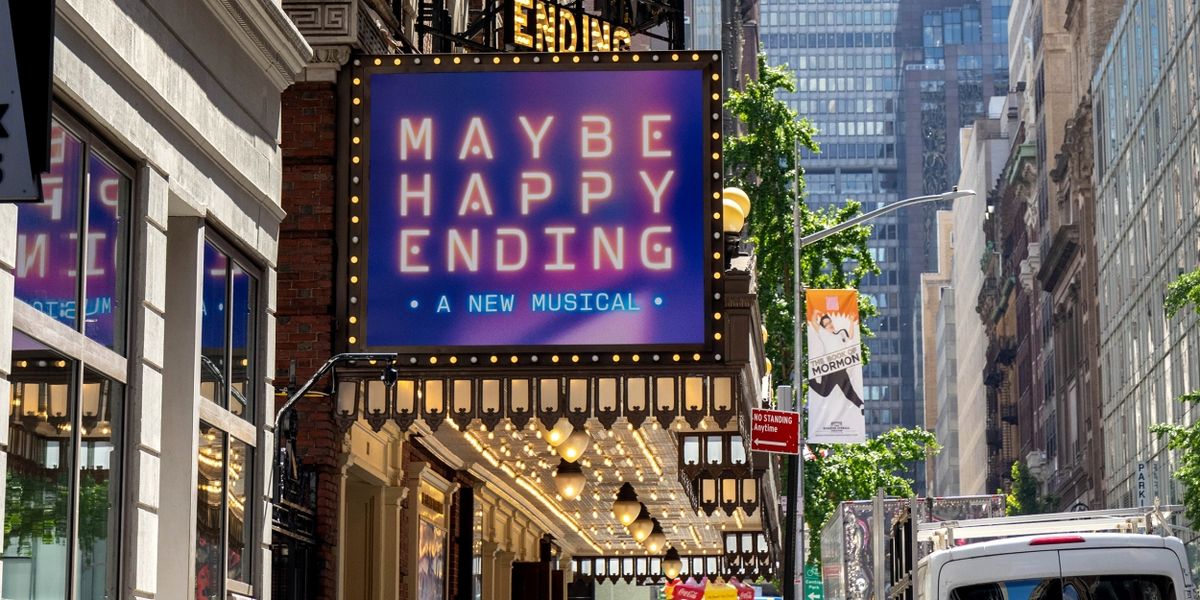
Why was Maybe Happy Ending the first Best Musical Tony Award winner at the Belasco Theatre?
Do you have a burning Broadway question? Dying to know more about an obscure Broadway fact? Broadway historian and self-proclaimed theatre nerd Jennifer Ashley Tepper is here to help with Broadway Deep Dive. BroadwayWorld is accepting questions from theatre fans like you. If you're lucky, your question might be selected as the topic of her next column!
Submit your Broadway question here!
This time, the reader question was: Why was Maybe Happy Ending the first Best Musical Tony Award winner at the Belasco Theatre?
Did you know that the Richard Rodgers Theatre, current home of Hamilton, has housed more Best Musical Tony Award winners than any other Broadway house?
Since the Tony Awards began in 1947 and began issuing a Best Musical Award in 1949, nine Best Musicals have played the Richard Rodgers Theatre, which used to be named the 46th Street Theatre. These are Guys and Dolls (won in 1951), Damn Yankees (1956), Redhead (1959), How To Succeed in Business Without Really Trying (1962), 1776 (1969), Raisin (1974), Nine (1982), In The Heights (2008), and finally Hamilton (2015).
Meanwhile, there have been Broadway houses that for years have never had a Tony Award-winning Best Musical. But what could a show’s theater have to do with its ability to win the Tony Awards’ top prize? Does the theater that a show is housed in affect the success of that show?
In the 21st century, with Broadway theaters always in demand and more productions than can be accommodated by the existing houses, obtaining a Broadway house is a producer’s competitive sport. Obviously, there are specific considerations when it comes to placing a show in the correct house (not that most producers have their choice of house, of course!). But beyond the specifics that might lead Kimberly Akimbo (2023), for example, to play the Booth instead of the Palace, prevailing industry sentiment is that there are three main aspects that make a theater desirable.
The first is location. For many years, the theaters on the east side of Broadway have been referred to as being on the “wrong side” of Broadway. Location can impact the ongoing success of a show. Being in an off-the-beaten path area, like the James Earl Jones Theatre, which is close to 6th Avenue or the Nederlander, which doesn’t share a block with any other theaters and is the southernmost house, means no foot traffic from potential customers that might be seeing another show or traveling through Times Square otherwise. If the average ticket buyer doesn’t see your marquee on the way to seeing another show, they are less likely to think of your show. Theater location is one of the most valuable forms of advertising a show can have.
The extreme version of this has been shows that literally pick up the business of their sold out neighbors. For example, the original Broadway production of Spelling Bee at Circle in the Square benefitted greatly from audience members who couldn’t get into Wicked walking over to their box office next door. The heavily theater-populated 45th Street often finds ticket buyers who can’t get into one show going to another within view instead. On 46th Street, the Richard Rodgers has benefitted from being in viewing distance of the center of Times Square and right in the middle of the theatre district.
Theatre layout also makes a big difference in terms of the success of a show. The Richard Rodgers is one of our only Broadway theaters with a raked auditorium, i.e. one that slopes upward. While this may mean some intense vertical sight lines for those seated in the rear orchestra, it mainly results in a higher percentage of “good seats” throughout the entire theater. When a seat has a high quality sight line, it can be sold for more money and it also makes for a happier customer.
Related to theatre layout, the Richard Rodgers also has only two levels: an orchestra and a mezzanine. Broadway theaters without a third level, a balcony, are more coveted since these shows don’t need to sell a slew of less attractive seats that bring up their capacity while bringing down their average ticket price and ability to create scarcity. The theaters with a large amount of seating distributed to the orchestra section are more desirable. A better layout often means better grosses.
The success of shows at certain theaters is created by a bit of a Catch-22. Often, the most anticipated shows helmed by the most successful producers have the power to obtain the most coveted theaters. In this way, a presumed hit might be able to get the Rodgers while a likely flop might only be able to get the Longacre. While of course no production’s trajectory is given, this kind of system is part of what has resulted in some theaters having more Tony Award-winning hits than others. Just as Bob Fosse, Gwen Verdon, and their team wanted to return to the Rodgers with Redhead after their success with Damn Yankees, Jeffrey Seller, Lin-Manuel Miranda, and their team wanted to return to the Rodgers with Hamilton after their success with In The Heights. That said, sometimes renting the Rodgers has been a coup resulting in unanticipated achievement, such as when the unlikely 1776 became an unexpected hit.
Lastly and separate from theatre layout, theatre size overall has an impact on whether a theater is considered desirable and on the overall success of shows that play there. Modern behemoths the Gershwin and the Minskoff had trouble finding hit shows until their current tenants, Wicked and The Lion King (1998), came to stay. (Worth noting is that Wicked did not win Best Musical; the Gershwin’s only Best Musical winner is Sweeney Todd (1979), which reportedly did not recoup during its original Broadway run. And The Lion King did not originally open at the Minskoff but at the New Amsterdam; the Minskoff’s only Best Musical winner is Sunset Boulevard (1994) which did not recoup during its original Broadway run.)
For many years, the smaller Broadway houses that were widely considered play houses didn’t host many hit musicals because the few musicals that played there were smaller, accordingly. For decades this made them less likely to be the season’s big winner even if some were outstanding in their own right. So, the majority of musicals that were most likely to win Best Musical gravitated toward houses, if they could win them, that were somewhere in the middle—like the Rodgers with its roughly 1,300-seat capacity.
But history is always waiting to be made. Fun Home (2015) was the first musical to win Best Musical at Circle in the Square, after more than 40 years as a Broadway house. More recently, in the past decade, The Band’s Visit (2018) was the Barrymore’s first Best Musical, A Strange Loop (2022) was the Lyceum’s, and Kimberly Akimbo (2023) was the Booth’s. While those theaters have hosted Broadway shows since the advent of the Tony Awards, they were mostly considered play houses for many years, with more rarer new musical bookings. It is only in recent years that the smaller sized musicals that might fit in the smaller sized Broadway theaters have more frequently been walking away with the season’s big prize. Dear Evan Hansen (2017) was also the first Best Musical winner at the Music Box, but it might have beaten Maybe Happy Ending to be the first Belasco Theatre-housed winner, had it opened at the Belasco, as was originally announced.
Ten of our current Broadway theaters have never housed a Best Musical winner, fifteen theaters have had only one, and yet the Rodgers has had nine! And notably, second place is a tie between the St. James and the Shubert, which have each had five. The Rodgers circumstantially wound up with several Best Musical winners with runs on the shorter side, while second place holders the St. James and Shubert wound up with winners that stayed put for many years, like Hello, Dolly! (1964) which spent seven years at the St. James and A Chorus Line (1975) which spent fifteen at the Shubert. This meant those theaters were off limits to new shows.
Also notable is that historically, four of our Best Musical Tony Award winners played Broadway theaters that are no longer. The Tony Awards’ first Best Musical winner, Kiss Me, Kate (1949), played at the New Century, a large Broadway theater at 7th Avenue and 58th Street, right near Central Park. In fact, the building was originally the Central Park Riding Academy. Known for opening with Al Jolson and being the subversive home of The Cradle Will Rock after it marched uptown, the New Century was destroyed in 1962.1957’s landmark Broadway hit My Fair Lady opened at the Mark Hellinger Theatre, which is now the Times Square Church. [link] Kismet, which won the Tony in 1954, found its home at the glorious Ziegfeld Theatre, a lavish spot on 54th Street and 6th Avenue that was also home to the original Show Boat a few decades prior. Like the New Century, the Ziegfeld was demolished in the 1960s to make way for a glass skyscraper as well. Finally, in 1966, Man of La Mancha won Best Musical while it was playing at the ANTA Washington Square, a makeshift industrial theatre space that was once where NYU’s Stern School of Business is today.
Maybe Happy Ending became the Belasco’s first Best Musical winner this year. In its 118 years as a Broadway theater, the Belasco has been home to only 15 new musicals, including Maybe Happy Ending. Only 12 of these were during the reign of the Tony Awards. Of those that opened during the Tony Awards, only four were nominated for Best Musical (Maybe Happy Ending, Girl From The North Country, Passing Strange, and James Joyce’s The Dead), and none were financial hits. For years, the Belasco was used for plays more than musicals, due to its size and layout. Because of its location, it has not been a coveted musical house.
The Belasco is a magnificent Broadway theater, created in splendor by the eccentric impresario David Belasco in 1907. Its ghost stories are legendary, its interior is sumptuous, and theatergoers get to enjoy historic murals, Tiffany lighting fixtures, and a ceiling of stained glass panels that is awe-inspiring. And yet, its location, size, and third level have kept it out of the running for major musical hits for so long. Maybe Happy Ending changed its history when it won Best Musical in 2025.
The Lyric, Haimes, Sondheim, Hudson, Hayes, Jones, Horne, Friedman, Ambassador, and Studio 54 are all yet to have a Best Musical winner. Could next season be their time?
In the cases of the Lyric, Haimes, Sondheim, Hudson, Friedman, and Studio 54, those theaters have only been Broadway houses for a fraction of the time that the Tony Awards have existed. And additionally, with the Haimes, Sondheim, Friedman, and Studio 54, those theaters are now owned by non-profit companies who rarely produce or rent their theaters out to new musical productions. The Hayes, Jones, Horne, and Ambassador don’t have any such excuse, although the Hayes rarely hosts musicals, with only seven new musicals opening there in the last 40 years. Additionally, the Hayes is now operated by Second Stage so like the theaters above that are operated by Roundabout or Manhattan Theatre Club, they are unlikely to program a new musical. The Ambassador has been tied up with Broadway’s Chicago revival for over 20 years and this shows no sign of changing any time soon.
This leaves the James Earl Jones Theatre and the Lena Horne Theatre. Is it finally time for their big Best Musical winner hits? The Horne is currently home of Six, so it’s off the table for now. The Jones has no spring tenant announced yet, so who knows?




Comments
To post a comment, you must register and login.