


Review: THE WANDERERS, Marylebone Theatre
Anna Ziegler’s acclaimed play transfers to London, but is it really as powerful as they say?
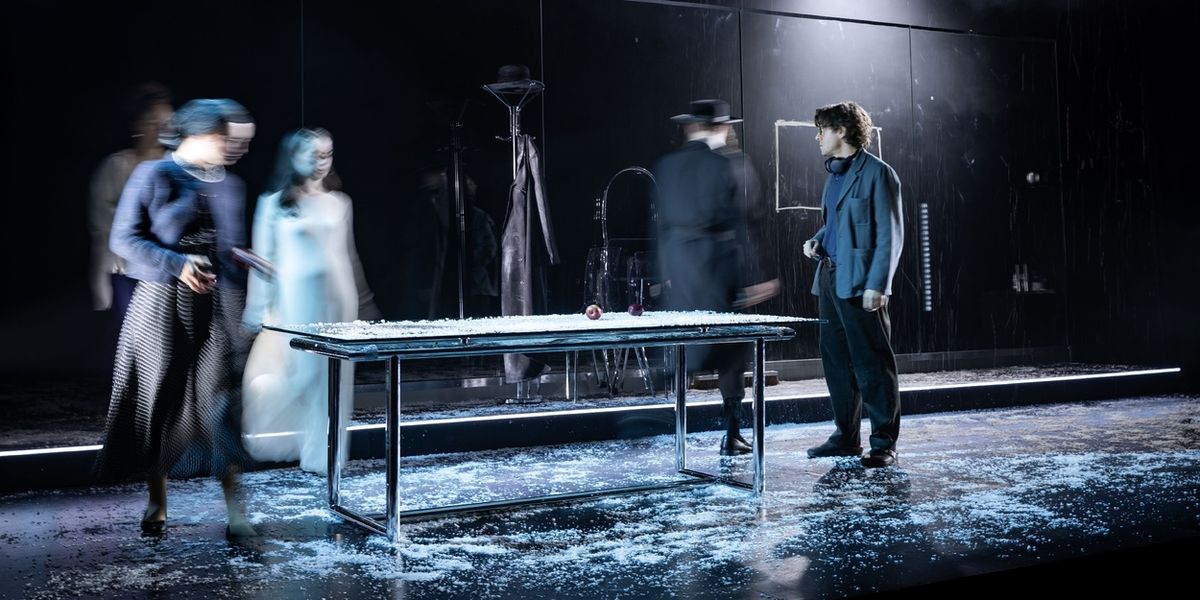
 Two Jewish couples and a big-time Hollywood diva are intrinsically connected in Anna Ziegler’s play. The plot runs on two tangents. Esther and Schmuli: Orthodox Jews from Brooklyn; Schmuli cares deeply about tradition, while Esther is a curious person by nature. Sophie and Abe: secular authors with different degrees of success between them; Abe intellectualises their lives and uses their cultural background as an accessory, while Sophie finds it hard to write a new book.
Both relationships instantly come off as deeply flawed. Enter Julia Cheever, LA starlet and admirer of Abe’s work. They fit like pieces of a puzzle to create a jagged picture of Abe’s “American Jewish experience.”
Director Igor Golyak transfers his acclaimed production (which originally starred Dawson’s Creek-favourite Katie Holmes as Julia) across the pond. Most known for the 2015 Nicole Kidman-led hit Photograph 51, Ziegler’s project is a slow-moving and imposing reflection on heritage, legacy, and inherited trauma. More transpires, and it’s not all positive. A vibrant current of misogyny (conscious and unconscious) runs through it, as well as a fairly problematic take on working mothers.
%20Alexander%20Forsyth%20as%20'Abe'%20and%20Paksie%20Vernon%20as%20'Sophie'%20-%20C)%20Mark%20Senior.jpg?format=auto&width=800)
Abe controls the narrative throughout. The stagecraft is playful and creative, with Golyak establishing a specific visual identity: the characters (mainly Abe) draw with liquid chalk on a large see-through screen and other surfaces designed by Jan Pappelbaum, introducing circumstances and events. From drawing a radio and using it to turn music on to sketching a rose to make it appear, it’s this peculiarity that makes the show what it is. Abe also divides the story into chapters – he is, after all, a writer.
Esther and Schmuli’s world – prescriptive, chauvinistic, and extremely conservative – clashes with Abe’s. He constantly watches on; his visions start by being endearing but swiftly turn tragic. While the old-timey tangent develops into a patriarchal nightmare for Esther. Whether subconsciously or not, those values are reflected by Abe in his own marriage to Sophie, who’s mixed-race and only half Jewish (something that Abe pretends not to be too hung-up on). This never fully tips into overt discrimination, fortunately.
%20Katerina%20Tannenbaum%20as%20'Esther'%20%26%20Eddie%20Toll%20as%20'Schmuli'%20(2)%20C)%20Mark%20Senior.jpg?format=auto&width=800)
He does, however, perhaps instinctively, try to coax Sophie into not writing and act like he thinks his mother should have had to in order to keep his family together. He might see this as the solution to prevent his household from collapsing in the face of his adultery and fading attraction to his wife. His disconnect is exacerbated by his attachment to Julia, with whom he starts an epistolary affair. It all builds up, and the processing of his anguish ends up being at the expense of his spouse.
Unfortunately, none of the topics are expanded, excavated, or analysed in any way. We are presented with two storylines that intersect and influence each other. It’s difficult to side with Abe as he self-victimises without restraint. But he is the Man, and as a Man he shall be the protagonist, even though his wife is far more interesting than he is. That is also true for Esther, when compared to Schmuli, but we at least get to know her more than Sophie.
%20Alexander%20Forsyth%20as%20'Abe'%20%26%20Anna%20Popplewell%20as%20'Julia'%20(2)%20C)%20Mark%20Senior.jpg?format=auto&width=800)
The cast is exceptional. Alexander Forsyth is contemplative and sombre as the tortured author, while Paksie Vernon is simply magnetic as Sophie. Exasperated, disillusioned, and heartbroken, she materialises the chasm between them until it becomes the elephant in the room. She blooms when Sophie finally stands up to the gaslighting chitchat Abe gives her. Anna Popplewell is an ethereal apparition, leaning into Abe’s fantasy. She and Forsyth gently chase one another in a waltz, often divided by space or props. Golyak toys with this quite a bit here, using the changes in distance between the bodies to indicate their state of mind.
Katerina Tannenbaum and Eddie Toll complete the company as a darkly delectable pairing. She is especially impressive and heartbreaking as the greatly inquisitive and caring woman. As Esther outgrows the rules of their community, she turns more vocal. We pity her enormously, and so does Ziegler. Toll, on the other hand, is positively frustrating. Schmuli refuses to hold his newborn daughter because he doesn’t know if it’s appropriate before he gradually edges towards spiritual violence and coercion.
%20Alexander%20Forsyth%20as%20'Abe'%2C%20Katerina%20Tannenbaum%20as%20'Esther'%20%26%20Eddie%20Toll%20as%20'Schmuli'%20C)%20Mark%20Senior.jpg?format=auto&width=800)
It’s an extensive rumination on family, Jewishness, marriage, and the boundaries of emotional infidelity, but it neglects the nuances and peculiarities of the characters, who ultimately remain two-dimensional figurines with very little identity. The narrative is severely self-indulgent, without as much scope or aim as it believes it's offering. It exploits womanhood for the benefit of its male protagonists and under-analyses the consequences of their actions. The direction and company are remarkable, but each element suffers the material.
The Wanderers runs at Marylebone Theatre until 29 November.
Photo Credits: Mark Senior
See more BroadwayWorld in Google
Our stories show up more often in Top Stories and Google’s AI answers.
Breaking Broadway alerts by text
Get the biggest stories sent straight to your phone.
Sign up for all the news on the Fall season, discounts & more...







Reader Reviews
To post a comment, you must register and login.