

Review: THE TEMPEST, Shakespeare’s Globe
Tim Crouch directs a metatheatrical take on the Shakespearean comedy
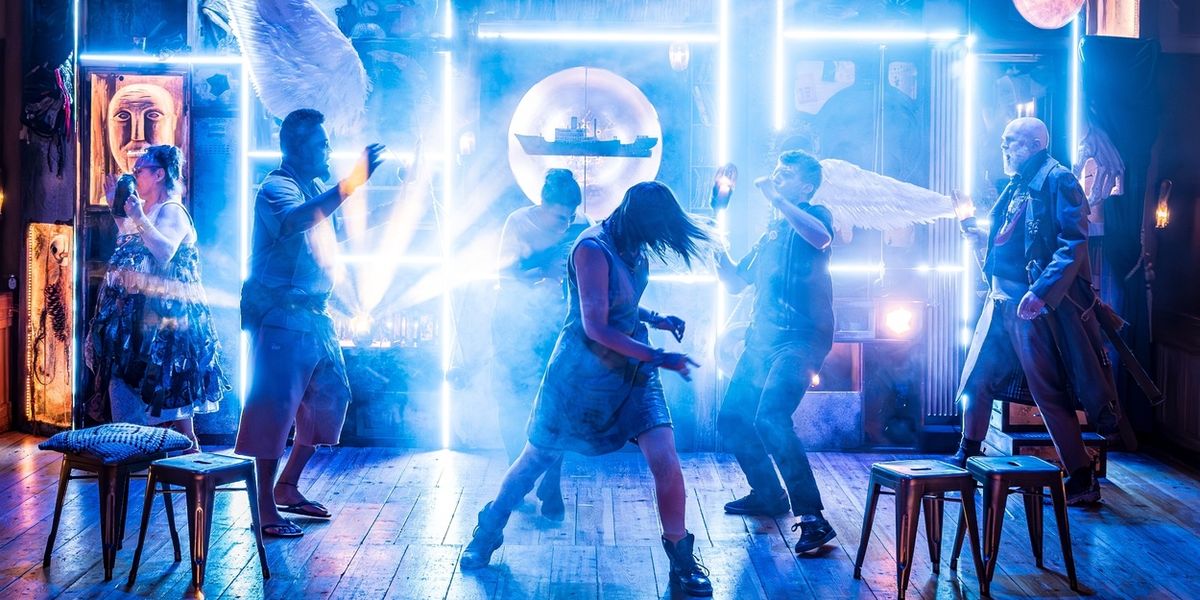
 Of all of Shakespeare’s plays, The Tempest is perhaps the most metatheatrical: the plot takes place in real time, almost everything that happens onstage has been conjured up by the sorcerer Prospero, who asks the audience at play’s end to “free” him with their applause. So who better to direct a new adaptation than the king of theatrical deconstruction himself, My Arm and An Oak Tree writer Tim Crouch?
The most obvious metatheatrical conceit on display here is that, like in Crouch’s 2009 play The Author, much of the cast is sitting in the audience. As Prospero begins to enact his revenge on those who usurped him as the Duke of Milan by engineering a shipwreck, he gradually summons them to his desert island from their seats. Prospero’s traitorous sister Antonia (Amanda Hadingue) and her crew proceed to clamber through the audience, take phone calls onstage and don the lanyards of Globe staff. They even mill around in character during the interval.
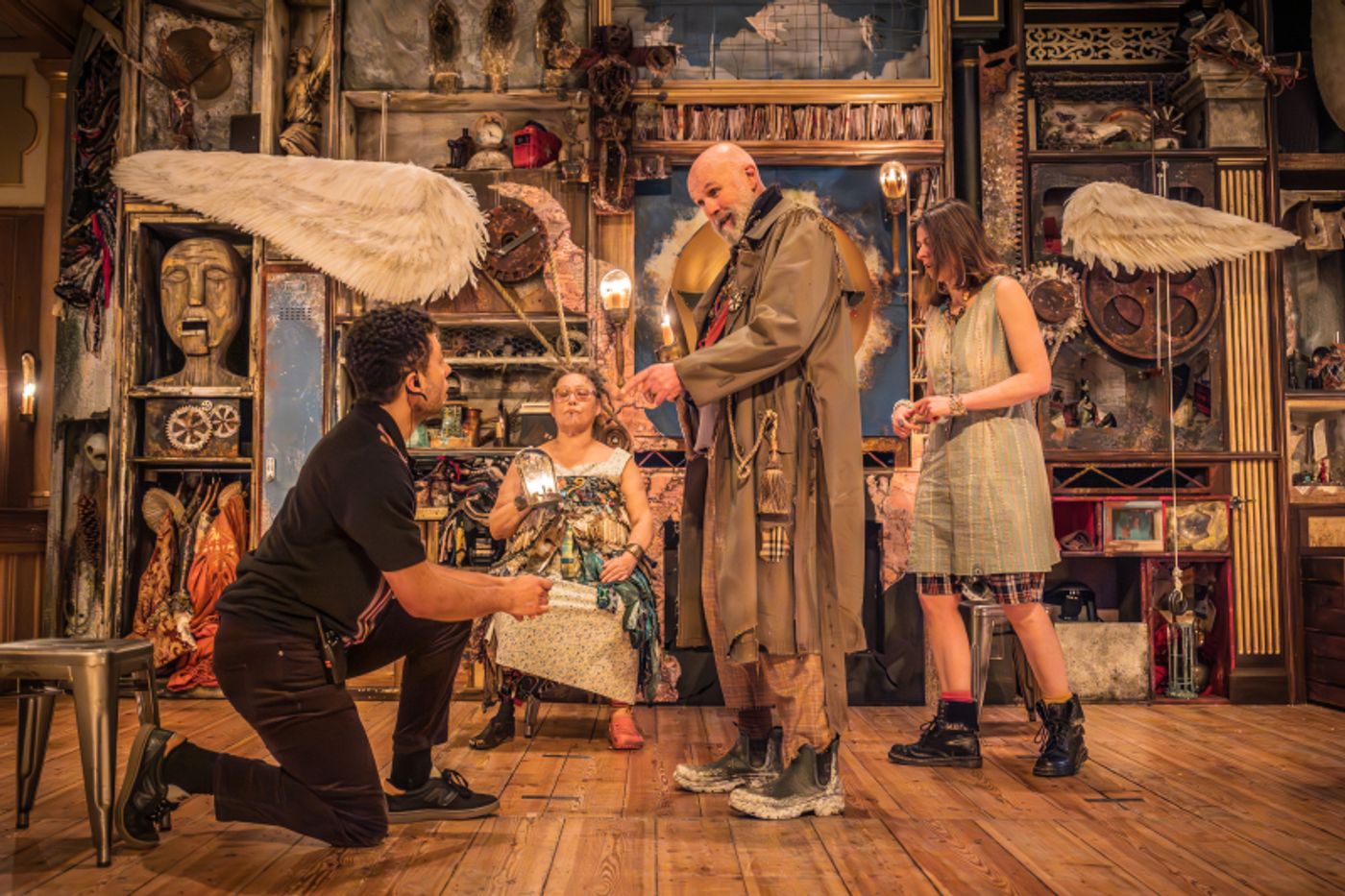
Photo credit: Marc Brenner
Unlike in Crouch’s previous work, though, this device is not solidly rooted in the text. Rather than reflecting on the shipwrecked crew’s lack of agency, or on how they feel about being trapped in a play, this production simply states that they’re outsiders and stops there. With the main comic relief characters, Stephano (Patricia Rodriguez) and Trinculo (Mercè Ribot), the ‘joke’ mainly seems to be that they’re tourists who speak with Spanish accents and use the word ‘arriba’ instead of ‘up’.
Somewhat more effective than these cheap hijinks is Crouch’s sensitivity when it comes to the act of storytelling. Our four leads – Prospero (played by Crouch himself), plus his daughter Miranda, and the island’s enslaved residents Caliban and Ariel – act more as narrators than as characters. In the enchanting opening scene, our quartet light candles and place effigies to initiate the shipwreck, before leaping into a lively repartee narrating the revenge plot to come, finishing each other’s sentences and picking up where one another left off.
Crouch has an interesting idea here, but hasn’t explored it to its full potential. The uneasy dynamic between Prospero, his daughter and the people he has enslaved is clearly at the play’s core, but because it is so enamoured of The Tempest as a commentary on theatre itself, this version fails to consider why these characters might want to craft competing personal mythologies.
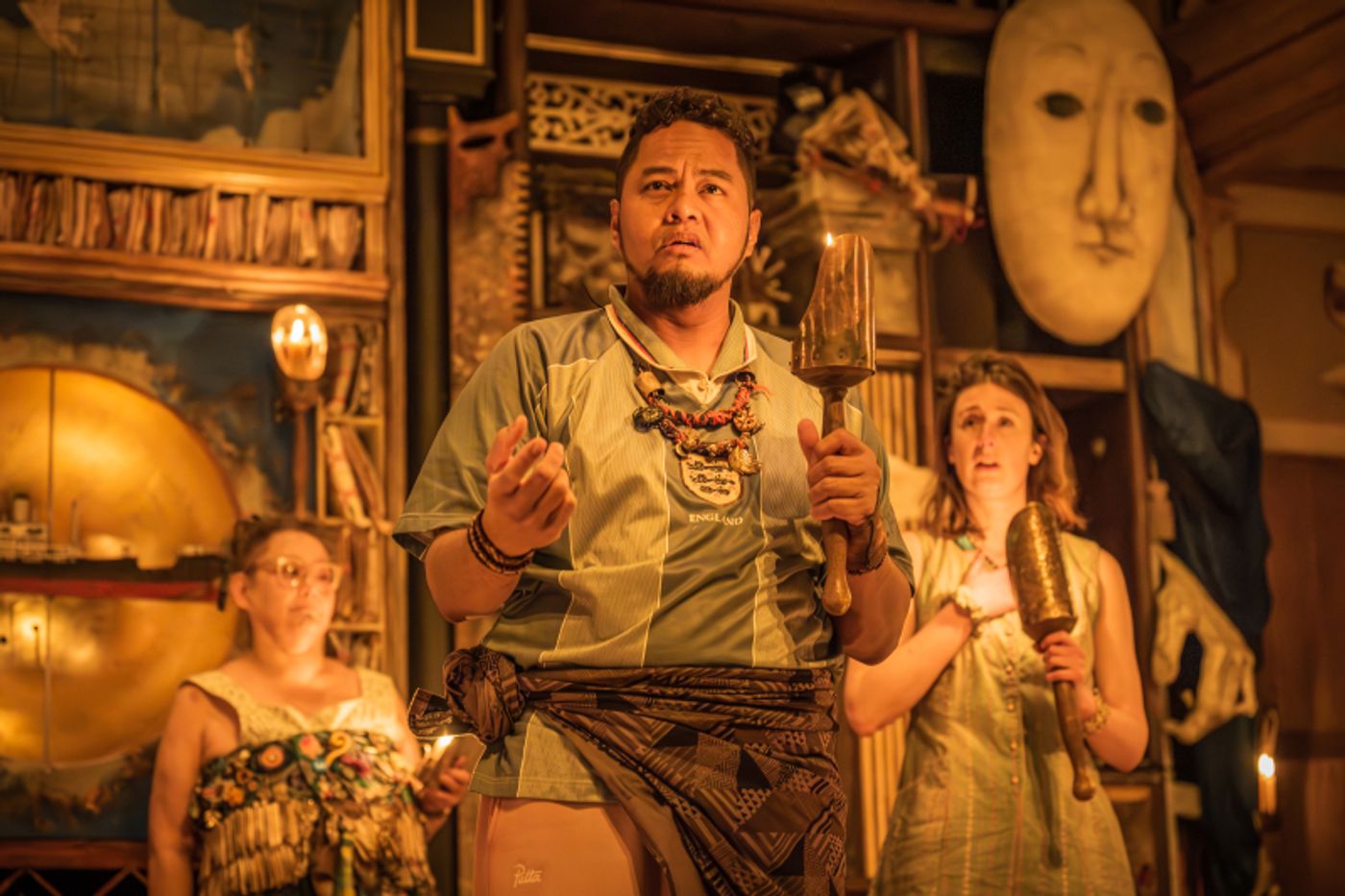
Photo credit: Marc Brenner
This is a particular shame for Faizal Abdullah’s Caliban – the Malay-Singaporean actor performs some of his character’s dialogue in Malay, and the production leans into the post-colonial flavour of lines like “this island’s mine”, but only ever superficially touches on the idea of a character using narration as an act of resistance. The subtly acted moment of vulnerability from Prospero in the final scenes, meanwhile, when he seems suddenly in thrall to his former subjects, feels hampered by a failure to explore these relationships properly earlier in the play.
Other than in that final scene, Crouch’s take on Prospero as an actor oscillates oddly between omniscient neutrality, like an all-seeing god, and tyrannical fits of rage. Sophie Steer’s Miranda also feels at odds tonally with the rest of the production, choosing wry, bawdy humour over the character’s usual naivety and sense of wonder, to the point where her character, who could have been a study in women with sheltered upbringings, instead feels like a caricature.
Where the direction and interpretation of the play falls flat, other elements soar. Set designer Rachana Jadhav’s work is a kind of hybrid of West African spirituality and steam punk (and a few striking LED lights), that evokes folklore, escapism and the unknown all at once, all of which should have been evoked by the production as a whole. The otherworldly harmonies in Orlando Gough’s haunting soprano duets give a similar sense, that we the audience are being transported past the fourth wall.
There is clearly a rich seam for Tempest adaptations that engage with the text’s metatheatrical qualities, and this kind of adaptation could easily bring out the play’s feminist and post-colonial undertones. But this version spends too much time on drawing out every possible element of metatheatre, and not enough on what those elements might mean.
The Tempest plays at the Sam Wanamaker Playhouse at Shakespeare’s Globe until 12 April
Photo credits: Marc Brenner
Reader Reviews
Videos