


Review Roundup: Conor McPherson's THE WEIR Returns to Irish Rep
The production is directed by Ciarán O’Reilly.
 Click for Tickets
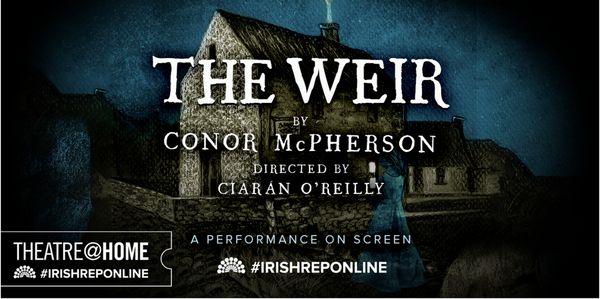
This summer Irish Rep brings back The Weir by Conor McPherson, directed by Ciarán O’Reilly. A longtime Irish Rep favorite, this marks the company’s fourth staging of The Weir, following acclaimed runs in 2013 and 2015, and a 2020 digital adaptation. Read reviews for the production.
In a remote country pub in Ireland, newcomer Valerie finds herself drawn into an evening of ghost stories shared by the local bachelors who gather there to drink. With the wind howling outside and a hint of tension in the air, what begins as playful blarney soon drifts into the supernatural realm when Valerie shares her own haunting tale.
The cast of The Weir includes Dan Butler as Jack, Johnny Hopkins as Brendan, John Keating as Jim, Sean Gormley as Finbar, and Sarah Street as Valerie.
 Juan A. Ramirez, New York Times: The production’s entire creative team, along with some of the cast, are return players, but there’s not a whiff of trotting out the same old. Instead, they render the play’s talkative yarns as heartily as a few rounds with old friends. That sense of familiarity (and the awareness that they are such close-knit revivers) even helps the play, which is essentially a hangout piece with a hazy supernatural charge.
Charles Isherwood, The Wall Street Journal: Although ‘The Weir’ is nominally a play focused on tales from the crypt, it’s more broadly and movingly a study in loneliness: how it grows upon you, how it can be soothed by the company of even casual friends and acquaintances met by chance, and how it can and probably will sidle into the lives of just about everyone at some point.
Michael Sommers, New York Stage Review: Amidst this persuasive environment, a superb company of five actors delivers believably natural performances as their characters talk of supernatural matters and issues relating to existence in a lonely place. Sparked by Dan Butler, whose character’s peppery manner conceals inner regret, the ensemble brings to life an exceptional play handsomely staged in a nice 148-seat theater, and that’s about as solid an Off Broadway experience as anyone can wish for this summer.
David Finkle, New York Stage Review: The effect of these sequences is an audience-gripping silence... a silence that threatens to halt breathing, a silence during which not even a single cough breaks through, a silence worth the admission price.
Thom Geier, Culture Sauce: Ever since its 1997 debut in London (followed by a successful Broadway run two years later), Conor McPherson’s intimate drama The Weir has been hailed as a modern masterpiece. And rightly so. The play, now getting a pitch-perfect revival at the Irish Repertory Theatre under Ciarán O’Reilly’s direction, celebrates the elemental pleasures of storytelling.
 Marc Miller, Talkin' Broadway: They're likable characters, they tell beguiling spooky little yarns. But what large truths are being revealed, what is there beyond a pleasant slice-of-life nod to the traditions of Irish storytelling? In those elements, it lacks weirwithal.
Alix Cohen, Theater Pizzazz: The play is an old friend to habitués of Irish Repertory Theatre, including myself. This is its fourth incarnation. Dan Butler peppers conversation with well honed barbs and reveals Jack’s sensitive side with finesse. John Keating is beautifully low key. The actor could give lessons in listening. Sean Gormley’s Finbar has just enough ego to separate himself, but the performer keeps him likeable. All have repeatedly played these roles. Camaraderie is organic.
Stanford Friedman, Front Row Center: Four Irishmen and a lass walk into a bar and tell some ghost stories. No joke—that, in short, is the premise of Conor McPherson’s atmospheric drama, The Weir. Set in a pub in 1998 rural Ireland and consisting primarily of monologues, the work does not so much have a beginning, middle, and end as it has a beginning and five middles. Irish Repertory Theatre director Ciarán O’Reilly calls on a veteran cast to make the play palatable, and they do not disappoint, together offering an engaging interpretation of a piece that, if structurally curious, at least features the three pillars of any good Irish play: loss, regret, and loneliness.
Average Rating: 85.0%
- To read more reviews, click here!
- Discuss the show on the BroadwayWorld Forum

|
Powered by

|






Reader Reviews
To post a comment, you must register and login.