


Review: DA VINCI CODE - SAKRILEG at National Tour, Germany
Spectacle, puzzles, intrigue - and captivating visuality: Dan Brown’s blockbuster thriller reimagined for the travelling stage
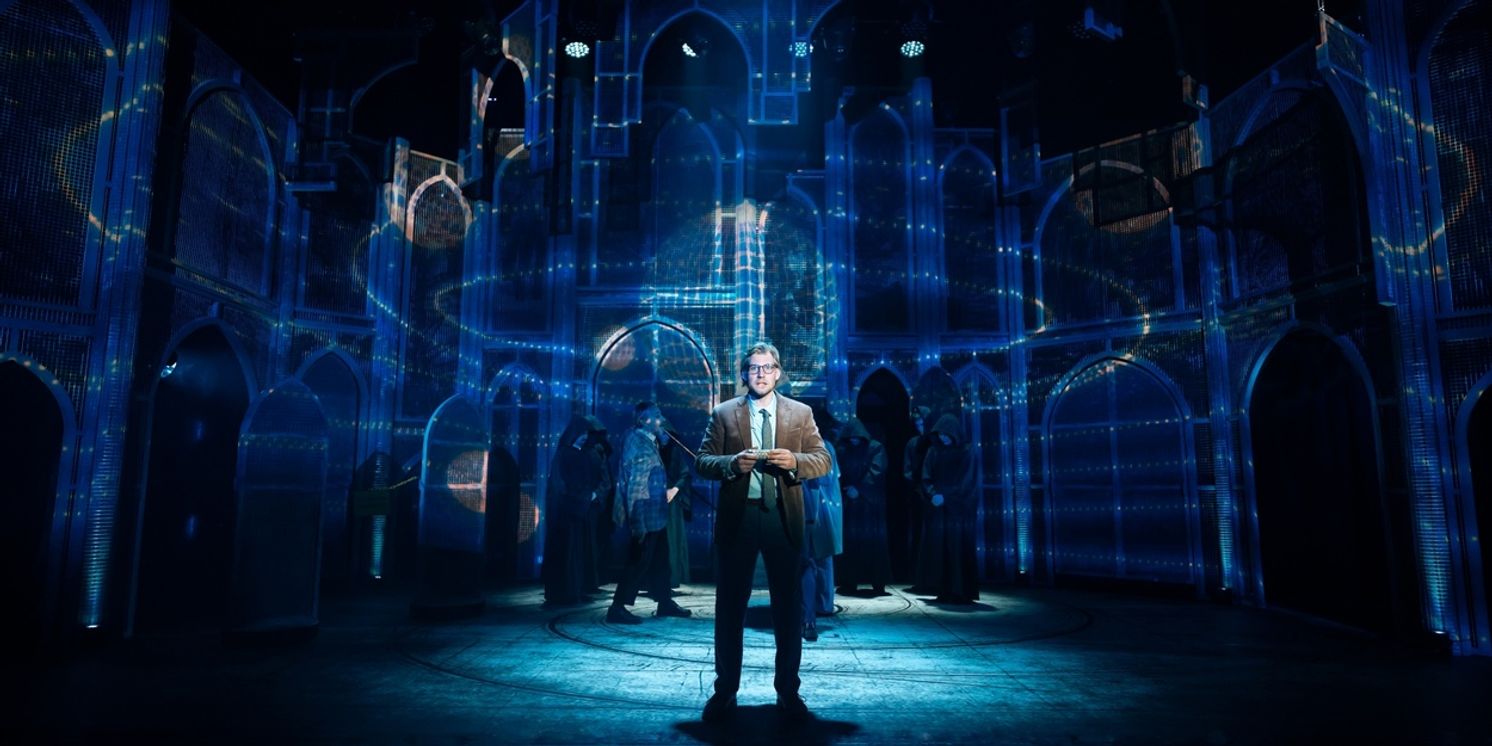
The touring company Showslot—best known for its high-end musical productions—has now brought Dan Brown’s thriller “The Da Vinci Code” (published in Germany as “Sakrileg”) to the travelling stage, following its adaptation of “Murder on the Orient Express”. With striking visual flair and a brisk, dynamic narrative style, the production scores highly, delivering an evening of suspenseful and thoroughly entertaining theatre.
Brown’s breakout novel—later adapted into a Hollywood film starring Tom Hanks, Ian McKellen and Alfred Molina alongside French stars Audrey Tautou and Jean Reno—became a global phenomenon and remains one of the most widely read novels among Germany’s historically inclined readership. Its popularity clearly endures, as evidenced by the strong ticket sales for this thriller play, which celebrated its premiere in Frankfurt. The stage adaptation by Rachel Wagstaff and Duncan Abel has already been performed in both the UK and the United States.
With an entirely new staging and a German translation by Katharina Carl and Dominik Hafner, director Christoph Drewitz takes on the complex source material—hardly the most accessible fare for a mainstream audience. The story follows symbologist Robert Langdon, who becomes entangled in a mysterious death case and embarks on a search for nothing less the Holy Grail “it”self. Alongside his fateful companion Sophie, he uncovers the hidden nature of Christianity and encounters both pagan and sacred secret societies. From Paris to Versailles, on to London and back again, the turbulent journey leads to the (entirely fictional) origins of Jesus Christ. Such a narrative demands tight scene management, focused character direction, and a significant dramaturgical pruning of Brown’s sprawling original. To compress the thriller epic into two and a half hours while preserving narrative clarity, suspense and dramatic momentum is no small feat—and Drewitz rises to the challenge with remarkable skill.
The propulsive score by Julius v. Maldeghem, given physical form through the choreographic sequences of Bart de Clercq, drives the narrative forward and ensures that even the long, information-dense dialogues never lose their momentum. The audience, however, must remain highly attentive—familiarity with the story certainly helps to loosen up a little. Fans of the novel will notice several omissions: the Opus Dei bishop Aringarosa, a central figure in the book, is absent; the religiously manic monk Silas appears somewhat less monstrous without some of his darker deeds; and the true antagonist—revealed on stage through the story’s famous twist—feels less omnipresently threatening than in the novel. Naturally, the stage cannot replicate the depth of the book or the same level of emotional identification with its characters. Nevertheless, the creative team succeeds in bringing a genuinely affecting story to the stage, even if the final resolution feels somewhat rushed.
Adam Nee’s set design, in symbiosis with Jack Weir’s lighting, proves outstanding. Cinematic images unfold in rapid succession, each one gripping and visually impressive. Through the use of cutting-edge projections, dramatic tension is heightened, parallel plotlines are interwoven or presented simultaneously, flashbacks are integrated into the unfolding action, symbolic motifs are clarified, and locations shift at breathtaking speed. All of this plays out against the static backdrop of Gothic architecture, which convincingly transforms itself into the Louvre or the church of Saint-Sulpice in Paris, London’s Temple Church or Westminster Abbey, and even a Renaissance château near Versailles. The immersive sound design by Dennis Heise, the meticulously synchronised projection and lighting programming by Tom Young and Tom Lee, the video design by Medime Dereby, and the video programming by Judith Noll and Daniel Rohrbach interlock seamlessly. Together they render even the story’s intricate riddles visually comprehensible—a grand spectacle on an impressively high technical level.
The sixteen-member ensemble performs with palpable energy, slipping fluidly between multiple roles. As a group of hooded figures in monastic robes, they function as almost mime-like apparitions who accompany and visually trace the story’s unfolding. Lucia Schulz appears as the resolute Swiss banker Vernet, while Susanna Panzner delivers an intense and passionate performance as Sister Sandrine—whose fate, unlike in the novel, proves rather less grim. The police duo Collet and Fache are convincingly portrayed by Christoph Bangerter and Dave Wilcox, though the production somewhat downplays the sense of constant pursuit by the authorities.
The central pair of protagonists is portrayed with convincing authenticity by Hannes Levianto as Robert Langdon and Helena Charlotte Sigal as Sophie Neveu. Levianto’s interpretation differs markedly from both novel and film: the near-heroic professor becomes, in his hands, an endearing history nerd swept along by events. Sigal dominates the narrative with her passionate stage presence, tracing Sophie’s many personal tragedies with great emotional nuance.
Silvio Römer as Silas and Elias Reichert as Rémy nearly steal the show through their expressive, almost ecstatic performances. Römer produces several chilling moments of genuine goosebumps, while Reichert manages—once his character’s motives are revealed—to generate bursts of gripping tension. The undisputed star of the evening, however, is Cusch Jung as the eccentric Sir Leigh Teabing, whose quest for the Grail reveals two very different sides of his character. This outstanding character actor does not merely play Teabing—he embodies him in every fibre: in movement, vocal delivery, and a highly distinctive cadence. Jung is among those rare performers who leave a lasting impression long after the curtain falls.
Suspenseful, visually striking and consistently entertaining, this production now begins its run across German-speaking stages.
Reader Reviews
Erhalten Sie Broadway-News auf WhatsApp
Erhalten Sie aktuelle Nachrichten, exklusive Berichte und Theaterupdates direkt in der App.

Videos