The History of WAITING FOR GODOT and Its Lasting Impact on Modern Theatre
Discover the origins, themes, and global impact of Samuel Beckett’s Waiting for Godot, the play that redefined modern theatre and the absurdist movement.
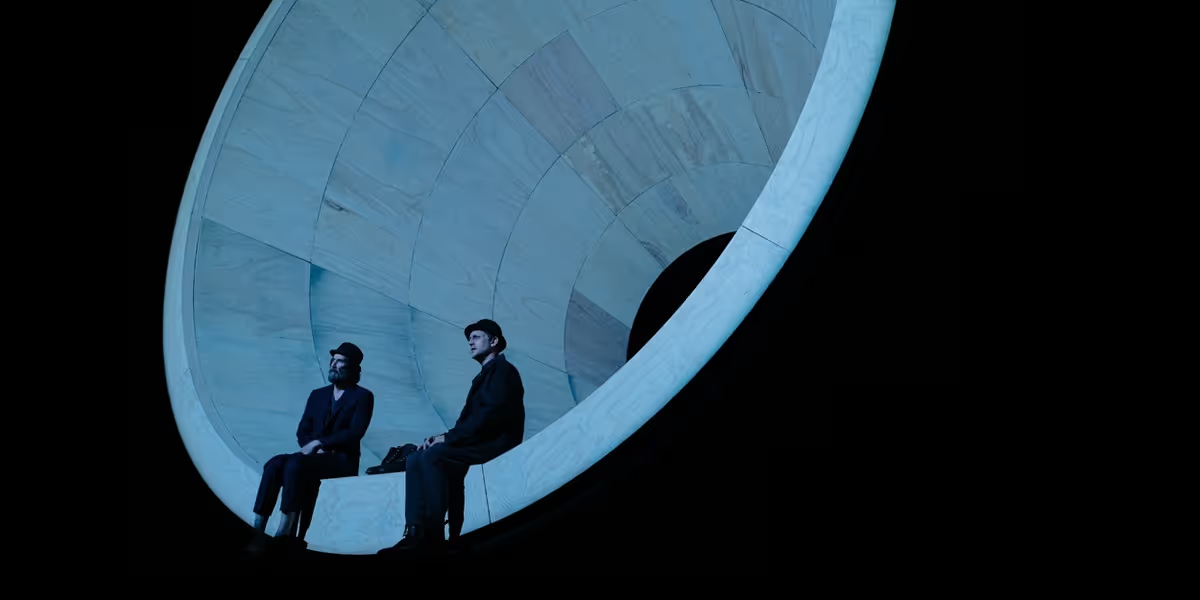
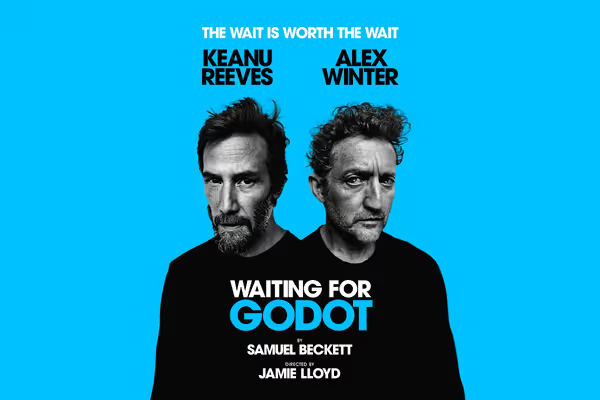
This fall, Broadway audiences return to Beckett’s barren lane as Waiting for Godot arrives at the Hudson Theatre, starring Keanu Reeves (in his Broadway debut) as Estragon and longtime collaborator Alex Winter as Vladimir. Read what the critics had to say.
As this new revival takes center stage, it offers an ideal moment to trace the play’s journey: from Beckett’s postwar France to its polarizing first performances in Paris and London, to its absorption into the Theater of the Absurd, and onward through decades of daring and divergent productions. Let's unpack the play’s history, its evolving meanings, and its stubbornly persistent legacy...
The Origins of Waiting for Godot
Samuel Beckett began writing En attendant Godot in 1948, during the postwar years he spent living in France. The devastation of World War II and his own experiences in the French Resistance deeply shaped his outlook on humanity, existence, and the absurdity of life’s routines. Having served as a courier for the Resistance and witnessed Europe’s collapse, Beckett turned to writing as a means to process the meaning—or meaninglessness—of it all.
Originally written in French before Beckett translated it into English himself, the play reflected his desire to write “without style,” stripping language down to its bare essentials. His influences included the philosophical works of Albert Camus and Jean-Paul Sartre, as well as the experimental language of his mentor, James Joyce. The result was a text that rejected traditional structure, plot, and resolution, yet resonated profoundly with a world still grappling with uncertainty.
The Play’s First Production
Waiting for Godot premiered on January 5, 1953 at the tiny Théâtre de Babylone in Paris, directed by Roger Blin. Early audiences were unsure what to make of it—many left confused, some stayed enthralled, and critics were divided. The play’s minimalism—a barren set, two tramps talking endlessly as they wait for someone who never arrives—was unlike anything seen on stage before.
Despite initial bewilderment, the production gained momentum through word of mouth. Intellectuals and artists recognized something revolutionary in Beckett’s bleak humor and rhythmic dialogue. Within months, the play became a cultural touchstone, sparking debates about the purpose of theatre itself.

The English-Language Premiere and Global Spread
The first English-language production opened in London in 1955 at the Arts Theatre, directed by Peter Hall. British critics were equally polarized—some hailed it as genius, others derided it as nonsense—but audiences were captivated by its strange blend of comedy and despair. The first American production began as a tour in 1956. The production struggled commercially, leading to its director and most of the cast being replaced before in opened on Broadway later that year.
It was, ironically, a 1957 production at San Quentin Prison in California that changed its reputation in the U.S. Inmates reportedly identified deeply with the play’s themes of waiting and confinement, and word of that reaction spread. From there, Godot traveled around the world, from Eastern Europe to Asia, often taking on new political or spiritual meanings in different cultures.
The Themes and Symbolism
At its core, Waiting for Godot is a meditation on existence itself. Through the repetitive, cyclical dialogue of Vladimir and Estragon, Beckett explored what it means to endure when nothing ever changes. The mysterious figure of Godot—who never appears—embodies the elusive hope or meaning that humans endlessly seek.
The play’s barren landscape, its sense of suspended time, and its alternating moments of slapstick and silence all reinforce the absurdity of human life. Beckett refused to confirm whether Godot symbolized God, salvation, or simply life’s unanswered questions, insisting that “if I knew, I would have said so.” That ambiguity has become the heart of its power, allowing audiences to find their own reflections within its emptiness.
The Rise of the Theatre of the Absurd
Waiting for Godot didn’t just enter the canon—it reshaped it. Beckett’s rejection of conventional narrative inspired a generation of playwrights, from Eugène Ionesco and Jean Genet to Harold Pinter and Tom Stoppard. Critics soon grouped these writers together under the label “Theatre of the Absurd,” a term coined by critic Martin Esslin in the 1960s.
This movement mirrored the existential disillusionment of the mid-20th century. Instead of heroes and plotlines, absurdist plays presented fragmented conversations, repetitive actions, and circular time. Beckett’s bleak humor and stripped-down style became emblematic of a world that no longer believed in logical order or moral certainty—but still found meaning in persistence.
Notable Productions and Interpretations
Since its debut, Godot has been continually reimagined. Peter Hall’s 1955 London production remains one of the most influential, while the 1957 San Quentin staging proved its universal relatability. Over the decades, major revivals have brought fresh insight—such as the 2009 Broadway production starring Ian McKellen and Patrick Stewart, which emphasized the tender friendship at the play’s core.
Directors have also experimented with setting and tone: Godot has been performed in bombed-out theaters, refugee camps, and even in war-torn Sarajevo in the 1990s as a gesture of defiance and endurance. Each staging reinforces the play’s timeless message that waiting, despair, and hope are constants of the human condition.

Waiting for Godot in Popular Culture
Few plays have permeated popular culture as deeply as Waiting for Godot. Its title alone has become shorthand for endless waiting or futile expectation. References and parodies appear everywhere—from The Simpsons to Sesame Street, from Tom Stoppard’s Rosencrantz and Guildenstern Are Dead to episodes of Seinfeld and The Big Bang Theory.
Visual artists, novelists, and musicians have all drawn on Beckett’s imagery of barren landscapes and circular dialogue. Even outside the theatre, Godot’s minimalist aesthetic and existential wit continue to influence filmmakers and storytellers who grapple with the absurdities of modern life.
The Legacy of Waiting for Godot
More than seventy years after its premiere, Waiting for Godot remains one of the most influential plays ever written. It challenged every rule of dramatic storytelling and forced audiences to question what theatre could—and should—be. Its humor, despair, and strange beauty continue to resonate with each new generation.
For modern audiences, Godot still feels startlingly relevant. In an age defined by uncertainty, isolation, and constant anticipation, Beckett’s vision of two figures waiting beneath a dying tree is as haunting as ever. The play endures not because it offers answers, but because it reminds us that the questions themselves are what keep us alive.
Famous Faces Who’ve Waited for Godot
Over the decades, Waiting for Godot has attracted some of the world’s most celebrated actors, each bringing a new layer of humanity—and humor—to Beckett’s timeless text. The play’s sparse setting and demanding dialogue make it both an actor’s challenge and a showcase for extraordinary performances.
In the early years, the 1955 London production directed by Peter Hall featured Paul Daneman and Peter Woodthorpe, while the first major American revival starred Burgess Meredith and Zero Mostel on Broadway in 1956. Later, renowned performers like Anthony Page, Robin Williams, Steve Martin, and Nathan Lane have all taken their turns at Beckett’s weary tramps, exploring the tension between the absurd and the deeply human.
More recent productions have continued this tradition of powerhouse pairings. The 2009 Broadway revival, led by Ian McKellen and Patrick Stewart, became one of the most acclaimed stagings of the 21st century—praised for the duo’s chemistry and the balance of melancholy and mischief they found in Beckett’s bleak humor. Now, with Keanu Reeves and Alex Winter stepping into the roles, the tradition continues: every new pairing reinvents the waiting, the laughter, and the longing at the heart of Godot.
|
Powered by

|