



 If, like me, you're white, male and educated, you won't have known a time when you’re merely an extra in your own life. So it’s hard to realise that when young people say that they "finally feel seen’" they mean it literally.
This hit home to me passing through Elephant and Castle in the early hours of the morning en route to the airport a few years ago. Bus stops were crowded with men and women I had never seen before, despite working on the infamous roundabout for over a decade. They were service workers going to The City to make ready the work spaces inside the glass towers. A vast majority appeared to be Latinx, many much shorter in stature than I am, reminding me of the porters in the opening scene of Aguirre, the Wrath of God. As this vibrant production tells me, I was not alone, individually and institutionally, in failing to discharge the basic dignity of seeing these people previously.
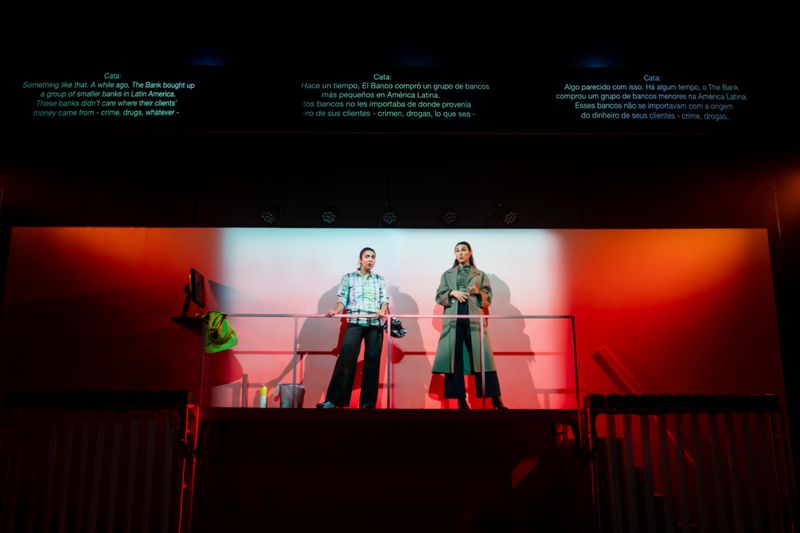
My Uncle is not Pablo Escobar is co-created by Valentina Andrade, Elizabeth Alvarado, Lucy Wray, Tommy Ross-Williams and Joana Nastari and rooted in the lives and experiences of Valentina Andrade & Elizabeth Alvarado. That’s a heavy wedge of cut and paste from the website, but this show, returning to Brixton House, is very much an ensemble effort that aims to represent some of the individual experiences that aggregate into the collective Latinx experience of London in the 2020s.
So, while all Latinx people will sigh as they cannot find a box to tick on census forms and most ethnic monitoring surveys, individually, they are as diverse as any community in class, background and sexuality and, critically for this show, in hopes and dreams too. Just because we haven't found our Alexandria Ocasio-Cortez, it doesn't mean she isn't there.
There’s a montage of the wearisome stereotyping and othering Latinx women face daily at the beginning of the play, more a cabaret sequence than a drama, but that prologue is both amusing and necessary because many in the audience will not have seen these women before or, at best, negligently misidentified them.
Soon the actors settle into character (though that’s not the end of the fourth wall breaking) and we get to know Ale, the driven A level student on her way to university; her sister Cata, the investigative journalist based in Chile but over in London; Lucia, the student activist who doesn’t know how to use a Henry hoover; and Honey, late night bar hostess and early morning cleaning crew manager. All have multiple identities and all navigate between their lives in the UK and their heritage in South America. They also feel that the ground, culturally, socially and politically, is shaky wherever they stand.
The plot really starts in the bank in which Ale works in Honey’s team of cleaners and is soon joined by fish-out-of-water, Lucia, sent by Cata who is researching an exposé of The City’s role in money laundering. Cata is fired by personal tragedy to destroy the cartels who run so much of life in Chile, Colombia and other countries at the end of a gun. It's a useful reminder that illegal drug use is not a victimless crime and that the best way to avoid the body count is to decriminalise and regulate it.
That grim reality sets an awkward tone, because we’re soon pitched into a preposterous plot hatched in order to trap the bank's money laundering CEO. It’s all very “And if it hadn’t been for you meddling kids I’d have gotten away with it” Scooby Doo stylings and even has a dog as a key to its success! How it gels with a full-throated condemnation of the UK’s financial services industry’s enabling of gangsterism on a continental scale, is a conundrum never quite solved.
If that problem grates a little, it is the energy, wit and charm of the actors that wins the day. Yanexi Enriquez gives her geekishly effective hacker Ale a blazing intelligence and, after a realisation of where her personal morality must take her, a commitment to the cause. Lorena Andrea is her elder sister, Cata, the journalist out for the story at all costs with access to considerably more resources than her comadres. Cecilia Alfonso-Eaton shows how Lucia, anglicised and middle class and as devoid of street-smarts as Ale brims over with them, finds her role and her sisterhood. Nathaly Sabino carries the pathos as her visa status is expired after she had quit her veterinarian science degree and she fears the Kafkaesque limbo that awaits her if she is apprehended, tireless grafter or not.
Despite the undoubtedly hard edge to the background politics and the pinning of blame where it should lie, the manufactured, self-owned inauthentic, but feelgood ending underlines that this show is, above its other aims, primarily a celebration of a culture slowly emerging to take its place in the rainbow that encompasses London. The dance, the music and the jokes certainly help too!
So if you have to take the plotting with a pinch of salt (yes, that is salt - you see how easy the stereotyping comes?) then it’s worth it for a starburst of pride and joy that’s big enough to stretch from Brixton to Bogotá.
My Uncle Is Not Pablo Escobar at Brixton House until 3 May
Photo images: Lucy Le Brocq
Sign up for all the news on the Fall season, discounts & more...
.jpg?format=auto&width=300)
.png?format=auto&width=365)





Reader Reviews
To post a comment, you must register and login.