


Review: IPHIGENIA, Arcola Theatre
Innovative and fearsomely relevant reimagining of Euripides' dilemma
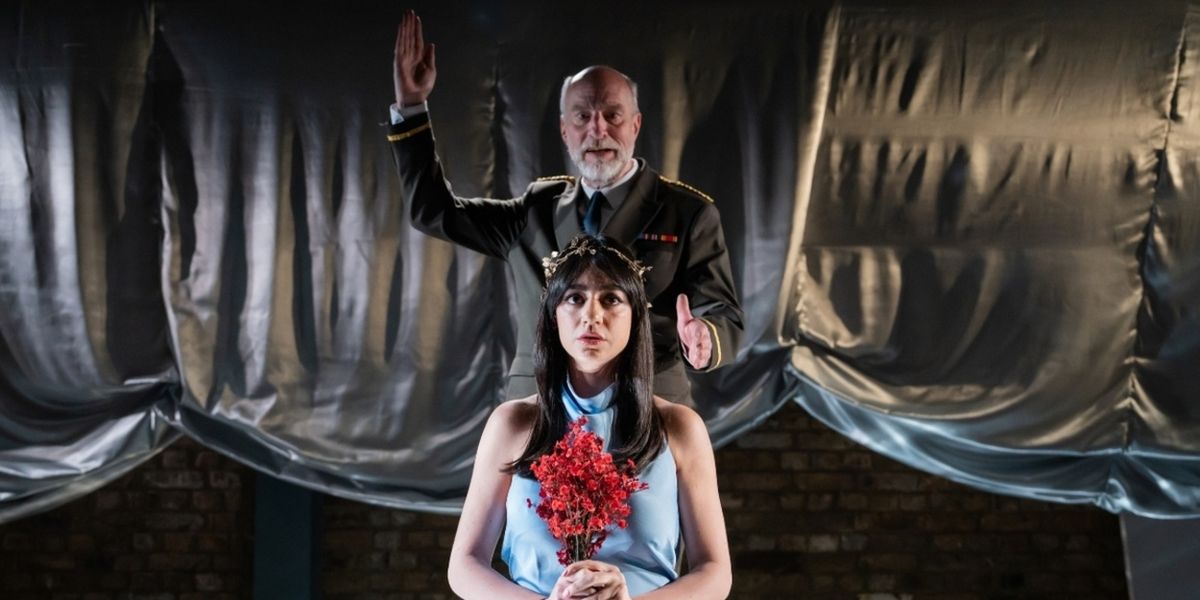
 When one thinks of how the likes of award ceremony speeches and interviews are used by actors and creatives to make political points about the world as it is today, it’s something of a surprise how few such thoughts filter into their day jobs. It seems there’s a reluctance to put on stage what’s said off the clock - excluding big state-of-the-nation landmarks at the NT, whose time may now have passed.
The Arcola has often bucked that trend, especially in its downstairs space that gains in intimacy what it loses in its low ceilinged rigidity. A few years ago, a play set in a freight container populated by refugees was an example of making best use of the studio’s limitations placing us, the audience, in the drama, intuiting the characters’ plight immediately.
%20Ikin%20Yum.jpg?format=auto&width=800)
Serdar Biliş reaches back over two millennia to adapt Euripides’ Iphigenia in Aulis and makes it speak, pointedly, uncomfortably, insistently to us, right here, right now. He uses a few tricks, some successfully, others less so, but the adapter/director is not hogging the limelight here (as too many do too often). The play still speaks with the power of its heritage and you just can’t avoid thinking about how many generations have been faced with its central dilemma and responded in the same way to the same pressures. What is 80 years or so of localised, relative peace set against centuries of war? What gives us any confidence that eight more years will come, never mind another 80?
Not that such grim speculation is on our minds as the opening scene is a bit The Play That Goes Wrong, with Simon Kunz, who will soon play Agamemnon, taking a “I can’t talk now, I’m at work” call from his son.
That sets up two themes that will run through the brisk 80 minutes that follows - the actors will occasionally return to themselves, breaking the fourth wall as they do so, and the complicated relationships between parents and children will underpin all that we see. A handy secondary effect is to dump a tranche of necessary exposition in an amusing and highly expeditious way. Very slick!
We’re soon into Euripides’ central concern - how far will a loving parent go in sacrificing (literally so in this case) their child’s interests and wellbeing? Agamemnon’s priests have told him that he must slit the throat of his daughter, Iphigenia (Mithra Malek in a sensitively controlled performance) to propitiate the gods so they will send the wind that will fill the sails of his fleet, poised to attack Troy. His warriors’ blood is up and he knows he cannot back down as they will turn on him and his wife, with his daughter likely to suffer far more before her inevitable slaughter too. It’s quite the dilemma.
But not for his wife, Iphigenia’s mother, Clytemnestra, played with fiery eyes by Indra Ové. Her bond is less biddable than Agamemnon’s and she rails against his pragmatism and against men more widely, placing the imminent death of her first born within the context of so many more. That the poor girl is there, at first surprised, then outraged, then accepting of her fate, brings a visceral quality to what might be more like an ethics seminar crossed with a very upmarket soap opera.
There’s Greek music and singing too, provided by Kalia Lyraki, but there’s a masterstroke, well nearly, in a Chorus of interview clips on video of women from war zones talking about sending their sons into battle specifically and male violence more generally. Those interludes crash us back into Gaza, Beirut, Ukraine, Afghanistan, Iran and hammer home the fact that the dilemma written all those years ago is still with us today. We do need to see the projections more clearly though, especially the subtitles, something that was only occasionally possible on opening night.
And the morning after? The news is led by the inquiry into the horrendous Southport atrocity of two years ago. Here’s a quote from The Guardian today.
“The inquiry chair said he had “profound concerns” about the “misguided and irresponsible” actions of Rudakubana’s parents, Alphonse Rudakubana and Laetitia Muzayire, who discovered in the weeks before the attack that their son was building a lethal arsenal of weapons but failed to report it to police for fear he would be arrested or taken into care.
If the full extent of [Rudakubana’s] family’s concerns had been shared with authorities in late July 2024 – including on the day of the attack – it is almost certain this tragedy would have been prevented.”
Schools and universities are retreating from teaching Classics and there’s always another rent-a-gob on hand in the media to denigrate arts education more generally. But the fact is that they’re not for everyone, but they do matter, with their wisdom too valuable to be swept into the dustbin of history.
Inconvenient truths are never welcomed by those in power.
Iphigenia runs at the Arcola Theatre until 2 May
Photo images: Ikin Yum
Sign up for all the news on the Fall season, discounts & more...
.jpg?format=auto&width=300)
.png?format=auto&width=365)





Reader Reviews
To post a comment, you must register and login.