


Review: CINDERELLA, London Coliseum
Rossini's fairytale comedy returns to the Coliseum after over 40 years
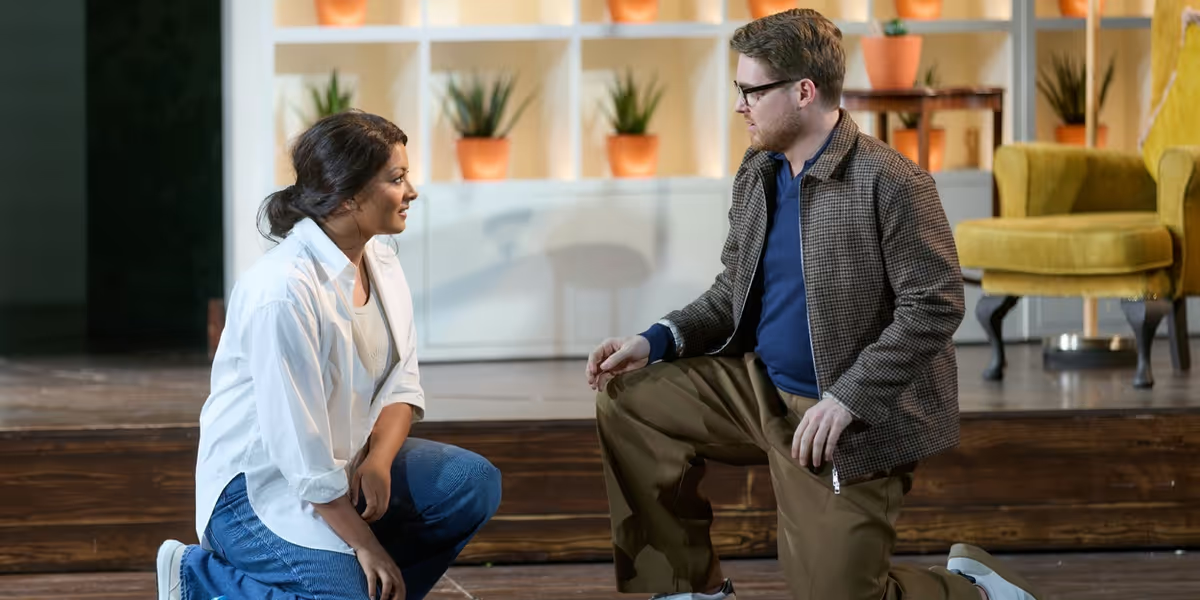
 It’s over 40 years since English National Opera staged Rossini's Cinderella (La Cenerentola) and they open their 2025-26 season with a vibrant new production of the sparkling comedy. After the rocky time the company has had in recent times, it is great to see them having such fun on stage.
Updated to the modern day, Cinderella is now Angelina, who cleans up after her stepfather and sisters. When the sisters are invited to a party where Prince Ramiro will choose his bride, Angelina’s family are determined she won’t be going with them. The prince and his assistant switch places and predictable chaos ensues until the inevitable happy ending.
The production is new in many senses, with conductor, director, and both leads all making their ENO debuts. It is a fine cast, with Deepa Johnny wonderfully poised as Angelina with a sprightly coloratura and a nimble capacity for Rossini's musical gymnastics. Her final aria is bright, clear and full of emotion. An assured debut.
Aaron Godfrey-Mayes is suitably charming as Don Ramiro. He has a lovely tenor, but on opening night his projection meant that he was difficult to hear when not placed front of stage, which was a real shame.
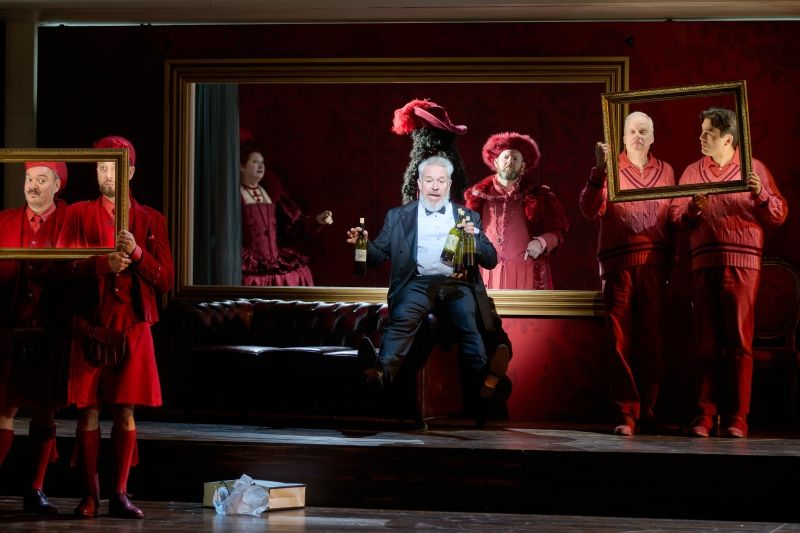
Photo Credit: Mark Douet
The stepsisters; former ENO Harewood Artist Isabelle Peters as Clorinda and Grace Durham as Tisbe, are no longer ugly and not particularly evil, but rather petulant and overbearing. David Ireland is warm and credibly likable as Alidoro, the fairy godmother replacement and the brilliant Simon Bailey has excellent clarity on his diction as stepfather as Don Magnifico.
Charles Rice isn't the strongest singer, but threatens to steal the show as a hugely charismatic Nandini, the Prince's assistant, louchly mixing himself Manhattan cocktails and reclining on the sofa while observing the unfolding chaos. His aria detailing the benefits of pretending to be a price is also very funny.
The all-male chorus is a highlight, dressed as a variety of royal ancestors and performing with real aplomb. The ensemble pieces are well-performed, particularly considering the intricacies demanded from Rossini’s score. What could tip into chaos is precise.
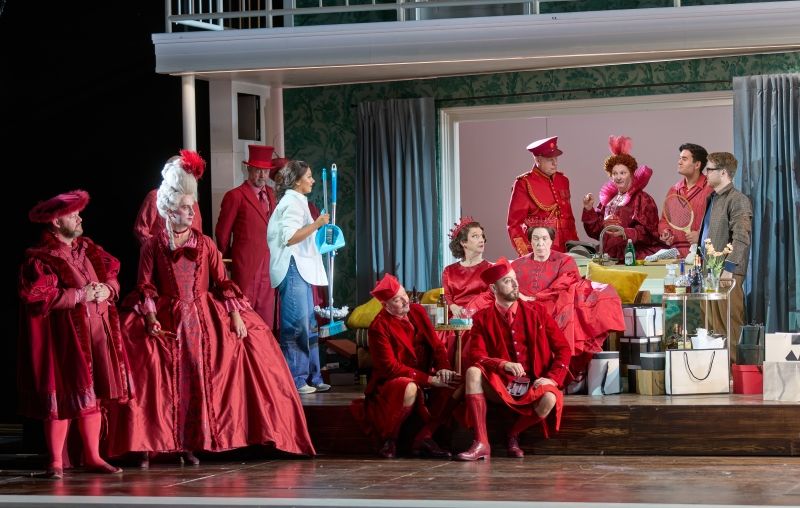
Photo Credit: Mark Douet
Julia Burbach’s production contains many engaging aspects, such as magical white mice and a cleverly designed lift to perhaps take the place of the pumpkin. But, there's a lot going on: Angelina’s mother is a silent, ghostly presence throughout most of the production, appearing to be placed there mainly to rotate the sets. The glass slipper becomes a bracelet (as bare ankles were not permitted to be shown on stage back in 1817) and there are references to lost shoes, but these are a bit lost in the melee. There is also an appearance by three child doppelgängers of the step-sisters and Don Magnifico which is funny, but seemingly without any meaning.
Bringing the production into the present day presents a feminist narrative challenge: if Angelina is so put-upon by her stepfather and sisters, why does she not get a job and move out? You need to suspend your disbelief that a young, intelligent woman would stick around to be an uncomplaining skivvy, waiting for a man to come and rescue her.
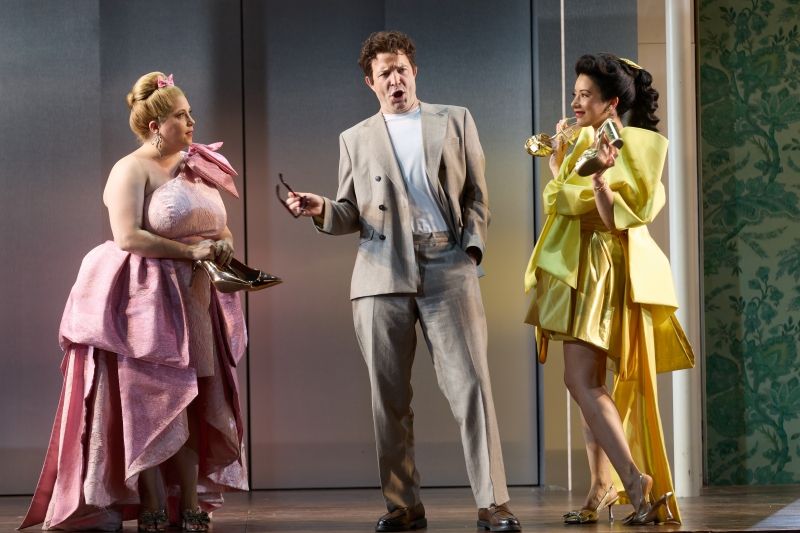
Photo Credit: Mark Douet
Christopher Cowell’s amusing translation leans very much to modern vernacular; "get your arse out of the way" is one example. Young Taiwanese conductor Yi-Chen Lin is animated in the pit, bringing out both the liveliness and more thoughtful moments of the score. The opera premiered in 1817, less than a year after The Barber of Seville. It’s impossible to ignore the similarities behind the Bel Canto compositions, both featuring the rapid-fire lyrics and swirling music phrasing.
Herbert Murauer’s set features a two-storey layout and rotating elements to take us from a cramped kitchen to the Prince's ballroom. Sussie Juhlin-Wallén’s lovely costumes use a specific colour for each character, which is eye-catching and effective. The stepsisters’ outfits are particularly ‘extra’, with huge bows, wide skirts and rippling underskirts made of flowers. The chorus receives the most creativity, with an inventive selection of red outfits ranging from Tudor to Georgian and one character who looks more than a little like an old fashioned bus conductor.
It's a fun and entertaining start to the new season. Fingers crossed for all that the drama remains on the stage.
Cinderella (La Cenerentola) is at the London Coliseum until 14 October
Photo Credits: Mark Douet






Reader Reviews
To post a comment, you must register and login.