


Review: BBC PROMS: SHOSTAKOVICH'S FIFTH BY HEART, Royal Albert Hall
Intense, visceral and quite unique.

 The intrigue surrounding Shostakovich’s “Fifth Symphony” has always surrounded the intensions of its composer. After the success of his The Lady Macbeth of The Mtensk District (to be performed at The Proms on 1 September), Shostakovich came under the scrutiny and glare of Stalin and his cultural censors. His future career and his life were at stake with what he produced next.
At a time of intense terror and mistrust in Russia and fearing for his life and his family’s safety, he shelved his “Fourth Symphony” (which wasn’t heard until 1961), presenting his “Fifth Symphony” to rapturous applause in 1937. Its true meaning has always been a matter of debate. Was it a true celebration of pure Soviet ideals or a veiled criticism and clever expression of dissent? The resonance with today’s world events could hardly be more prescient.
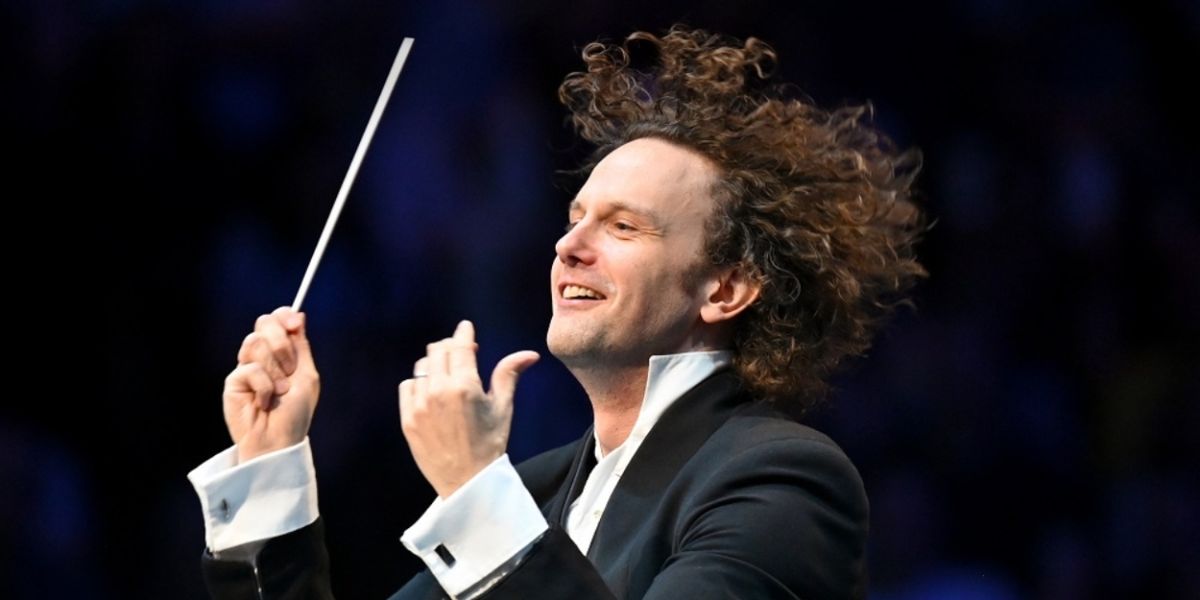
At The Proms over the weekend, conductor Nicholas Collon and his remarkable Aurora Orchestra collaborated with contemporary theatre company Frantic Assembly to explore the dual meanings and hypocrisies surrounding this seminal piece of music. The result is an inspired and genuinely innovative way of delving into the heart of the piece to educate the audience without ever dipping into condescension.
The Aurora Orchestra is a pioneer in memorised orchestral performances, becoming synonymous at The Proms for performing without sheet music and with many members standing. The result is much more than a gimmick; an engagement between the musicians, conductor and audience that is intense, visceral and quite unique.
The first half is a dramatic and musical exploration of the music; imagining conversations, interactions and sinister meetings between Shostakovich, Yevgeny Mravinsky, the conductor of the first performance of the symphony, and Stalin’s artistic committee, who sit in judgment of whether the composition is a success or subversive.
Mravinsky is played by Collon himself, who is remarkably assured as he clearly explains to the committee how each movement supports the regime’s ideals, then contrasting this with evidence of how the movements may be seen as completely subversive. All the while the orchestra cleverly demonstrates his points with snippets of the music to illustrate his points. It’s a masterful manner of getting deep into the contradictions and multiple interpretations of the work.
We are persuaded of Beethoven’s influence on the movements, who was a favourite of Stalin, but then Mravinsky also points out the references to Mahler, who was a forbidden bourgeois figure. Is the second movement too simple, or not simple enough? The third movement; an ode to the Soviet heart and soul, or a lament for a broken people? Is the final movement a perfect Socialist symphony or an act of forced rejoicing and defiance against the state?
Max Revell performs as a silent Shostakovich, expressing his fear, turmoil and genius through sinuous movement alone. Polly Frame, Craig Stein and Sarah Twomey are all very convincing of members of the committee, both officious and terrified themselves.
Musicians are picked up and moved around the platform staging, as though levitating at points. The physical dexterity needed to pull this off while not affecting the playing is astonishing.
The “Fifth Symphony” is a canvas upon which a conductor can project his or her own interpretations; Leonard Bernstein famously upped the tempo of the fourth movement hugely. It is also a piece that only resonates fully when its context is understood. And that is what worked so well about this Prom.
The second half is the performance of the Symphony itself. Collon takes us on Shostakovich’s journey, exposing all his musical ingenuity and deep emotional resonance. Each of the four movements is carefully performed to demonstrate the individual narrative arc and distinct character, with a discernible understanding and rapport between the conductor and orchestra.
The first movement built from its brooding opening, moving to an almost mocking militaristic march, then faded exquisitely again. The scherzo had much of the sardonic resonance exposed and the wonderful third Largo (written in just three days) was a masterclass in orchestral restraint, building to the emotional climax of the end movement.
The ending of the symphony was ambiguous and mysterious as ever. Did it represent a positive resolution of conflict or an expression of a forced rejoicing? There is a renewed vibrancy and energy to the strings here as the Collon’s conducting finds the hidden message behind the false spirit of optimism and celebration. The multiple repetition of the notes in the coda sounded like an anguished cry of despair, with an inherent energy running throughout.
Witnessing the unique Aurora Orchestra is a treat in itself, but this inspired collaboration with Frantic Assembly took this Prom to another level. Bravo!
Shostakovich’s Fifth by Heart is available on BBC Sounds here.
The BBC Proms is at the Royal Albert Hall until 13 September.
Photo Credit: Chris Christodoulou/BBC





Reader Reviews
To post a comment, you must register and login.