


Review: BREMEN TOWN at Tarragon Theatre
Tarragon's season opener is a heartbreaking meditation on obsolescence
We live in a time of planned obsolescence.
In order to keep the wheels of capitalism moving, things are designed to outlive their usefulness in an increasingly rapid pace, so that they can be discarded, then replaced by the next generation. This is bad enough when it comes to consumer goods and heartwrenching when it involves animals, but what happens when that logic applies to human beings?
Opening Tarragon Theatre’s 2025-2026 season, writer-director Gregory Prest’s Bremen Town started life at the 2023 Next Stage Theatre Festival. A version of the classic “The Town Musicians of Bremen” Grimm fairy tale that changes the animal avatars into people, Prest’s play is a hard-hitting meditation on aging and loss wrapped in an amiable fable. With compelling performances by Toronto theatre stalwarts, this tight, heartbreaking production might inspire you to call your grandparents and tell them that they matter.
In the original fairy tale, an ass, a dog, a cat, and a chicken, after outliving their usefulness on the farm, journey to Bremen in the hope of beginning a new life as musicians. In Prest’s adaptation, the beasts of burden are people, their last names cheeky German translations of the animals they represent. Frau Esel (Nancy Palk) demonstrates a donkey-like stubbornness and obstinance as she tries to retain what shreds remain of her dignity; after spending 45 years as the housekeeper at a venerable estate, the youngest to start in the position, she’s been kicked to the curb with an absence of fanfare.
Palk’s piercing gaze and imperious, commanding tone make it perfectly believable that the townspeople quail in her presence. Reminding herself to practice “tallness” when she feels laid low, she announces angrily to anyone who will hear her that she will now travel to Bremen to live with her accomplished musician son, whom she hasn’t seen in years.
Through a series of unfortunate events, she gains a guide in goofy magician Herr Hund (Oliver Dennis), performing some entertainingly hokey tricks (magic consultant Peter Fernandes) with puppyish enthusiasm for his stupefied audience, and co-travelers in Herr Katze (William Webster), mournfully searching for a home that hasn’t existed for decades, and the fluttering, birdlike Frau Henne (Sheila McCarthy, looking like she might disappear in an instant), being sold as chattel by her own daughter.
Frau Esel’s only comfort is imagining herself to still be above these other elder unfortunates, who chafe at her every nerve and who seem to coast on dreams and imagination. Much of the play is a philosophical battle between a woman who thinks that the world is a horrible place that can’t be helped, and a trio who believes that the only way to deal with an unkind universe is in one’s reaction to it, taking joy where one can. Can Frau Esel ever admit that it’s a gift to allow yourself to depend on others, if only a little?
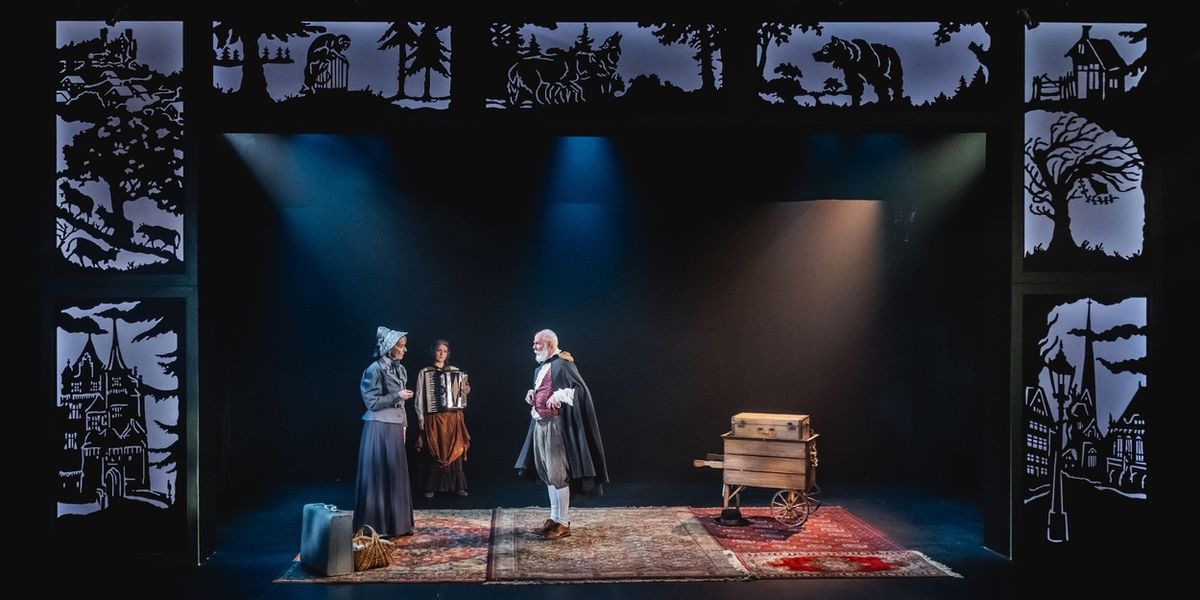
The largely bare stage, covered with ornate rugs, transforms to multiple locations via the occasional wooden cart laden with goods. Otherwise, we imagine the scene via description by our narrator, Vogel (Tatjana Cornij), who noodles atmospherically on the accordion and provides commentary, sometimes functioning as Frau Esel’s pleading inner child. A lovely woodcut border by set designer Nancy Perrin brings to mind a book of 19th-century fairytales, and Perrin’s sharp, layered costumes round out that aesthetic. Esel towers in a severe, dark outfit and conical bonnet, Katze’s worn brown coat covers a knit grandpa sweater, and Hund’s swishing cape, too-tight vest and knee socks give him the air of a man trying to recapture his youth.
Playing multiple bit parts, most of which are there to torment their elders, Veronica Hortigüela, Dan Mousseau, and Farhang Ghajar keep things moving with antagonistic aplomb. Their frenzied energy and occasionally shrieking volume provide a stark contrast to the older quartet, who, other than the hard-marching Frau Esel, move with a sort of quiet, wearied dignity.
Hortiguela is particularly adept at portraying wide-eyed small children, and Ghajar brings a menacing seduction to his role as the keeper of a dancing bear. That tortured animal (Dan Mousseau in a fuzzy mask) is the clearest, saddest metaphor in a play full of them; poked and prodded into unnatural movements at the end of a rope, it gets to eat only if its owner decides it’s still useful.
When I first saw Bremen Town at Next Stage, I had mixed feelings about it, wondering if the pill was a little too bitter to swallow. This time, the bittersweet show hit me squarely in the heart; I’m not sure if it’s changed, or if I have. Palk is a tremendous anchor, making it increasingly clear that Esel’s anger and curt behaviour come from a woman who has been deeply wounded, and who suddenly discovers that her rigourous self-sufficiency is no longer adequate as a shield. And Dennis, McCarthy, and Webster powerfully remind us that, if we’re not being seen by society, we can at least see each other.
As we gather around the holiday table, some surrounded by several generations, I’ll be hoping for a world where people never become obsolete.
Photo of Nancy Palk, Tatjana Cornij, and Oliver Dennis by Jae Yang

Sign up for all the news on the Fall season, discounts & more...
|
MOZART REQUIEM Meridian Arts Centre (6/19-6/19) |

|
WonderPhil's PA Day of Magic Wychwood Theatre (11/20-11/20) |

|
HARMONY OF THE WORLD Meridian Arts Centre (3/06-3/06) |

|
Disney and Pixar's Finding Nemo Young People's Theatre (11/26-12/27) |
|
Mistletoe & Mistakes The Moonlight Lounge at TacoTaco (12/06-12/06) |

|
HYPROV Is Back in Fredericton! A Night of Hypnosis, Improv & Comedy HYPROV Is Back in Fredericton! A Night of Hypnosis, Improv & Comedy (11/17-11/17) |

|
The Descent of Orpheus Opera Atelier (10/22-10/25) |

|
Sex in the '80s Canadian Stage (1/16-2/07) |

|
Battles Young People's Theatre (4/26-5/06) |

|
Matilda The Musical Theatre Aquarius (3/10-4/04) |

Reader Reviews
To post a comment, you must register and login.