


Interview: David Hein & Irene Sankoff On Developing New Works At TheatreWorks Silicon Valley
The creators of "Come from Away" bring their latest musical to Palo Alto for readings on August 16th and 17th
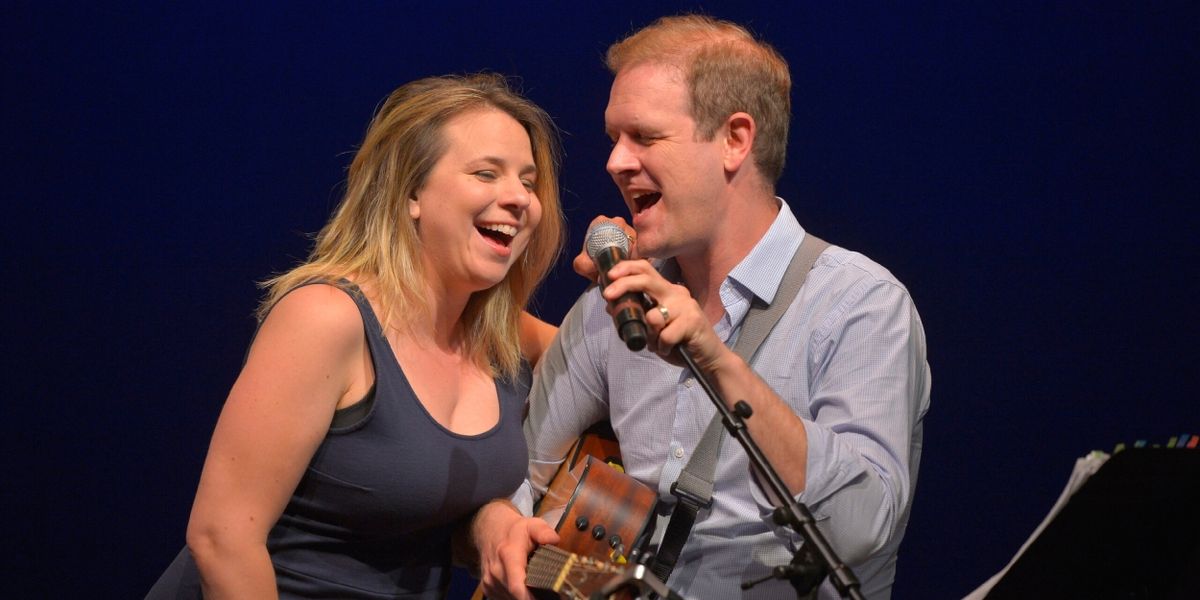
Musical theater lovers have been waiting almost a decade to see what writers David Hein and Irene Sankoff would come up with following their smash hit Come from Away, and thanks to TheatreWorks Silicon Valley, Bay Area audiences are about to find out. Hein and Sankoff’s new musical, Vienna, is part of TheatreWorks’ 22nd Annual New Works Festival which began in late July and continues through this coming Sunday, featuring readings of Vienna on August 16th and 17th. Vienna is the cherry on top of a particularly strong lineup this year, including two other musicals – Mark Saltzman’s whimsical Alice, Formerly of Wonderland and the epically intimate The Bridge with a score by the Kilbanes - plus Christopher Oscar Peña’s trenchant family drama, malcreados and Bay Area playwright Geetha Reddy’s The Employee Dharma Handbook.
Hein and Sankoff are musical theater unicorns, a married team who write music, lyrics and book all on their own. A number of years ago when their separate performing careers were often keeping them apart, they decided to write a show basically so they could spend time together. That scrappy little musical, My Mother’s Lesbian Jewish Wiccan Wedding, put them on the map (and with that title alone, how could it not?), leading to Come From Away which ran for over 1,600 performances on Broadway and toured internationally. Now that rights have been released to regional and community theaters, Come from Away is set to become the most frequently-produced musical in the country, quite possibly for years to come.
I recently caught up with Hein and Sankoff by phone from their home just north of Toronto, Canada. We talked about why they’re excited to bring Vienna in its formative stages to TheatreWorks and why this is such a homecoming for them, their process for working together and how it’s evolved since they became parents, and how they’re handling the pressure to come up with another big hit. They’re the type of couple who know each other very well, with a tendency to expand on each other’s thoughts seamlessly without a pause in the conversation. And just when you think their relationship is maybe a little too ideal, they’re also perfectly candid about the challenges they face as a couple whose working and home lives are so intertwined. The following has been edited for length and clarity.
I loved Come from Away, both on Broadway and the first national tour, but I saw it again just a few days ago in a small community theater production and I found the show even more moving in that context. You could feel the audience responding in an entirely different way, like “We know those people!”
DH: Oh, great! I was afraid you were going the other way with that comparison. [laughs]
IS: Honestly, that’s what it was written for. Like it was written on students, it was written for kids. I don’t know if you saw that “Stagedoor Manor” thing, but it was so delightful to see young people playing those roles again. It’s a special magic to see them not playing their age and taking stuff on and just hearing it in their voices, cause that’s how the workshop was the first two or three times we heard the whole thing. And I still maintain that if it works in a school production or a community theater production, you know you’ve got something solid.
Is Vienna the first show you’ve written since Come from Away, or just the first one that’s ready for public readings?
IS: Both, kind of…
DH: It’s complicated. We’ve written many, many projects since Come from Away - TV pilots, film projects - and they all went very well and didn’t happen for various reasons, some because of COVID, although all may have future lives. And there have been a number of theater projects and Vienna is one of them. It’s very fresh where it is right now, and at the same time it’s something that’s been developing organically for some time.
What stage are you at right now with Vienna? Do you have a reasonably complete script?
IS: We have a first act that we’re just dying to hear a reaction to, and we have ideas for the second act –
DH: And even some of that first act might become parts of the second act, but we’re just testing it out as a full act. We have a lot of pieces and we’re trying to put them together.
IS: It reminds me of Come from Away in that we have all of these stories that have the same thread and yet we’re like “Okay, but how do we move between these different groups of people?” And now we have the added challenge of it’s over three disparate timelines in the 20th and 21st centuries. So it’s large in scope once again, but it’s just really a personal story about families.
We heard it in a room with just actors a couple months ago down at South Coast Rep and it gave us the courage to bring it the next steps to Palo Alto. We were like “Okay, this kind of hangs together better than we’d hoped!” So we’ve done some rewrites and hopefully not destroyed it. [laughs] We’re so excited to hear it, because it is something that has been on our hearts and our minds for a long time.
I would imagine that any theater company in the country would be more than happy to help you develop your new musical. How did you choose TheatreWorks Silicon Valley?
DH: TheatreWorks workshopped a fresh look at our first musical, My Mother’s Lesbian Jewish Wiccan Wedding, a couple years back. And before that we had tried out some songs from an earlier project, some of which may reappear in Vienna, so we have a relationship with them. We see the TheatreWorks folks out at NAMT [National Alliance for Musical Theatre] each year in New York and it’s been an ongoing conversation about what would we be interested in coming back to do. And every time we’ve been out there, it’s been a joy. Partly it’s that we’re Canadians coming down to California and we fall in love with it, like “Why do we live somewhere that’s so cold?!” But also, they’re so generous that it really feels family-oriented. We’ve brought our daughter before.
IS: Both times, and she’s coming with us again. They’ve taken great care of us in terms of giving us the space and the time we need to workshop things, providing the actors as we need them and just being super-encouraging.
DH: It’s also a great community there. It’s very lonely being writers. I mean, its wonderful to be able to write with your wife and [tongue in cheek] it’s always perfect, there’s never any issues – but occasionally you like to meet other writers and find out what they’re working on. We have some lifelong friends who have come out of our time with TheatreWorks and that we continue to keep up with. It’s a joy to be developing something as part of a broader festival and collaboration with people in that way.
IS: Yeah, there’s a couple people like [director] David [Ivers] that we’re friends with that we also continue to work with.
DH: Zack Zadek was working on a piece when we first went out there, and just this week we’re demo-ing a song for an animated film together, so you never know where things are going to lead.
IS: And Billy [Liberatore] at TheatreWorks is music directing for us again.

in TheatreWorks' 2017 New Works Festival (photo by Kevin Berne)
Birthing a new musical is such a delicate process that you might not want to reveal too much about Vienna yet, but what do you feel comfortable sharing about what the show is at this point?
DH: It is a show…
IS: [laughs] It is a musical, part of it takes place in Vienna, part of it takes place in America, with different timelines. It’s about three families, not all of them blood-related. I totally want to see how audiences react so it’s hard to say more …
DH: I do think there’s something – I even feel this seeing shows on Broadway or you know anywhere - that when you go to see a show you have already seen so many performances from it on social media, you’ve heard the authors or the director or the stars talk about it, you know everything about it. It’s so rare to come into a piece and be delighted and surprised and amazed where it’s taking you. And that applies to almost all media at this point. Everything gets teased and slowly dripped out before you even see it. We’re really excited about this show and don’t want to quite put a label on it yet or say exactly what it’s about. Because (A) it might change and (B) we’ve been working on it really hard and want to let it be what it is.
I love that. When I saw Maybe Happy Ending on Broadway this year, I went in knot knowing much about it and was just floored to see how the show developed in such surprising ways.
DH: Yeah, it’s delightful when that happens. We forget that you used to go see a show you’d never heard of just because you were told it was good.
IS: And at the same time, I understand that it’s hard. You’ve only got so many evenings, and if you’ve got a kid you’ve gotta get a sitter, you’ve got to go out for dinner. So I can understand why people want to know what things are about, but the TheatreWorks audiences at this festival are used to coming to see a bunch of things, just showing up and taking a chance.
DH: One of the joys of a festival like this is that you actually get to see something that is brand new, that no one else has seen. Like this is the first audience that this piece has ever really seen, and the first time some of these songs have ever been heard by an audience. It’s a chance for us to ask questions so you can be the first people to tell us if it’s all terrible or tell us there’s potential. [laughs] There’s a lot of power in the audience there; it’s an opportunity to be a part of the process. I love that theaters like TheatreWorks promote a literacy and an excitement about creating new works.
You’re the only husband-wife team I can think of who write entire musicals together - book, music and lyrics. What is your process for collaborating? Do you work in the same room? Do you take a divide and conquer approach?
IS: With Come from Away, we were not parents yet so we were together all of the time. We started it in my brother’s cabin in northern Ontario and were able to focus on it 24/7 and strew cue cards around the house. It looked like something from A Beautiful Mind as we were trying to pull things together. [Now that we have a child] we’ve had to get creative because we can’t work whenever we want to and can’t always work at the same time anymore.
DH: And we have many irons on the fire that we’re working on at once, some of them together and some of them separately.
IS: It’s ever evolving. Sometimes we shoot ideas back and forth and write a scene as we go, but more often than not lately there’s a handoff. Someone takes a pass and then the other person goes through and changes stuff, and we discuss it. A lot of the time in Costa Mesa was spent just talking with David Ivers, the director, debriefing about we had heard, what we thought needed sort of thickening and what we thought needed to slim down. I’ve missed that part of the process, the talking it out and saying what it is, getting the cue cards out and putting them across the table or the white board like we did with Come from Away.
DH: Writers retreats are often a challenge for parents because you have child care, but they are such a joy because you’ve been given this blank time that you are supposed to use for this work. As opposed to, you know, you’re supposed to work on it at home but you’re also supposed to work on five other projects and you’re supposed to clean the house and you’re supposed to also cook dinner and spend time together. What’s wonderful is all this time away from everything else just to focus and talk and really dig in and be inspired. The show grows by leaps and bounds just because of those conversations.
As collaborators, what do you each think the other person uniquely brings to the table?
IS: Ooh - nice!
DH: This is therapy! Right – and not like what do we think are their greatest flaws? [laughs]
IS: David’s such an optimist and he’s the one that generally keeps things pushing forward – [pauses to reconsider] although even that’s flipped now. Oh, gosh, I don’t know…
DH: That’s so challenging to answer because on any day we play different roles for each other. Just to brag about my cool wife for a second - I feel like I maybe slap things down on the page and then she makes them immeasurably better. There’s a level of questioning and realism and character work and thoughtfulness and imagination, just coming up with new directions I never would have thought of. I kind of feel like if I’m working in 2D, she makes it 3D and 4D – or 5D, whatever. Smell-O-Vision. [laughs]
But I think that’s why it’s hard to pin down. There’s a million different ways, whether it’s questioning a lyric, rewriting a scene, or just coming up with “What if we jumped to the future in Act II?” which suddenly changes everything. I can always count on her to take me out of whatever tiny box my head was working in and make the world so much bigger and the piece so much better. And… she’s really pretty.
IS: Stop! David is the more gifted songwriter, there’s no question about it. I try to do lyrics or sing something out sometimes, but he’s got the gift of me being like “Okay, so there’s a mom and she doesn’t know what she wants and suddenly these other moms are making fun of her because her daughter was trying to…” You know, just some crazy story, and then he’ll go away and come back with it as a song, and I’m like, “Yeah, exactly like that!” It’s some sort of alchemy, honestly, taking raw material and turning it into this perfectly personal, unique charm of a song.
Couples everywhere would probably love to know how you manage to work so closely together without wanting to kill each other at times.
IS: Lots of therapy, honest to god. We have a career coach who works with big companies and we’re her only flaky artists. She tethers us to the earth, reminding us that this is still a business. She teaches us how to talk to each other, to set down goals. She’s been absolutely amazing at helping us work together. When we wrote Come from Away, of course we wanted it to be as good as possible, but it’s a different pressure cooker now, a larger situation, and she is used to working with big corporations that are in the public eye and keeping them healthy and functioning. Or healthily dysfunctioning? I don’t know, but she’s been great.
DH: We’ve often talked about when you’re working with a co-writer or a director or producers it’s very much like a marriage. It’s all a relationship. Everyone has feelings and everyone has challenges to that and it’s about how you overcome obstacles.
We work together all the time, so there isn’t a “Now you stop working and go home and you don’t ever discuss work” [part to our day] and drawing boundaries has been a challenge. You know, how are we just gonna be parents? Or just gonna be husband and wife tonight? Or just watch TV shows, relax and not do this? Sometimes those things are good because you actually need the break, not only personally but time away from the project to let the other person sit and simmer and think about it. In some ways there’s stuff that we’ve learned from writing together that’s helped our marriage, and stuff we’ve learned from our marriage that’s helped our writing together.
Irene, as you mentioned, you’re now dealing with a whole new level of pressure –
IS: Yes.
Because when you wrote Come from Away, nobody knew who you were.
IS: Nope!
But now everybody in the musical theater world knows who you are. What has that shift been like for you?
IS: It’s… really hard and I think that’s why for a little bit we were “Okay, let’s try a bunch of different things, let’s try just writing a bunch of songs, let’s try writing for animation.” Like let’s just spread our wings and get some space away from the musical theater world and see what else is out there. And then we both also started other musicals on our own. As somebody said to us, “You just have to get the second one out there.”
DH: Come from Away is our second one really, but yeah -
IS: After Wiccan Wedding, and that one went okay,
DH: The thing I always remember is we originally wrote My Mother’s Lesbian Jewish Wiccan Wedding as a way for us to spend time together one summer. Between our day jobs and our night jobs we never saw each other and we were like “Why don’t we just put on a musical in the Fringe and then we’ll get to actually hang out and have fun together?”
And that’s really how you started writing together, not just a cute story some publicist cooked up?
DH: No! We had jobs - Irene was an actress and I was a singer-songwriter, and we were not thinking in any way “Oh, let’s be writers.” Then it got picked up by the Mirvishes, Canada’s largest theater producer, and we had to quit our day jobs. But that was never the goal. With Come from Away, we just hoped that Canadian high schools would be forced to do it as some sort of history project, you know? We were really doing it because we had fallen in love with the story and the people and Newfoundland in general, and we thought it should be celebrated.
We shouldn’t be - and we aren’t - writing anything because we have to have a follow-up to Come from Away. I mean, that was such an amazing, once-in-a-lifetime experience that trying to recreate it would be insane. We’re trying to work on projects that we love, and work on them together so that we can spend time together and have fun and enjoy writing together. And if we do that with projects that challenge us and feel scary, just like Come from Away did –
IS: Yeah, this project is challenging and scary, and we’ve fallen in love with the people that we’re writing about.
DH: Those are the reasons why we should be doing it, and any other pressure beyond that is just… pressure.
IS: And we try to keep it small, like “Let’s focus on what it is we’re trying to do and the message we’re trying to get across in the worlds we’re showing.” And honestly, just make sure it’s coherent, cause it is a big project we’re trying to get into a two-act (maybe only a one-act - I don’t know) show by the time we’re done.
DH: That’s the fun of developing at a place like TheatreWorks. We are going to learn a million things about our show, in front of people.
You are both accomplished performers in your own right. If there was to be a big Come from Away 25th anniversary production in another 15 years or so, which roles would you like to play?
DH: Well, can I brag about how great Irene was playing Bonnie in Come from Away in the Canadian productions?
IS: Last year in Ottawa, I did the role of Bonnie at the National Arts Centre. I would do Bonnie again, for sure.
DH: Bonnie and her husband, Doug, are the two who are bickering throughout the show a little bit even though they love each other, even though their jobs are extremely hard. We also are doing this interview surrounded by three cats, so the animal part of their story is based on us.
IS: As we were writing it on the kids, I remember them being “Omigod, Bonnie and Doug are the two of you!” So, yeah, that would be super fun for us to play someday.
When I saw the show again this week, it occurred to me that Come from Away’s secret sauce might actually be the sections about the animals -
IS: Awww...
Because it allows us as to feel what the Gander folks are experiencing on a whole different level. How did figure out that the show needed to include that storyline?
IS: I’m just obsessed animal rescue. When I have spare time, that’s what I do. I pick up cats off the side of the road.
DH: One of our favorite places to go in Gander is the SPCA to see Bonnie and all the animals. I also think for people who know only the cast album, Bonnie and Doug’s storyline is not musicalized in the songs much so it sometimes comes as a delightful story that you didn’t know just based on the cast album.
You started with something like 15,000 potential stories to tell and you had to keep whittling things down, but you held onto Bonnie’s story about taking care of the animals.
IS: Yeah, and it’s a level of commitment that a lot of people would cut off at. They’d be like “Well, we’re already above and beyond what we’re capable of doing, so let’s just write this off as a loss.”
DH: I also think it’s an example of the storytelling of Come from Away that you could easily, say, tell the story of there’s a woman named Bonnie who helped the animals who were stuck in the holds, and that would be a really unexciting way to tell that story. But what the story gives you is so many levels of exploration of her realizing the animals were on the plane and being told she maybe shouldn’t go on there because they were being treated as bomb threats, and then going on and discovering how many animals there were on there, and then discovering there were bonobos on there, and then discovering that one of them was pregnant.
The layers and layers and layers of how really challenging this was and how each step was another obstacle - it was such a gift as storytellers and really allowed us to celebrate how hard this was for these people and how they did it without even thinking about it.
IS: We had some producers and directors that we were interviewing say “It’s too many characters. We’re cutting the animals.” And that was kind of our cue to walk the other way.
DH: We’d think “Let’s just pass. You don’t have a heart.” [laughs]
IS: Yeah, and I don’t know if I have to write this into the high school version, but I can’t wait to see a production where everyone’s playing one of the cats and one of the dogs, and someone’s playing a rock and someone’s playing a tree. Like, c’mon, that’s just gotta happen! [laughs]
(Header photo of Irene Sankoff and David Hein by Kevin Berne)
The TheatreWorks 22nd Annual New Works Festival runs through August 17, 2025 at the Lucie Stern Theatre, 1305 Middlefield Rd., Palo Alto. For a detailed schedule, festival passes and single event tickets visit theatreworks.org or call 877-662-8978.
|
Julius Caesar Marin Shakespeare Company (8/14-9/13) |

|
Pickleball Hillbarn Theatre (8/20-9/13) |

|
Company City Lights Theater Company (7/15-8/22) |

|
Sara Felder’s Class Act The Marsh (8/12-8/15) |

|
Roar! The Marsh Berkeley (8/29-8/30) |
|
The Last Five Years by Jason Robert Brown Santa Cruz Shakespeare (9/11-10/03) |
|
Knockoff Broadway: The Improvised Musical All Out Comedy Theater (7/25-12/26) |
|
The Phantom of the Opera San Jose Center for the Performing Arts (10/07-10/18) |

|
Pearl Louise’s Lovin Jaleal The Marsh (8/14-8/16) |

|
Macbeth Santa Cruz Shakespeare (7/12-8/30) |