


Interview: Carey Perloff of THE CHERRY ORCHARD at Marin Theatre
The Bay Area theater luminary directs the classic Chekhov play running January 29th to February 22nd in Mill Valley
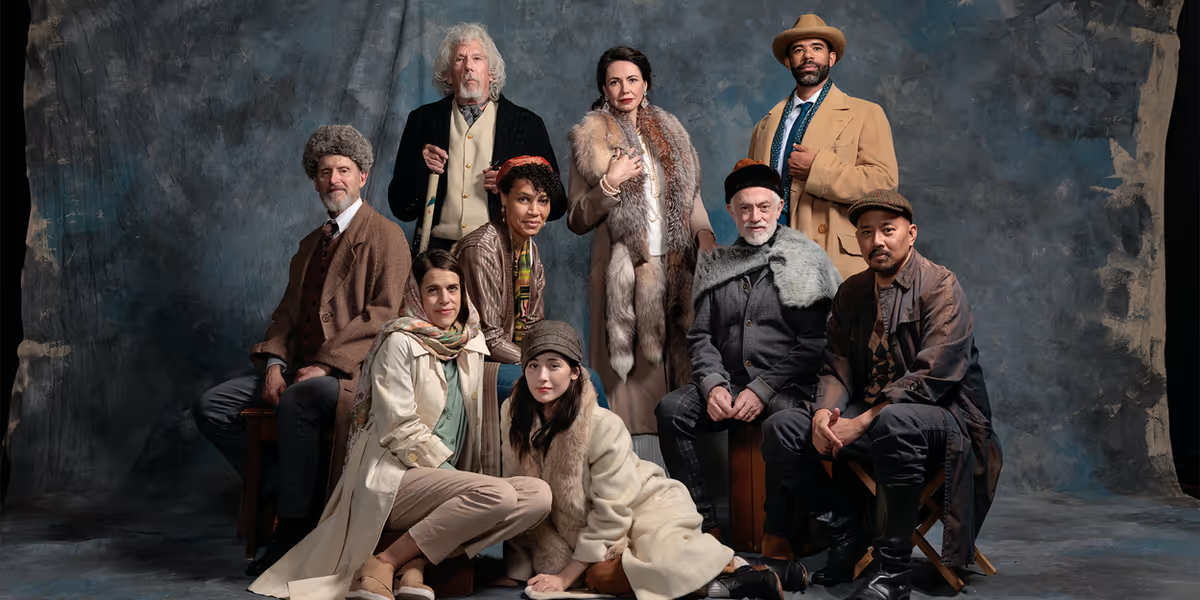
Carey Perloff has reached that stage in her career where she can be very choosy about the projects she takes on, but when Marin Theatre offered her the opportunity to direct The Cherry Orchard, she said yes immediately. It happened to be the only Chekhov play she’d never gotten a crack at, plus she’d really enjoyed working with the company last year on Harley Granville-Barker’s Waste. She also found striking parallels between contemporary American society and Chekhov’s fading Russian aristocrats in their inability to cope with changing times. And to sweeten the deal, she cast a slew of Bay Area theater veterans, including Liz Sklar, Anthony Fusco, Danny Scheie, Leontyne Mbele-Mbong, Jomar Tagatac, Howard Swain, Joseph O’Malley, Rosie Hallett, Anna Takayo and Lance Gardner, who happens to be Marin Theatre’s artistic director.
Perloff is best known for the 26 years she spent leading San Francisco’s American Conservatory Theater where she holds the forever title of Artistic Director Emerita. Her post-A.C.T. career has been especially fruitful as she travels the country to work with artistic directors she particularly admires on plays she truly loves, such as the first American production of Tom Stoppard’s Leopoldstadt. Perloff has been very content to no longer lead a theater company and just focus on directing. She has also been doing a lot of writing, something she rarely had time for as an artistic director.
I caught up with Perloff by phone one recent evening while she was still buzzing with energy from the day’s rehearsal. We talked about why she feels The Cherry Orchard remains so relevant, what it’s like to direct her boss in a play, and how she managed to meet the incredible challenges she faced early on in her career as a young woman in leadership positions. Perloff is one of those naturally gifted conversationalists who possesses a phenomenal recall for names and details and can also be delightfully dishy without being mean or needing to settle a score. And, as could be expected for someone who made her mark directing scads of classic works, her knowledge of theater is encyclopedic. The following has been lightly edited for length and clarity.
Have you ever directed a production of The Cherry Orchard before?
No, but I’ve done all the other Chekhovs, and I’ll tell you what’s interesting. We did Cherry Orchard at A.C.T. the year we moved back into the Geary after the earthquake. I wanted to do plays in rep, and so we did Cherry Orchard and The Matchmaker in rep, if you can imagine, although it was a good combination. We commissioned this translation from Paul Schmidt, and Barbara Damashek directed it, so I produced it but I’d never directed it. When Lance called me last year and said, “I think we should do Cherry Orchard,” I was incredibly excited, cause it’s sort of the one that had gotten away from me.
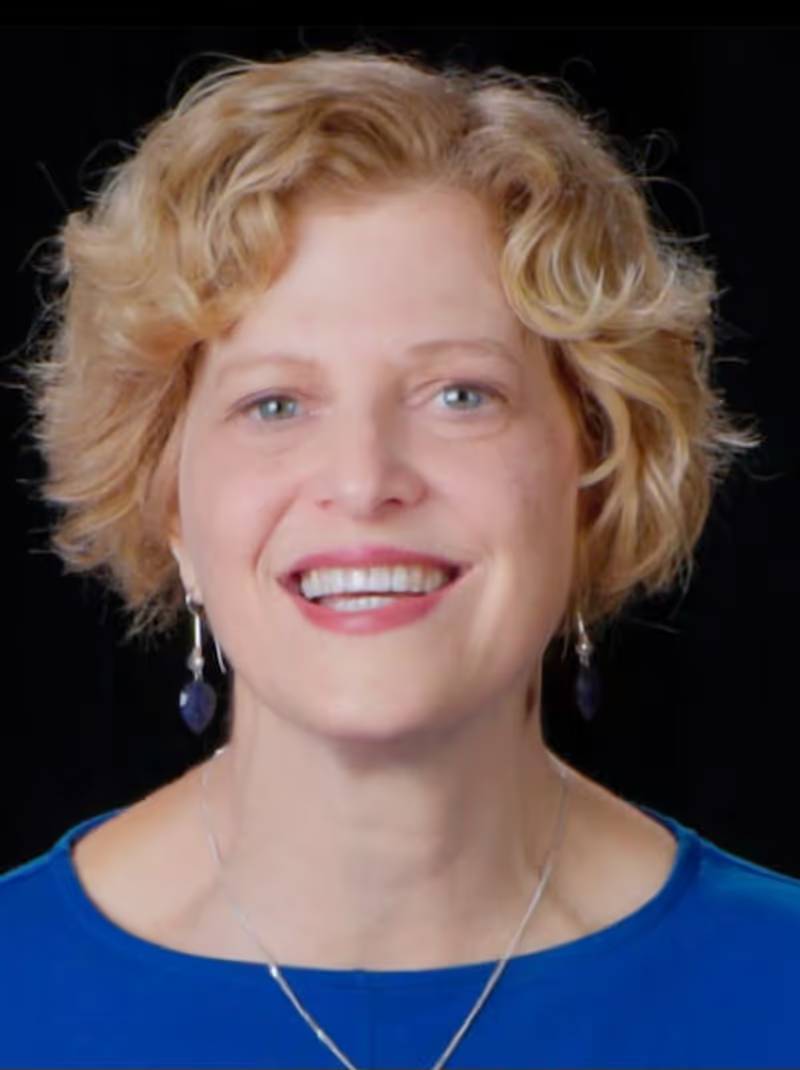
(photo courtesy of Marin Theatre)
Why did you want to do this play now?
Well, last year Lance and I did Waste together, the Granville-Barker play. It’s an incredible play and we had this company of Bay Area all-stars - Anthony Fusco, Jomar Tagatac, Liz Sklar, Lance, Leontyne Mbele-Mbong, just amazing actors. We had such an amazing experience working on that that Lance and I thought about which other plays we could do that would use that company, and so we started talking about Chekhov a year ago.
First, we thought about Seagull, but he didn’t want to do it because it had been done not that long ago, and then this strange thing happened. We had started rehearsals of Waste January 6, 2025, and that was the day of the LA fires and my sister lost her home. I got this text from her saying “We’re evacuating.” and twenty minutes later “The house is gone.” So when we finished rehearsals, I kept going back down to LA and driving around the Palisades, and you would see one house standing and then the next house was just a frame of itself, with maybe a sofa outside with ash on it. My sister said the only thing they found in their house were the metal pedals from her grand piano, and that seemed so Chekhovian, this sense of incredible loss and change, and how hard change is.
Those are very progressive communities, particularly Altadena, and I was driving around Altadena and this is a community that had supported many things about homelessness, etc. But once that neighborhood burned down, everybody wanted to rebuild it exactly how it had been, and I realized how deeply that’s part of human nature. We long for a more beautiful future, but then when it actually comes time to do something different, we’re terrified and just can’t see our way to doing it. And that’s The Cherry Orchard, right?
Lyubov Andreievna knows the house is being mortgaged and that it’s on the auction block in two months, she knows they don’t have any money, she knows they don’t have any prospect of making any money. The serfs have been freed, there’s no industry, she married the wrong person, she almost killed herself in Paris. And along comes a change agent, which is Lopakhin, played by Lance (brilliantly), who says “I have the solution. You just have to do it differently. Take down the orchard, divide it up, build holiday homes and everyone will be happy.” It is the right solution, and she just cannot face it, because that’s how we deal with change, you know what I mean? Even if it would be better to divide things up, to build apartment buildings, house more people. We know all these things in California, we’re a million housing units short, and yet we don’t want to change our neighborhoods. Ever.
It’s a play about the older generation somehow being incapable of handing the reins to the young generation, and this young generation saying, “What have you done to us? What are we? Who are we? What are we going to inherit?” I thought about it just watching the Mamdani inauguration speech and how generationally divided New York is. There are all these young people saying, “Thank god, there’s somebody speaking for us.” And older people saying, “The guy is crazy. He’s promising a million things that will never happen.” There is a huge generational divide in our country right now. So Lance and I had been talking about a lot of things, and when he called me about Cherry Orchard, just speaking about our culture right now, it feels incredibly immediate.
And - unlike many contemporary plays which point the finger and tell you what to feel and who the bad people are and who the good people are – what is so amazing about Chekhov is that he was a doctor, he just shows you the diagnosis. He doesn’t give you the cure, he doesn’t say these people are wrong, these people are good, this is what should happen. Even though he knows the revolution is coming. He wrote it in 1903, the first Russian revolution is 1905, then comes the big revolution in 1917, so the winds of change are obviously blowing. But he doesn’t come down one way or the other, he just shows you how painful it is – and how funny.
I’m so glad you mentioned that. I think a lot of people forget that The Cherry Orchard is actually a comedy.
Oh, it’s hilarious!
Albeit with a large dose of Russian sadness, too. As a director, how do you guide your cast to find the humor?
So this is exactly what we were working on today, and I think it’s this: the person speaking is very high stakes, is full of longing, is in love with the person they’re talking to or has a political belief to share. And the person they’re talking to is either powdering their nose, playing the guitar or in love with somebody else, and certainly not listening. That’s what makes it hilarious, that we miss each other all the time. Something feels very important or very big and for the other person it’s completely banal, or they’re yawning or they fall asleep, or they interrupt and ask for money. Everybody in this play thinks they’re the star of their own movie. Their concerns, their beliefs, their emotions are the most important. Which is kind of true in life, right? We all think, “Oh, no, but my feelings are what count.” And what’s funny, cause it’s so true and so painful, is nobody else is listening because they have their own problems.
There’s also a ton of physical comedy. Yepikhodov is madly in love with Dunyasha and he plays love songs sometimes on the guitar but mostly he’s always crashing into the furniture and falling down stairs and ridiculous things happen. Or Lance found something today. He stands there all of Act I waiting for Lyubov to look at him and say, “Wow, look at you in the five years since I’ve been gone. You’ve got a new suit, you look amazing.” And she just walks right past him and doesn’t even notice he’s there. It’s so sad, but so hilarious. By the third time, you’re just laughing because you think “Okay, guess she’s not gonna notice.”
How did you choose this translation by Paul Schmidt? You mentioned that you had originally commissioned it for A.C.T.
Paul Schmidt was such a genius. He was a Russian scholar, a Harvard PhD, but also an actor, and quite an avant garde one. He was part of the Wooster Group in New York for some years and did a deconstructed Three Sisters called Brace Up! I knew him very well, and his partner is a wonderful composer named Mark Bennett, much younger than he. Mark and I have worked together often over the years.
Paul and I met when I was running CSC [Classic Stage Company] in New York in my twenties, and I always adored him so when I came to A.C.T., I commissioned him to do Uncle Vanya for me, which I did with Wendell Pierce and all kinds of wonderful people. Then we commissioned him to do Three Sisters, and that included Anthony Fusco, who’s in this, and the rest were my core company back in the day at A.C.T. – Marco Barricelli, Rene Augesen, Steven Anthony Jones, Gregory Wallce, all those wonderful actors.
I’ll tell you what I loved so much about him. He always sat there with the Russian, his Russian was perfect, and he would read you aloud what the Russian sounded like, which is helpful even if you don’t speak Russian, just to get a sense of is this an ultimatum, is this a question, is it a seduction, what is it? He was very clear that we’re not doing [early Chekhov translator] Constance Garnett, we don’t want them to sound British, we don’t want them to look like Laura Ashley, we are translating this for American contemporary actors. He really listened to their voices and their needs and personalities, and did a lot of revisions as he went. He was extremely collaborative, and just really funny, really helpful.
Very sadly, Paul Schmidt was one of the first people in the American theater that we lost to AIDS. I miss working with him so much and I know he would have still been here, tinkering with these translations and doing them. When Lance invited me to do this, I read every translation I could get my hands on – and there are many – and I came back to Paul. I just thought there’s nobody better. Also, because I am still in such close touch with Mark Bennett, if we need to tweak or question something, I knew he would be amenable. It’s a very funny and very immediate translation. It’s not anachronistic in the sense that they’re carrying around cell phones and that kind of thing, but it feels a hundred percent like contemporary people talking to each other.
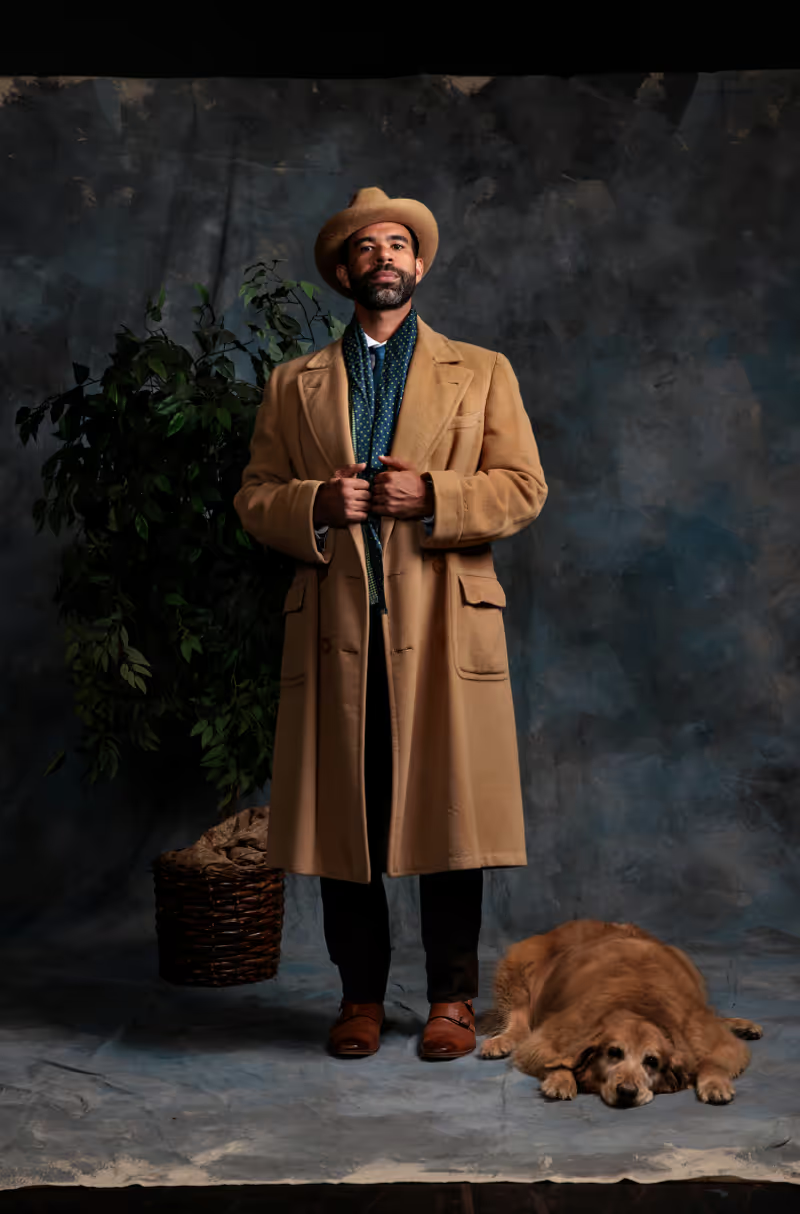
The Cherry Orchard at Marin Theatre
It sounds like you and Lance Gardner work very well together. What it’s like to basically be directing your boss in a play?
I know - isn’t that fun?! You know, when I left A.C.T., I had been running a theater all my life, since I was 25 years old and I know nobody believes this, but I was so happy not to be running a theater anymore. I was really ready to be done. It took a while for me to get my sea legs – but I’ve been directing all over the country and writing a lot, and it has been the most amazing experience. I can concentrate on the work at hand in a way that I never could when I was running a theater, because I was always on a break doing what poor Lance has to do now, which is putting sandbags out and fixing the toilets and writing a press release and triaging a staff disaster and everything.
So I feel incredibly empathetic to Lance. I think he’s really one of the best leaders we have. I have been going across America looking for theaters led by people who I think actually have some vision, and it’s really been interesting, exciting and often difficult. I think this is a really terrible time for the American theater. But Lance is amazing. He’s relentless and funny and fierce. He’s extraordinarily smart, completely self-taught, but amazingly smart and his perspective is always unique. And what I really admire is he’ll be in the room as an actor, as a peer of everybody else. He doesn’t pull rank with the other actors, he makes the room very easy for everybody. But – as soon as it’s break time, he goes and does what he has to do, you know what I mean?
He takes direction better than anybody, like he’s incredibly fun, he’s really easy to direct, he’s funny, he’ll try whatever. So I feel like my job is to both use his time incredibly well when we’re in the room because I know how precious the time of an artistic director is, and then honestly just help in any way I can, outside of it. Like if there are donors I know from all my years at A.C.T. that I can help bring money to Marin, cause they really need it, I am totally happy to go out there and fundraise for him or do press, or do whatever’s necessary, or just leave him be, because I’m really rooting for him. I think he has a big vision, and that’s very hard to find. I’m convinced he’s going to make this theater something really important.
When you took over the reins at Classic Stage Company in New York, you were 25 and then you started at A.C.T. in your early 30s. It wasn’t that common to have women in those roles to begin with, not to mention such a young woman. Did you feel like a pioneer?
Oh, man – I don’t know that I felt like a pioneer. I felt very alone. Not so much when I was at CSC because it was part of a real downtown community. It was below 14th Street, up the street from La Mama, the Public, PS 122. We all were scrappy, avant-garde, different kinds of theaters and we looked out for each other. To be honest, when I took over CSC, the guy who ran it hadn’t paid payroll taxes for 5 years and it was so broke all we were thinking about was what did we need to do to save this theater. So I think nobody else but a 25-year-old woman who didn’t know any better would have taken the job anyway. I was so busy trying to save the theater, I didn’t think, “Oh, I’m a pioneer.” [laughs]
And when I came to A.C.T., I did not realize how bad things were there. I knew the earthquake had happened [nearly destroying the Geary Theatre], but I thought “Omigod, it’s this big famous theater.” You know, I’d gone to Stanford as an undergrad so I’d come and sit in the back of the back balcony as a kid. I thought this is a big, rich theater and I get to San Francisco and discover that it’s completely bankrupt, that a lot of bad things had gone on internally with the managing director. You know, money had been … I won’t say embezzled, but disappeared. The board had no idea how bad things really were, the theater lay in ruins, FEMA hadn’t give us our money and we were calling Nancy Pelosi on the floor of the Democratic convention to say “We have to get our FEMA money.” And I had a two-year-old and my husband was in law school. It was insane! So I never stopped to think, “Oh, this is unusual.” I just thought, “Oh my god, this is a disaster. How are we going to save this theater?”
My first year I was dancing as fast as I could, and I felt totally alone because the Bay Area theater community is very spread out and there was not a lot of support. I think A.C.T. was the flagship, so it was separate, and the people running the other big organizations were men twice my age without children, so I didn’t really have anybody that I could call and say “Now what do I do?” But I had a really wonderful board chair named Alan Stein, and he stuck with me. And my first year I got in so much trouble. I was picketed by the Catholic church because we did this outrageous production of The Duchess of Malfi and they thought it was anti-Catholic, and then we did this play called The Pope and the Witch about abortion.
So I was in big trouble, and when I got called in by the board chair at the end of the year, I was sure he was gonna fire me and frankly I was completely ready to be fired. I was like “Just fire me and let me go back to New York.” And I’ll never forget it, he was such an amazing man, he said, “Look, change is really hard. You’ve done the hard part and now you have to see it through.” And I was like “I do? I have to see it through?!” So, I had some allies. I told Howard Swain in rehearsal today that Joy Carlin was really helpful to me, Craig Slate who ran the Young Conservatory, there were people who were amazing to me and incredibly kind.
But it was a nightmare few years, until we could get the money together and start to rebuild the theater, and then to reopen it. That was like a five-year process, and by then I’d sort of found my sea legs and there was a lot of hope because it was exciting and the theater was beautiful. It’s so moving all these years after to reconnect with people like Mimi Haas, who’s Mayor Daniel Lurie’s mother. She was the first donor I met when I came, and Daniel was a student at University High School. He came with Mimi to see the first play I did, and I wasn’t that much older than he was. It was a Strindberg play and Mimi said, “Would you talk to Daniel? He has to write a paper on it for UHS.” And I said, “Of course.”
That’s how I met Daniel and Mimi, and Mimi was incredible. Theater wasn’t even her first love, she ran SFMOMA. But she was fantastic. So there were people like that – Sako Fisher was like that, there were donors who were really kind to me and supportive and stuck with me. Cause I did some outrageous things the first couple years [laughs] and I thought, “Ooh, this is too radical for this audience.” And then we caught up to each other, you know?
So I really get it with Lance and I think he is really brave. He doesn’t want to do standard-issue theater, but he also knows he has to fill the seats. One of the things he’s brilliant at is really talking to the audience, telling them why he chose a certain play. He did this speech when we gave a fundraiser about Cherry Orchard about 1861 when the serfs were freed in Russia, and how thrilling everyone thought that was gonna be, then they realized it was a train wreck because there was nothing else for the serfs to do. They had no land, no money, no skills, and meanwhile the people who owned them now had farms to tend with no labor. Lance said, “And five years later, civil war happens in America and it’s a similar period of complete upheaval, and what are southern landowners supposed to do? What are the freed supposed to do?” Here he is as a Black man and artistic director putting those things together and talking to his audience about it, with no notes. It was really amazing, and I thought, “Well, that’s part of being an artistic director.” You really have to get up and share the vision why does this matter to you, and why should it matter to them.
At this point in your career, you can be pretty choosy about the projects you take on. What are you looking for in taking on something new?
I’ll give you one example. The summer before last I went down to Santa Cruz Shakespeare and did As You Like It. (And he’s another great leader by the way, [artistic director] Charlie Pasternak, another young actor who’s leading a company. I think actors leading companies is a really good thing; I love that.) But anyway, what I realized is, in all my ears at A.C.T. doing many, many classical plays, I had done far too little Shakespeare because I thought, “Well, loads of other companies on the West coast do Shakespeare well so we don’t need to do Shakespeare. I should do Marlowe or Webster or Brecht or Sophocles or…” I did a million other classics, but I disappointed myself when I left A.C.T. that I’d done so little Shakespeare. So the second Charlie called me, I was in.
And he kept saying to me, “But you know we don’t have that much money” and you know this and that. And I was like “It doesn’t matter.” And I had the most wonderful time. I had a great company and it’s a great play and I was incredibly happy. So that was one example: I’d go anywhere to do Shakespeare. I’d go anywhere to do Chekhov or really any great classical play. These are my favorite things.
The other thing of course is I’d go anywhere to do Tom Stoppard. Over the last two years, I did the first American production of Stoppard’s Leopoldstadt, which is his last play. It’s incredibly beautiful and it’s about Viennese Jews, which is really my family history. I did the first production for Loretta Greco, my old friend from the Magic who’s now at the Huntington, and we took that to Washington, D.C. This spring, I’m doing it for Braden Abraham at the Writers Theater in Chicago.
Those writers who mean so much to me – Pinter, Stoppard, that world. I would go anywhere to do a Stoppard play, particularly the last one. We lost him a month ago so for me to have a chance to honor him by doing it, that’s really meaningful. And then I’ve been writing my own work, so I had a play developed at Denver Theater Center and I’m gonna go back there. That’s really fun because I had much less writing time when I was at A.C.T.
So it’s thinking about that. I’m working on Oedipus right now that we’re gonna do this fall at PlayMakers. And again, I did a lot of Greek tragedy at A.C.T., but Oedipus, which is arguably the greatest one, just passed me by. So that chance I couldn’t miss. And it’s also just going to work for people whom I really love and admire and would love to participate in their journey, you know? Like how can I help the American theater? I’m not running a theater anymore, nor do I want to run a theater anymore, but I care very much about this field, so I keep thinking “How can I be useful?” And one way is to go support artistic directors who I think are doing exciting work, and just do the best work I can do for them.
---
(Header photo of Marin Theatre’s The Cherry Orchard cast by Chris Hardy. From top L to R: Howard Swain, Liz Sklar, Lance Gardner, Anthony Fusco, Leontyne Mbele-Mbong, Danny Scheie, Jomar Tagatac, Rosie Hallett and Anna Takayo)
---
The Cherry Orchard will be performed January 29 – February 22, 2026 at Marin Theatre, 397 Miller Avenue, Mill Valley. Tickets are available at MarinTheatre.org or by calling 415-388-5208.
Sign up for all the news on the Fall season, discounts & more...
|
Bye Bye Birdie Warren Theater (9/18-10/04) |

|
Gutenberg! The Musical! Hillbarn Theatre (10/08-11/01) |

|
The 2026 GLIDE Holiday Jam: Turn It Up and Turn It Out The Warfield (11/05-11/05) |
|
Mrs. Winchester (or, a Gun in the First Act) City Lights Theater Company (10/04-10/04) |

|
Hello, Dolly! Hillbarn Theatre (4/15-5/09) |
|
Empty Nest and All the Rest City Lights Theater Company (10/11-10/11) |

|
POTUS Live Oak Theater (9/11-9/26) |
|
Dear San Francisco Club Fugazi (9/16-3/31) |

|
The Death of Meyerhold Shotgun Players Ashby Stage (11/28-1/01) |

|
“E4TT Call For Scores: Solo Piano, Vol. 3” Berkeley Piano Club (10/25-10/25) |
