


Review: STEW at Rebel Phoenix Theatre Collective
A powerful portrayal of generational bonds and buried secrets unfolds in STEW at Rebel Phoenix Theatre Collective.

For most of us, many formative and influential memories start in the kitchen. From recipes being cooked that are passed down from generation to generation, announcing good news, or gathering with family and friends, this place is cemented as the nexus of our lived experiences. It is no surprise, then, that Zora Howard’s Stew, a play about family, is set there. What simmers beneath its domestic surface is anything but insignificant. Produced by Rebel Phoenix Theatre Collective and directed by Felicia Penza, this staging understands that kitchens are not just places of nourishment but sites of memory, labor, conflict, and inherited trauma. In this production, Stew becomes less a linear narrative and more a ritual—one in which history, grief, humor, and love circulate continuously, refusing to settle in the past.
Howard’s play centers on the Tucker family, where three generations of Black women – Mama, the matriarch, and her adult daughter, Lillian, her teenage daughter Nelly, and her pre-teen granddaughter, Lil’ Mama – gather to prepare Mama’s famous stew for an important community event. As they chop, stir, and argue over the recipe and their roles in the kitchen, simmering tensions about health, relationships, unspoken hurts, and family secrets begin to surface, revealing bitter resentments and deep emotional bonds. Against the backdrop of laughter and banter, the play explores the patterns passed down through generations, the weight of unspoken history, and the tenuous balance between love and pain, ending with a haunting sense that not everything can be cooked down or resolved.
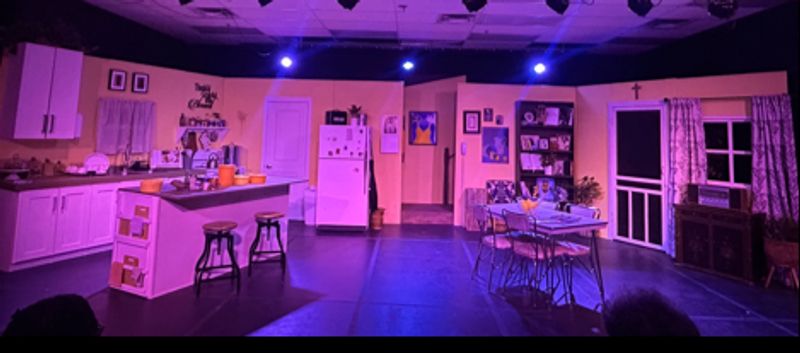
The set design, realized and built by Alexandra and Dustin Kallis, respectively, immediately grounds the audience in a recognizable, fully realized domestic world. Walking into the space, the kitchen feels authentic to its bones: the vintage yellow walls, a refrigerator with family photos attached to the freezer door, a bookshelf filled with cultural touchstones like Nina Simone, and photo albums pulled from the director’s own collection, each containing memories of kitchens just like this one. There is a powerful sensory familiarity here—so much so that it evokes smell-memory, conjuring the feeling of stepping into a grandmother’s house before a single line is even spoken.
At the center of the production is Cherylandria Banks as Mama, a woman who moves through the space with visible exhaustion but also resolve. Her physicality suggests someone who has seen too much but has had no choice other than to keep going—each step weighted, each action propelled by necessity rather than ease. Banks’ Mama carries both authority and weariness, delivering sharp humor as the family’s anchor while also embodying the immense burden of Black motherhood. Her moments of gravity, particularly during the Richard III monologue about a mother and her child, land with devastating force, reframing Shakespeare through the lens of contemporary racial violence and maternal fear.
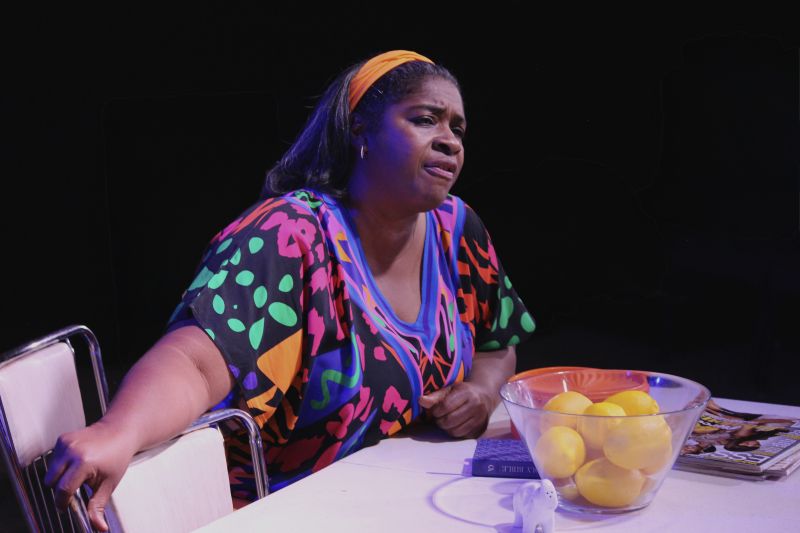
Photo by: Melany Tate
Banks joined the production less than a week before opening and remains on book for the performance, but it is hardly noticeable with the agility of her quips and the passion and warmth in her words. When Mama’s language fractures and becomes quieter, disconnected, and nearly incomprehensible, you soon realize that it's the nature of how Mama's trauma has affected her speech delivery, not because she is on script. These moments ultimately align with the play’s exploration of stored trauma and psychological rupture; the visual reality of being on book sometimes blurs the line between intentional disintegration and logistical necessity initially, but once it's understood that this is how Mama presents recalling trauma, the confusion is removed.
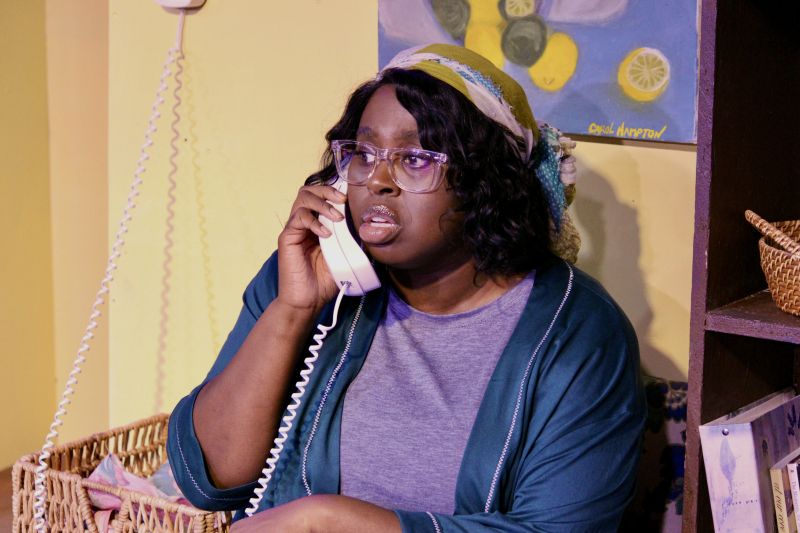
Photo by: Melany Tate
Deatra D. Branston, as Lillian, brings a fierce, controlled intensity to the role, echoing Mama’s vocal strength while allowing uncertainty to linger beneath the surface. Her delivery of the line “It’s all in your head,” spoken directly into Mama’s eyes, becomes one of the production’s most unsettling moments, less reassurance than self-persuasion, revealing how denial operates as a survival mechanism passed down through generations. As the one who is supposed to have things taken care of, we soon see the facade that Branston has crafted being chipped away throughout the play.
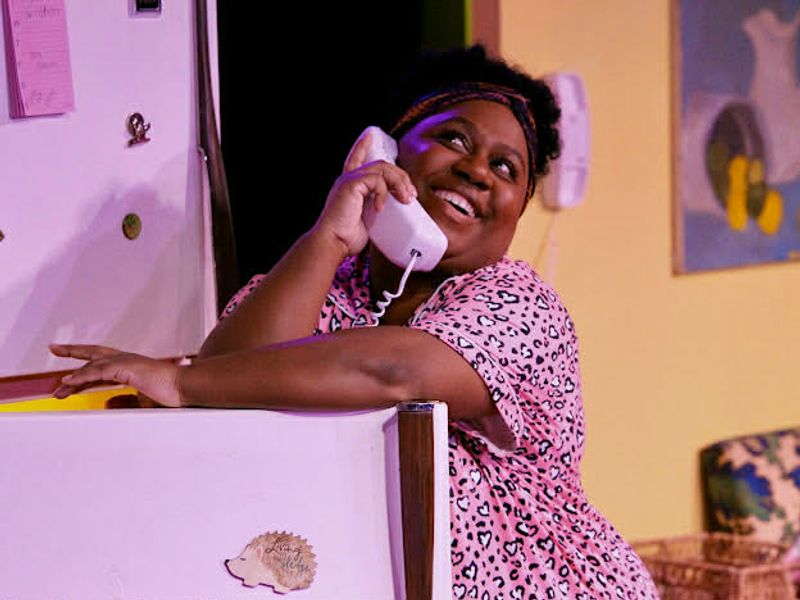
Photo by: Melany Tate
Nelly, played by Kieara Kurtz-Williams, leads the play with an irrepressible sense of joy and an infectious personality that gives the impression of a bubble perpetually on the verge of bursting. Kurtz-Williams plays her with a buoyant, almost Puck-like physicality, using her body and voice to claim space confidently and proudly. Beneath that playfulness, however, lies a palpable longing—one that surfaces most clearly in her arguments with Lillian. It is the yearning of someone who wants desperately to be taken seriously while still being treated like a child. Nelly responds to most situations with humor, deflecting tension with wit until she is pushed too far; in those moments, particularly opposite Lillian, Kurtz-Williams allows a definitive defiance to crack through the joy at times, showing a gift not just of commanding a room but owning it.
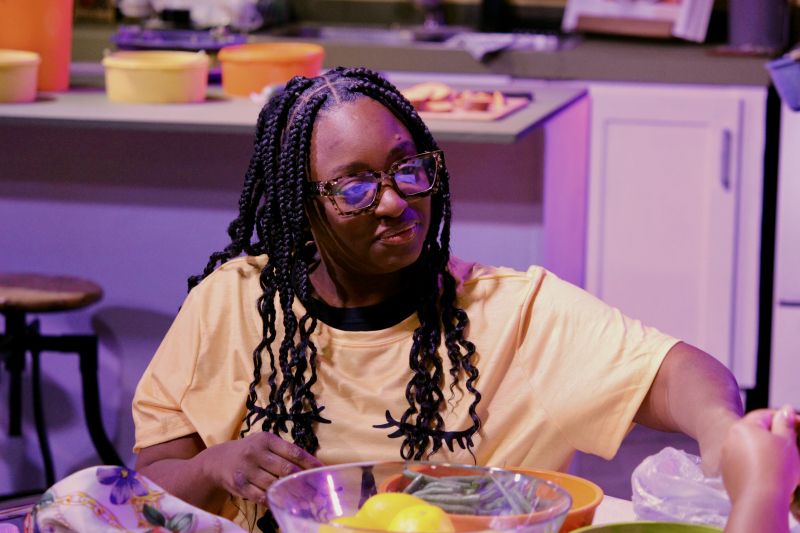
Photo by: Melany Tate
Kayla Howard’s Lil’ Mama arrives with a different but equally vital energy—bratty, dramatic, and unapologetically loud in her need to be seen. She stomps into scenes often with frenetic “why, why, why?” questions delivered without pause, sometimes inviting attention and other times simply demanding it. Howard balances mischief with a distinct innocence, crafting a comedic portrayal of brattiness that never tips into irritation. Instead, she leans into childlike wonder to temper the attitude, allowing the audience to delight in Lil’ Mama rather than recoil from her. Her vocal delivery is particularly memorable: sassy and throaty, pitched just high enough to evoke excitement, impatience, and curiosity all at once.
Penza’s direction leans into a cyclical structure, allowing moments to echo rather than resolve, and trusting the audience to sit with discomfort rather than rush toward resolution. The stew itself functions as an actionable metaphor rather than a purely reflective one. Its preparation is chaotic, communal, and emotionally charged—everyone tending to it at once, often without coordination. In this way, the stew mirrors the life of the family itself: food as comfort, food as chaos, food as the labor that keeps everyone alive even when order feels impossible. It is something that must be tended to, regardless of emotional readiness, much like grief and survival within a Black household.
Sound design, by Nat Coe, proves to be one of the production’s most effective storytelling tools. Gospel music underscores Mama’s deep connection to the church, offering moments of solace and tradition, while some of the play’s audio moments seek to rupture that sense of safety. Joanna DeShay weaves a playful tapestry in her costume design, while making sure to highlight each of the characters’ personalities and relationships flawlessly.
What lingers most after the lights fade is the bond between this family and the audience. There is a profound sense of recognition here, even for those who may not share this specific cultural experience. Howard’s play, and Penza’s thoughtful staging, place the audience inside a family they might never have known and ask them to feel the weight of what that family carries every day. Stew makes clear that these events are not singular or contained. They live in the body, in language that breaks under pressure, in denial that masquerades as reassurance, and in rituals that repeat because there is no alternative. This production argues that intergenerational trauma does not recede neatly into history—it reverberates forward, shaping the present and threatening the future. Stew not only shows strength in its performances and design, but also in the way it forges connection, through love, through grief, and through the fierce insistence on survival.
Stew runs through January 31 with Rebel Phoenix Theatre Collective.
Prefer BroadwayWorld in Google Search?
Add us as a preferred source so our stories show up more often in Top Stories and Google’s AI answers — for you.
Sign up for all the news on the Fall season, discounts & more...

|
Proof Temple of Music and Art (9/27-10/17) |

|
EUREKA DAY Stray Cat Theatre (10/09-10/17) |

|
The Comedy of Errors By William Shakespeare Adapted by Stephen Frankenfield Live Theatre Workshop (9/18-10/11) |

|
The Taming Flagstaff Shakespeare Festival (9/19-10/04) |

|
Clue Hale Centre Theatre Arizona (12/31-2/06) |

|
Black Comedy Live Theatre Workshop (10/30-11/22) |

|
A Room in the Castle Beaver Street Theatre (9/18-10/03) |

|
Grupo Arga Detectives Privados Grupo Arga Detectives Privados (5/18-10/18) |

|
Mean Girls MCC Performing Arts Center (10/09-11/08) |

|
MY MAN GODFREY Don Bluth Front Row Theatre (1/21-2/27) |

Reader Reviews
To post a comment, you must register and login.