


MABOU MINES Explores Cinematic Ventures in New Film Series
The series includes films like Moi-meme and Dead End Kids.
Mabou Mines is launching Mabou Mines Cinema, a new a series exploring the company founding members' little-seen forays into film, including the new wave-inspired, Breuer-directed Moi-Même, featuring a brief cameo by Jean-Luc Godard, which the group shot in Paris in 1968 before officially forming the company (but which was only recently resurrected and reimagined by Breuer's son Mojo Lorwin); The Red Horse (1974) and B. Beaver Animations (1979), two of the company's first experiments with video; JoAnne Akalaitis's feature film version of her Obie-winning play Dead End Kids (1986), which takes a darkly comic and philosophical approach to the prospect of nuclear Armageddon (and boasts a soundtrack by David Byrne and Philip Glass); and filmmaker Jill Godmilow's epic, six-hour, fly-on-the-wall documentary Lear '87 Archive (2001) (never-before-screened theatrically), which follows the rehearsal process for the company's ground-breaking gender-reversed version of Shakespeare's King Lear, directed by Breuer and starring Maleczech. In addition to the aforementioned artists, the films in this series feature Mabou mainstays Honora Fergusson, Ellen McElduff, Greg Mehrten, Maude Mitchell, Fred Neumann, Terry O'Reilly, Bill Raymond, and many other legends of downtown theater.
Mabou Mines Cinema will feature 6 different programs running March 13 - 19 at Anthology Film Archives.
The programs and schedules are as follows:
Program 1 - Fri, Mar 13 at 6:30 and Wed, Mar 18 at 6:30
Moi-Même (Mojo Lorwin/Lee Breuer, 1968/2024, 65 min)
Both the first and the most recent Mabou foray into celluloid, this new wave-inspired film — which was shot in Paris in 1968 two years before the company was formed, and features a brief cameo by Jean-Luc Godard — stars Kevin Mathewson as a 13-year-old wannabe auteur alongside David Warrilow, Ruth Maleczech, and Fred Neumann playing various film industry figures (or are they hallucinations?) guiding and impeding him on his quest to become a director. The 16mm raw footage was abandoned without sound or script until it was resurrected and reimagined by Breuer's son Mojo Lorwin in 2024. A collaboration between father and son across half a century, Moi-Même is both a lost 1960s arthouse film and a new experimental work in its own right which uses the original footage to tell a story about the political and artistic legacy of the 60s in our time and to explore the meaning of abandoned projects. "In its dreamy 60 minutes that take up questions of personal and artistic legacy, Moi-Même reminds us, too, of the abiding commitment beneath Breuer's — and Mabou Mines's — oeuvre: that refusing commercial narrative logics can help inspire new visions for the world." — Alisa Solomon, Jewish Currents. The screening on Fri, Mar 13 will be followed by a Q&A with Mojo Lorwin and actor Kevin Mathewson.
Program 2 - Fri, Mar 13 at 8:45 and Wed, Mar 18 at 8:30
The Red Horse Animation (Lee Breuer, 1974, 38 min)
First performed in 1970, Red Horse was the first Mabou production and the first of Breuer's Animations series (which featured animal protagonists brought to life by multiple performers). Starring JoAnne Akalaitis, Ruth Maleczech, and David Warrilow, and with a live score by Philip Glass, Red Horse — a statement of Breuer's intentions as an artist and a meditation on his relationship to his conformist workaholic father — sees the young company toeing the line between theater and performance art. This psychedelic video version features camerawork by experimental filmmaker Dee Dee Halleck. "[O]ne of the most radical uses of performance space to be seen up to this time in the American theater. It is a major aesthetic breakthrough." — Bonnie Marranca, SoHo Weekly News
The B. Beaver Animation (Lee Breuer/Chris Coughlan/Craig Jones, 1979, 32 min)
The second of Breuer's Animations, first performed in 1974, features Neumann as the eponymous beaver philosophizing about the art of dam-building — weighing family responsibility against creative urges against his paranoid fantasies of persecution. This stripped-down monologue version of the play is a unique record of Fred Neumann's tour-de-force performance. The close-up videography by Chris Coughlan and Craig Jones heightens the maniacal Cassavetes-esque aspects of Neumann's Beaver. "Facing this strange, disorienting exercise, one should abjure explication. The most rewarding approach is to relax and enjoy the voyage." — Mel Gussow, New York Times
Sister Suzie Cinema (Lee Breuer, 1982, 19 min)
Sister Suzie Cinema is a doo-wop opera paean to the silver screen written by Breuer and composer Bob Telson for the New Jersey a capella quintet 14 Karat Soul in 1980. An unlikely counterpoint between Breuer's cinerotic double entendres and the transcendent harmonies of the singers, the short musical was at one point part of a double bill with the work-in-progress Gospel at Colonus (then featuring 14 Karat Soul as well). Produced by Liza Lorwin (The Gospel at Colonus, Peter and Wendy), this film version was shot in London in 1982, but never finished or released. "Movies, doo-wop singing, free-associative imagery and yearning, unabashed romance are the makings of Sister Suzie Cinema...a fantasy about fantasies — about the way movies, music and other cultural artifacts shape what we feel." — John Pareles, New York Times. The screening on Wed, Mar 18 will be followed by a Q&A with Carl Hancock Rux, Sister Suzie Cinema composer Bob Telson, and 14 Karat Soul lead singer Glenny T.
Program 3 - Sat, Mar 14 at 4:00 (Pt. 1), Sun, Mar 15 at 4:00 (Pt. 2)
Mabou Mines' Lear '87 Archive (Condensed) (Jill Godmilow, 2001, 336 min)
Having worked with Mabou on Far From Poland, Jill Godmilow (who passed away in late 2025) decided to undertake this epic Frederick Wiseman-style fly-on-the-wall documentary of the 1987 rehearsal process for Lee Breuer's gender-reversed production of Shakespeare's King Lear, starring Ruth Maleczech. Never-before-screened theatrically, Godmilow's film subtly juxtaposes the play's themes of power and renunciation with the company's collaborative working process and the state of the women's movement at the time. Featuring Greg Mehrten, Ellen McElduff, Karen Kandel, Bill Raymond, Honora Fergusson, and Breuer and Maleczech's children Lute Ramblin' and Clove Galilee, alongside Isabell Monk of The Gospel at Colonus, Lola Pashalinski and Black Eyed Susan of the Ridiculous Theatrical Company, and Ron Vawter of the Wooster Group, as well as a score by electronic music pioneer Pauline Oliveros, Lear '87 is a sort of Let It Be for the company — a one-of-a-kind document, capturing Mabou at a crossroads in its history, before many of its first generation of collaborators would go their separate ways. Kandel, Maleczech, Mehrten, and Monk all won Obies for their performances. "If you have any brains, you know you're going to be thinking about it for the rest of your life." — Michael Feingold, The Village Voice. Lear '87 Archive will be presented in two parts: the first half (ca. 175 min) will screen on Sat, Mar 14 followed by a Q&A with actor Greg Mehrten. The second half (ca. 170) will screen on Sun, Mar 15.
Program 4 - Sat, Mar 14 at 8:15 and Tues, Mar 17 at 7:00
Far From Poland (Jill Godmilow, 1984, 110 min)
Godmilow's agit-prop documentary/fiction hybrid film about the Polish Solidarity movement, the first successful independent labor union to emerge in the Eastern Bloc during the Cold War, was also her first collaboration with Mabou Mines. Denied a travel visa by the Polish government, Godmilow stays home and goes Brechtian, recreating actual interviews with Solidarity leader Anna Walentynowicz in a New York loft with Ruth Maleczech in the lead role. The film also stars Honora Fergusson as a reporter, Bill Raymond as a government censor, David Warrilow as the voice of the Polish dictator Wojciech Jaruzelski, and Mark Margolis (PI) as a shipyard worker. Far From Poland is a powerful portrait of resistance suddenly springing up in a time of despair, as well as a self-reflexive meditation on the impossibility of understanding a revolution an ocean away. Made in collaboration with Andrzej Tymowski, Susan Delson, and Mark Magill. Preserved by the Academy Film Archive. "A groundbreaking work in the history of experimental documentary cinema." — Museum of Modern Art in Warsaw
Program 5 - Sun, Mar 15 at 7:45
Mabou Mines Dollhouse (Lee Breuer, 2008, 124 min)
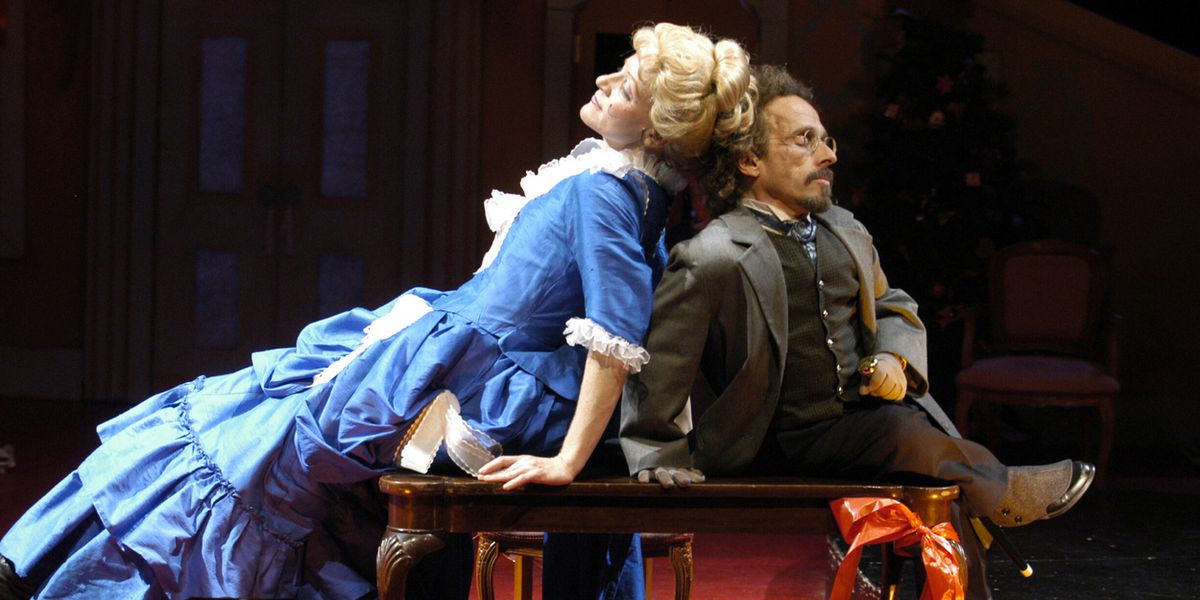
Breuer and Maude Mitchell's internationally acclaimed Obie-winning take on Ibsen's proto-feminist play, first performed in 2003, featured tall women (led by Mitchell as Nora) enslaved to the desires and whims of men under five feet tall, a visual allegory for the paper tiger of patriarchy. This cinematic version of the production is in the tradition of Bergman's Magic Flute and Powell and Pressburger's Tales of Hoffmann, with puppet spectators watching human performers in a tragicomic reverse-puppet show. Silent film melodrama, Norwegian folk elements, and circus acts culminate in a devastating operatic climax. "The whole experience is so fascinating — thrilling here, confounding there — that it must be seen." — Margo Jefferson, New York Times. The screening will be followed by a Q&A with Olga Taxidou and actress and co-adaptor Maude Mitchell.
Program 6 - Mon, Mar 16 at 7:00 and Thurs, Mar 19 at 7:00
Other Children (JoAnne Akalaitis, 1979, 19 min)
Other Children is Akalaitis's first film, shot in beautiful color 16mm in 1979 and lovingly restored by IndieCollect in 2022. Based on a story by Jane Bowles, it is a lyrical experimental film about unsupervised children shot in Cape Breton, Nova Scotia. Although not a Mabou Mines production, the film features performances by company members Bill Raymond and Ellen McElduff alongside Joan Jonas and Akalaitis and Philip Glass's daughter Juliet Glass. The cinematography is by filmmaker Jacki Ochs, while it was edited by frequent Mabou collaborator David Hardy.
Dead End Kids: A History of Nuclear Power (JoAnne Akalaitis, 1986, 87 min)
Made in the wake of the Three Mile Island partial nuclear meltdown, Akalaitis's cinematic adaptation of her Obie-winning 1980 play is an existential collage of scenes touching on the scientific, cultural, and political history of nuclear technology, peppered with vaudeville-style vignettes which add a surreal layer of gallows humor to the proceedings. Brimming with anger through a veneer of deadpan irony, Dead End Kids juxtaposes the tale of Faust, the philosophy of the alchemists, the life of Marie Curie, the bombings at Hiroshima and Nagasaki, wartime propaganda, and damage control PSAs by the nuclear industry against a synth soundtrack by David Byrne (who makes a cameo), with additional music by Philip Glass. The large ensemble cast includes Ellen McElduff, Ruth Maleczech, Terry O'Reilly, Greg Mehrten, Fred Neumann, Akalaitis and Glass's children Juliet and Zachary Glass, and Lee Breuer and Maleczech's children Clove Galilee and Lute Ramblin', alongside Theater Three Collaborative's George Bartenieff. Several scenes were shot in PS 122. "Almost single-handedly [Akalaitis] is giving new life to the whole notion of political theater." — Frank Rich, New York Times
For more information visit anthologyfilmarchives.org.
Sign up for all the news on the Fall season, discounts & more...

|
LA GRINGA Repertorio (2/08-12/31) |

|
LA CASA DE BERNARDA ALBA Repertorio (11/15-12/31) |

|
After All These Years AMT Theater (9/09-10/10) |

|
Priscilla Queen of the Desert the Musical Gallery Players (9/18-10/04) PHOTOS |

|
EN EL TIEMPO DE LAS MARIPOSAS Repertorio (1/07-12/31) |

|
FunikiJam’s WORLD MUSIC FAIR Actors Temple Theatre (10/17-12/05) |
