


Review: JUST LIKE US at Los Angeles Theatre Center
Insightful play about living the "dream" life from Latino Theater Company
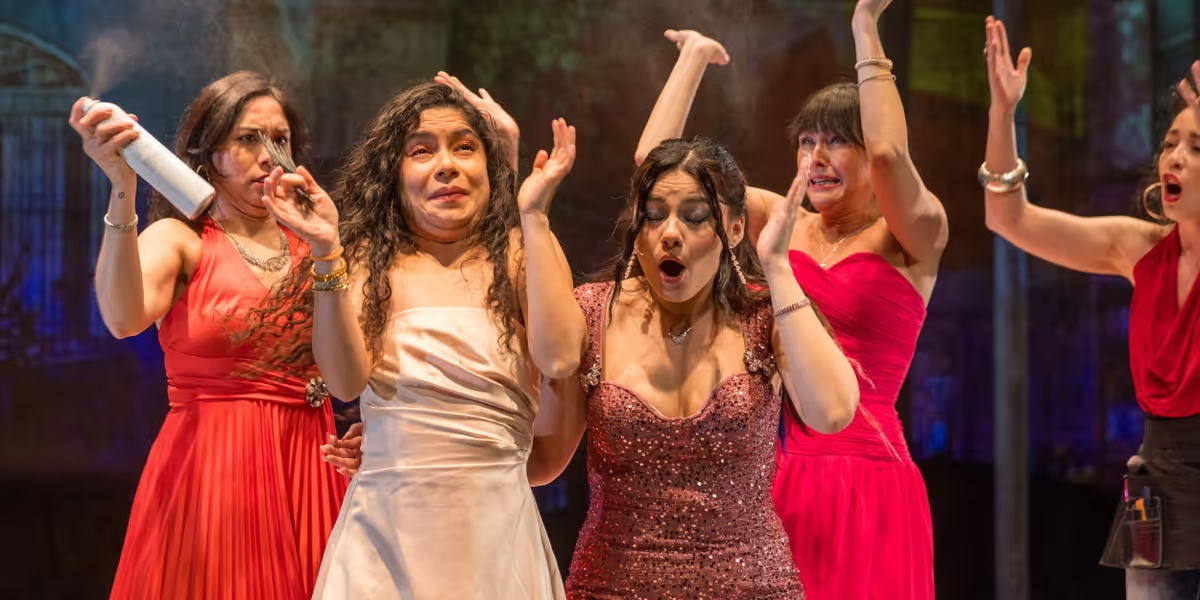
There’s something timeless and joyous in the sight of four high school girls simply being high school girls, whether primping, embracing each other, checking each other’s appearances or dancing wildly - together or separately. When we first encounter, Marisela, Elissa, Yadira and Clara – four high school friends living in Denver, CO. they’re getting ready for prom. As the title Just Like Us suggests, they could be any teen-age girls, extraordinarily just as themselves.
Except that they’re introduced and tracked by a politically-connected fortysomething journalist who is following their every move, their friendships and their circumstances for an article she’s writing about how the immigration crisis plunges a dagger into some people’s ability to live the American Dream. All four girls are smart and would ordinarily be college-bound. But where Elissa and Clara have documentation and are legal US citizens with a clear path to higher education and all the benefits that affords, Yadira and Marisella are undocumented. Their path is uncertain.
Just Like Us, by playwright Karen Zacarias, is based on Helen Thorpe’s non-fiction account of these young women. Tenderly staged by director Fidel Gomez in its west coast premiere by the Latino Theater Company at Los Angeles Theatre Center, the docudrama boils our stomach juices more over the circumstances of our country than over what we witness being played out among the central characters. Which does feel like the point. Just Like Us could be more about them – Marisela, Yadira, Clara and Elisa – and less about the boundaries of American values that the girls test.
Part of the (intentional?) thorniness is the presence of the character Helen Thorpe (played by Elyse Mirto) within her own narrative. We get that Helen dove into this topic with the aim of writing an article. As her research progresses, she has become invested in the fates of the women she’s befriended. But on more than one occasion, we can’t help but as ourselves – as indeed some of the other ancillary characters do – “what’s she doing here?” Helen herself struggles with this, and the question will have a payout at the end as Marisela makes a significant (if on the nose) statement about the importance of telling one’s own story, particularly when it comes to defining one’s American identify.
When asked directly, Mirto’s no-BS Helen says she wants to see – and depict - America “through the eyes of illegal Latin girls.” Well and good. What is not answered is how Helen got there in the first place. How did a white journalist of privilege, married to the Mayor of Denver, get four Latinas with so much at risk to trust her so completely that they seem entirely at ease with her hanging around their schools, their families, their lives. She’s their safety net, and their critical foil.
It falls to Helen to introduce the girls – Clara (Noelle Franco), sensitive, focused and trustworthy; Yadira (Newt Arlandiz), poised, organized and private; the slightly bossy Elissa (Valerie Rose Vega) and Marisela (Blanca Isabella), who emerges as the play’s protagonist. Marisela delights in her bright colors, her boyfriends, her occasionally risky behavior. She’s also a straight-A valedictorian, a girl with a future brighter than the streaks in her hair as long as our nation’s intolerance over her outsider-dom doesn’t derail her.
Through Helen, we follow these girls through meetings with college recruiters and community advocates who are looking to help them succeed. We meet Marisela’s dirt-poor migrant parents who want to protect her more fervently than they want her to have a better life. Outside the girls’ immediate orbit, we hear from Rep Tom Tancredo (Oscar Emmanuel Fabela), a Republican Congressman from Colorado who, despite being the grandson of Italian immigrants, is a hawk against illegal immigrants. The play takes some pains to point out that in the mid-2000s, as these actions are unfolding, immigration is less of a partisan issue. As Tancredo (the closest thing the play has to an outright villain) looks to deport dreamers, other Republican donors fund dreamers’ scholarships. A Republican, Helen points out, co-sponsored the Dream Act.
As the girls move into college, the bonds of their friendship are tested and Elissa moves away. As college students at the University of Denver, Clara, Yadira and Marisela – with Helen still very much in their lives – play out their lives while the landscape over immigration shifts. Some of these situations, like an ignorant, but well-meaning white friend from Bible Study friend named Lucy (Sari Sanchez, excellent in multiple roles), are drawn into a debate with the girls so Helen can facilitate conversations and teachable moments. Helen herself is drawn in when it comes to light that an undocumented man who killed a Denver cop once worked for her husband. Helen seems to wrestle with the irony of this, but not for very long.
The story branches off to focus on Yadira who is forced to care for her 13-year-old sister Zulema (Vega again) after the girls’ mother is caught using a fake ID and flees to Mexico. “Yadira is growing up fast,” Helen informs us, as she finds her article now developing into a book. “She has to.”
Given that Zacarias’s dialog is often on the didactic side to drive home the play’s messaging, the nine-person cast largely does a steady job of establishing interesting characters. Arlandiz and Isabella anchor the proceedings as two girls who face a difficult set of challenges in different ways. Both actors are credible as high schoolers, as college activists and as budding adults. Fabela and Sanchez smoothly flesh out seven and six characters respectively, with Fabela working in two languages. And Mirto takes Helen Thorpe beyond the narrative mouthpiece that the role occasionally threatens to become.
In his vibrant staging of Tacos La Brooklyn for LTC at this theater in 2023, director Gomez took us around the world, from east LA to Japan. The canvas feels nearly as broad for the world of Just Like Us as Francois-Pierre Couture’s open set, enhanced by Hsuan-Kuang Hsieh’s projections and Lee (Xinyaun Li)’s lighting illuminate an America that Zacarias/Thorpe view as either very colorful or very dark, as the winds change.
As the women of Just Like Us went through their experiences nearly a full decade before Donald Trump’s first presidency, the events somehow feel both ripped from the headlines and of a different time. In the play, a sympathetic cop pulls Marisela over, looks at her fake ID, congratulates her on her upcoming graduation and lets her off with a busted taillight. Were those same circumstances to occur today, you wonder whether that former valedictorian might not end up not just deported but behind bars in a foreign country. There’s your American dream.
Just Like Us plays through May 25 at514 S. Spring Street, L.A.
Photo of Valerie Rose Vega, Newt Arlandiz, Blanca Isabella and Noelle Franco
Photo Credit: Grettel Cortes Photography.


|
Good Night, Oscar North Coast Repertory (9/16-10/11) |

|
Catch Me If You Can Colony Theatre (9/17-10/18) |

|
Comics Reading Comics Dynasty Typewriter (9/13-9/13) |

|
Gershwin and the Golden Age The Soraya (10/11-10/11) |

|
It's A Lot Lyric Hyperion Theater & Cafe (9/17-9/19) |

|
Jane Austen UnScripted Kings Road Park (9/12-9/27) |

|
Melt : The Play The Marilyn Theatre at the Lee Strasberg Institute (9/24-10/02) |
|
Our Man in Santiago by Mark Wilding Odyssey Theatre Ensemble (9/10-9/20) |

|
East To West: Hood To Hollywood The Hudson Theater (Guild Space) (9/18-9/19) |

|
2026 New Works Festival Helen Borgers Theatre (5/15-9/20) |
Reader Reviews
To post a comment, you must register and login.