


Review: Exciting Bullock and Finley Take on Met Debut of Adams’s ANTONY & CLEOPATRA
Despite Efforts of Cast and Stunning Pulitzer Production, with Adams Leading Met Orchestra, New Opera Disappoints
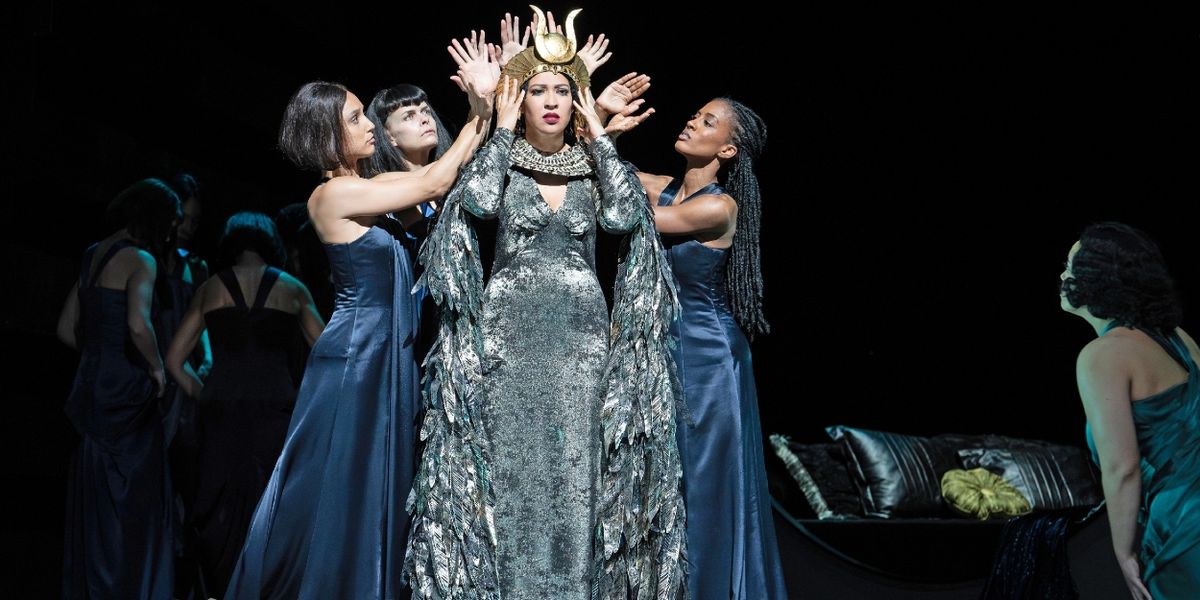
There’s an old expression, “A lawyer who defends himself has a fool for a client.” While John Adams didn’t decide to take on the libretto for his latest opera, Monday night’s Met premiere, ANTONY AND CLEOPATRA, all on his own, I wonder whether he might have bypassed the one resource that might have been most useful: Arrigo Boito.
Boito took another of Shakespeare’s sprawling plays, OTHELLO, and made it better than the original--cutting comic asides and trimming characters so that Otello and Desdemona were truly the center of the action without distractions. While the librettist (who died in 1918) would obviously not have been available to work with Adams himself, a look at how he reshaped the original to fit a different art form might have given a better result.
Instead, Adams left himself to his own devices--with the help of director Elkhanah Pulitzer and dramaturg Lucia Scheckner, as well as some long-dead writers like Plutarch and Virgil--and came up with a piece that’s still feels too long (even after pruning the version heard in San Francisco in 2022).
Worse, it very often feels that there is no compelling reason for having made it an opera from the way it was handled. In fact, the work is almost always at its best musically when it plays out as an orchestral piece, giving a wonderful showcase for the sparkling Met orchestra. Adams conducted the performance smartly and certainly got what he wanted from the score, but it left me wondering why it sometimes felt like a symphonic work interrupted by singing.
That’s not to say that his first-rate cast--in debuting director Pulitzer’s knockout production, with scenery by Mimi Lien, lighting David Finn, sound by Mark Grey and costumes by Constance Hoffman)--doesn’t do its considerable best to put the opera across. The only piece of the puzzle that was a letdown was the plethora of pretty standard marching throughout the piece, from choreographer Annie-B Parson.
Bass-baritone Gerard Finley and soprano Julia Bullock, as the title characters, may have been given too much politics and not enough love-making (except for an opening scene that had lots of heavy breathing from the cast and giggling from the audience) but they were brilliant. (Her closeups in Bill Morrison’s projections were stunning.) Their singing scenes together worked well, sounding mellifluous and full voiced and they had good chemistry, though their on-again, off-again relationship was complicated to say the least, sometimes reminiscent of Otello and Desdemona.
Antony’s scene with Caesar (tenor Paul Appleby in fine form, as he was even when the material didn’t support him well enough--when he sings to the crowd there wasn’t enough heft to the music) was an indubitable success. Appleby did well in a role much less sympathetic than his usual appearances at the Met.
Some of the minor characters were given vocal showcases of their own, which worked out appealingly. I particularly like the way the character of Octavia--Caesar’s sister used as a political pawn by marrying her off to Antony--was sung lucidly by mezzo Elizabeth de Shong, commanding the stage with little effort. As Enobarbus, bass-baritone Alfred Walker also had the opportunity to shine through some appealing singing.
But often, the lesser characters were, indeed, lesser. It’s too bad that baritone Jarrett Ott, as Agrippa, in his Met debut, who I’ve heard to better effect elsewhere, was what it sometimes relegated to what’s called “luxury casting” (translated into “not given enough to do” outside of exposition). I felt the same about Cleopatra’s lady Charmian, portrayed by mezzo Taylor Raven, also a debut, and tenor Brenton Ryan, as Eros, in their exposition- and acting-heavy roles.
This is the second time that the Met has mounted an opera about Antony and Cleopatra that showed itself to be less than the sum of its parts. (The first, famously, was the Samuel Barber version that opened the Met at Lincoln Center in 1966, to a Franco Zeffirelli libretto (!) that also leaned heavily on the original text by Shakespeare.) Do we have another Cleopatra to look forward to? They do say that “third time’s the charm”.
Caption: Julia Bullock as Cleopatra (center)
Credit: Karen Almond/Met Opera
Sign up for all the news on the Summer season, discounts & more...

Reader Reviews
To post a comment, you must register and login.