


Review: TURANDOT, Royal Ballet And Opera
As protests gather outside and personal history simmers within, Covent Garden’s grandest fixture refuses to blink.
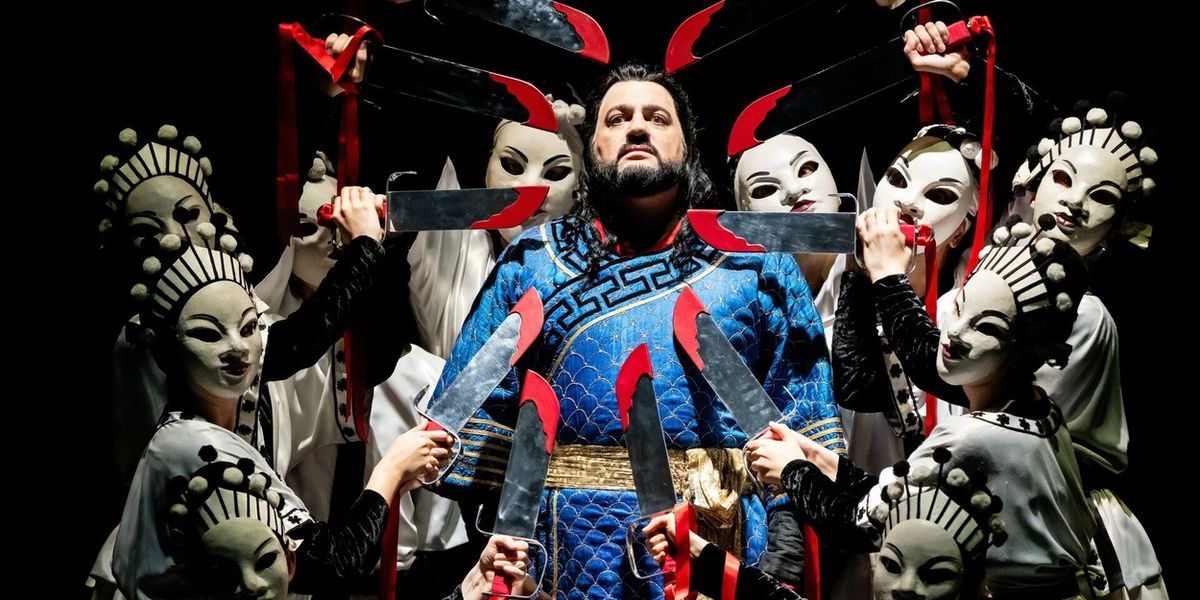
 The Royal Opera House’s Turandot has now been running so long it feels less like a revival and more like a listed structure. You don’t attend it so much as pass through it, like a familiar corridor or a particularly grand roundabout. With close to 300 performances under its belt and two runs in this calendar year alone, this production has become the most frequently staged opera in Europe, second only to Zeffirelli’s La Bohème at the Met in the global endurance league. If cockroaches ever start staging Puccini after the apocalypse, this is the version they’ll use.
Andrei Șerban’s 1984 staging, designed by Sally Jacobs, remains a formidable slab of theatrical masonry. It is vast, ceremonial and unapologetically unsubtle, presenting Puccini’s fantasy China as a kind of deluxe operatic heritage site. Everything is on display, nothing is interrogated. The Royal Opera House favours it for the same reasons we tell small children and tourists that the monarch lives at Buckingham Palace: it looks impressive, it’s already paid for, and it discourages difficult questions.
Under the eye of revival director Jack Furness, Anna Netrebko and Yusif Eyvazov stride into this venerable edifice as Turandot and Calaf, dragging behind them a personal backstory that Puccini never intended but modern opera cannot resist. Together for a decade before separating in 2024, the pair now find themselves night after night enacting an operatic power struggle about dominance, persistence and emotional brinkmanship. Watching them sing into each other’s faces feels less like romance and more like an extremely well-funded mediation session.
Puccini’s opera already treats love as conquest, and here that dynamic feels sharpened by reality. Netrebko’s Turandot is vocally unassailable, all polished authority and glacial control, a woman who doesn’t merely set riddles but enforces them. Eyvazov’s Calaf responds with heroic determination, pressing forward with ardour that increasingly resembles refusal to take the hint or see the red flags; if there's ever a sequel to Turandot, it is easy to imagine it starting with Calaf's execution. Despite these excellent performances, it is difficult not to read the tension as something more than dramatic, and equally difficult to decide whether that makes the evening more truthful or merely more uncomfortable.
As if that weren’t enough tension for one evening, press night also came with a complimentary political argument, staged conveniently outside the building. A small but determined protest gathered in the piazza, objecting to Netrebko’s nationality and past political associations. For once, the booing was sensibly relocated outdoors, leaving the opera house itself free for its usual activities: occasional coughing, London-accented cries of “brava!” and pretending that none of this is at all awkward. Inside, Puccini thundered on; outside, the cultural reckoning continued.
Musically, the evening leaned hard into monumentality. The orchestra surged and blazed, the chorus delivered with the force of an approaching weather system, and the famous moments landed exactly where expected. Liù (played by the phenomenal Masabane Cecilia Rangwanasha), as ever, provided the opera’s emotional escape hatch, briefly reminding us what vulnerability sounds like before being crushed by the machinery around her.
Șerban’s direction, carefully preserved rather than re-examined, remains visually imposing but dramaturgically inert. What once passed for stylised myth now feels like avoidance, its exoticism left untouched and unquestioned. The production does not so much engage with modern conversations as politely ignore them, confident that longevity will do the arguing on its behalf.
And perhaps that is the point. This Turandot is no longer just an opera but an assertion of institutional permanence. It suggests that controversy will pass, relationships will fracture, politics will intrude, and yet the gong will still sound, the riddles will still be posed, and “Nessun dorma” will still ring out on schedule.
You leave not having witnessed a reinterpretation so much as a reaffirmation of why this production is such a hit with audiences. Love may be cruel, power may be contested, and the world outside may be arguing loudly, but inside Covent Garden, Turandot remains immovable. Like all great fixtures, it assumes it will outlast us. It’s probably right.
Turandot continues at Royal Ballet And Opera until 4 February 2026
Photo credit: Camilla Greenwell






Reader Reviews
To post a comment, you must register and login.