


Review: ORPHEUS FOR ALL at Carnegie Hall
Every ticket free of charge for selected concerts
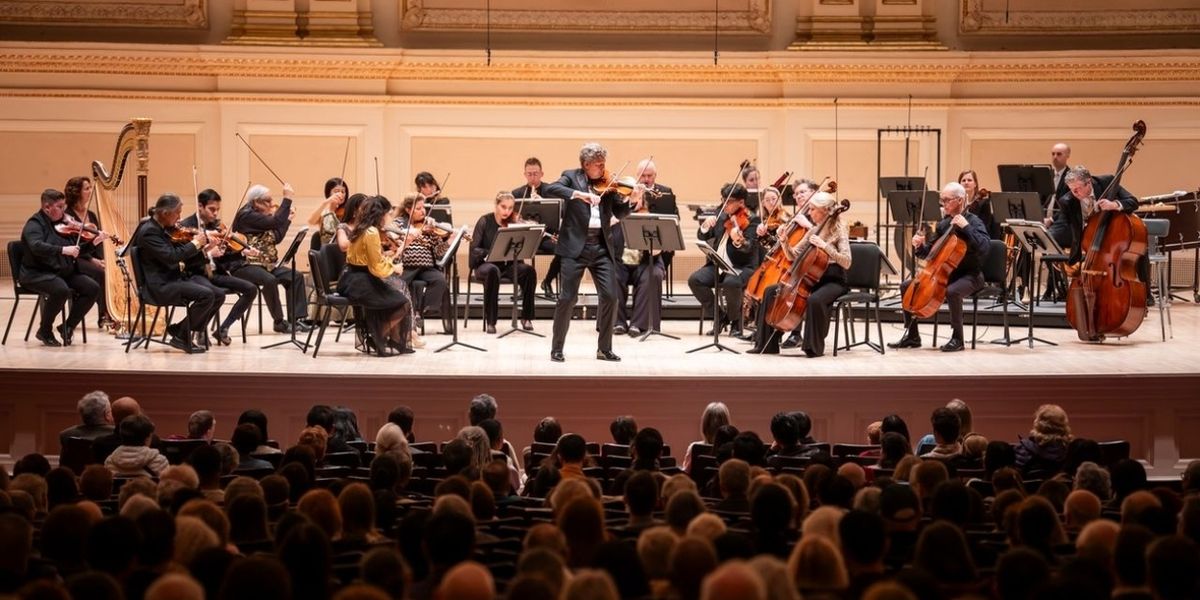
Some people think the concept of a conductor-free orchestra is as ridiculous as a horse race without riders. How could it possibly work, they wonder. Who gets them to start and stop at the same time? For fifty years Orpheus has been confounding and amazing audiences with their exceptional variety of repertoire, its fine execution, and overall excellence, all without a conductor on a podium. In return, Orpheus has made its music accessible to all. This season they’ve begun a new initiative to that end; “thanks to the generosity of our founding Orpheus for All program sponsors, this pilot allows us to welcome new audiences and share the Orpheus experience with more New Yorkers than ever before.” (from Orpheus Executive Director Alexander Schierle).
The concert of Saturday October 25 was the first in this series. Almost all the music was composed by late nineteenth and early twentieth century French composers. The only contemporary piece was the 2025 commission (and New York premiere) by Orpheus of acclaimed composer Jessica Meyer’s Cartes Postales, which had a French theme. Written during a brief sojourn in various parts of France, Meyer conjured up a sound world unique to that place and time. This joyful, whimsical series of three movements also held mystical moments, which were created by various instrumental combinations such as vibraphone and flute. It was as wonderful to see a living composer come up to Carnegie Hall’s stage (after the performance) as it was to hear her delightful music.
The evening’s soloist was the Canadian violinist James Ehnes. Ehnes is a world-wide audience favorite. His performances of Ernest Chausson’s Poème for Violin and Orchestra Op. 25 and Camille Saint-Saëns’ Introduction and Rondo Capriccioso Op. 28 sparkled with wit and poetry. Ehnes’ flawless technique awed the audience, as did the subtle accompaniment of the orchestra. The absence of a conductor was never a consideration. Orpheus was perfectly fine on its own. Ehnes gave Saint-Saëns’ fiery music the precise, virtuoso treatment it needed. It was stunning.
The concert opened with the lush, magical Prélude à l’après-midi d’un faune by Claude Debussy and closed with Maurice Ravel’s Chamber Symphony (after Piano Trio in A Minor, M.67A). Beautifully played by the master musicians of Orpheus, both compositions demonstrated many of their musical and extra-musical skills.
The concert was recorded by Classical New York, WQXR. Listen to the broadcast on November 15, 2025 at 8 p.m. at 105.9FM or stream at WQXR.org
|
American Composers Orchestra: New Virtuoso: Low End Theory at Carnegie Hall Carnegie Hall (3/18-3/18) |
|
American Composers Orchestra: Hello, America: We Gather Here at Carnegie Hall Carnegie Hall (10/27-10/27) |
Reader Reviews
To post a comment, you must register and login.