


The History of THE PIRATES OF PENZANCE
Pirates! The Penzance Musical is running on Broadway at the Todd Haimes Theatre.
Do you have a burning Broadway question? Dying to know more about an obscure Broadway fact? Broadway historian and self-proclaimed theatre nerd Jennifer Ashley Tepper is here to help with Broadway Deep Dive. BroadwayWorld is accepting questions from theatre fans like you. If you're lucky, your question might be selected as the topic of her next column!
Submit your Broadway question here!
This time, the reader question was: What is the history of The Pirates of Penzance on Broadway?
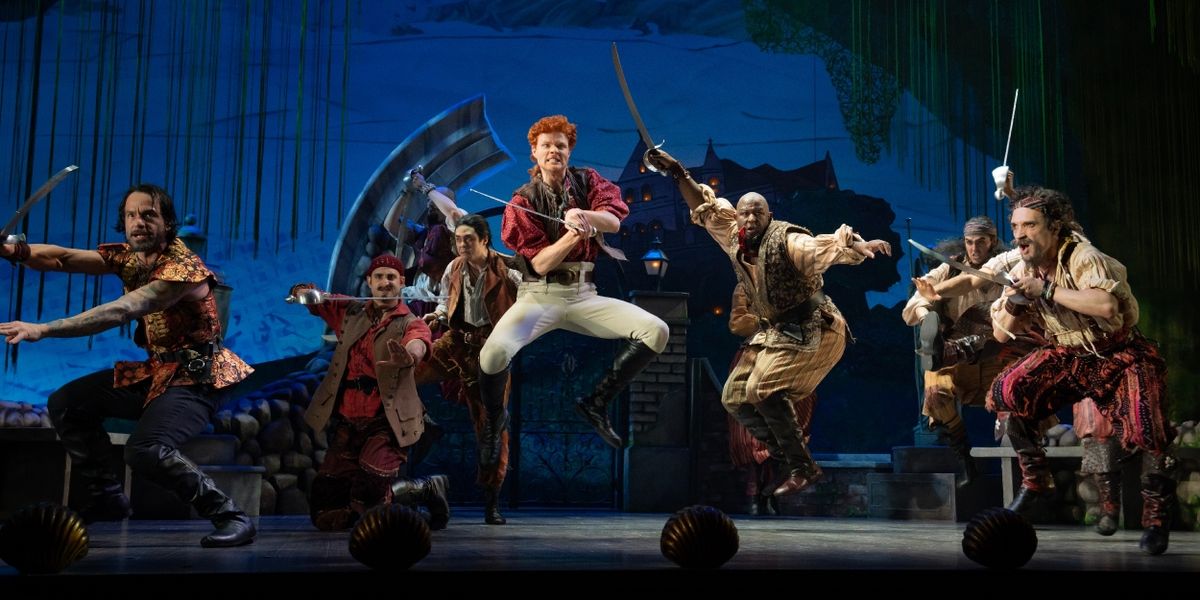
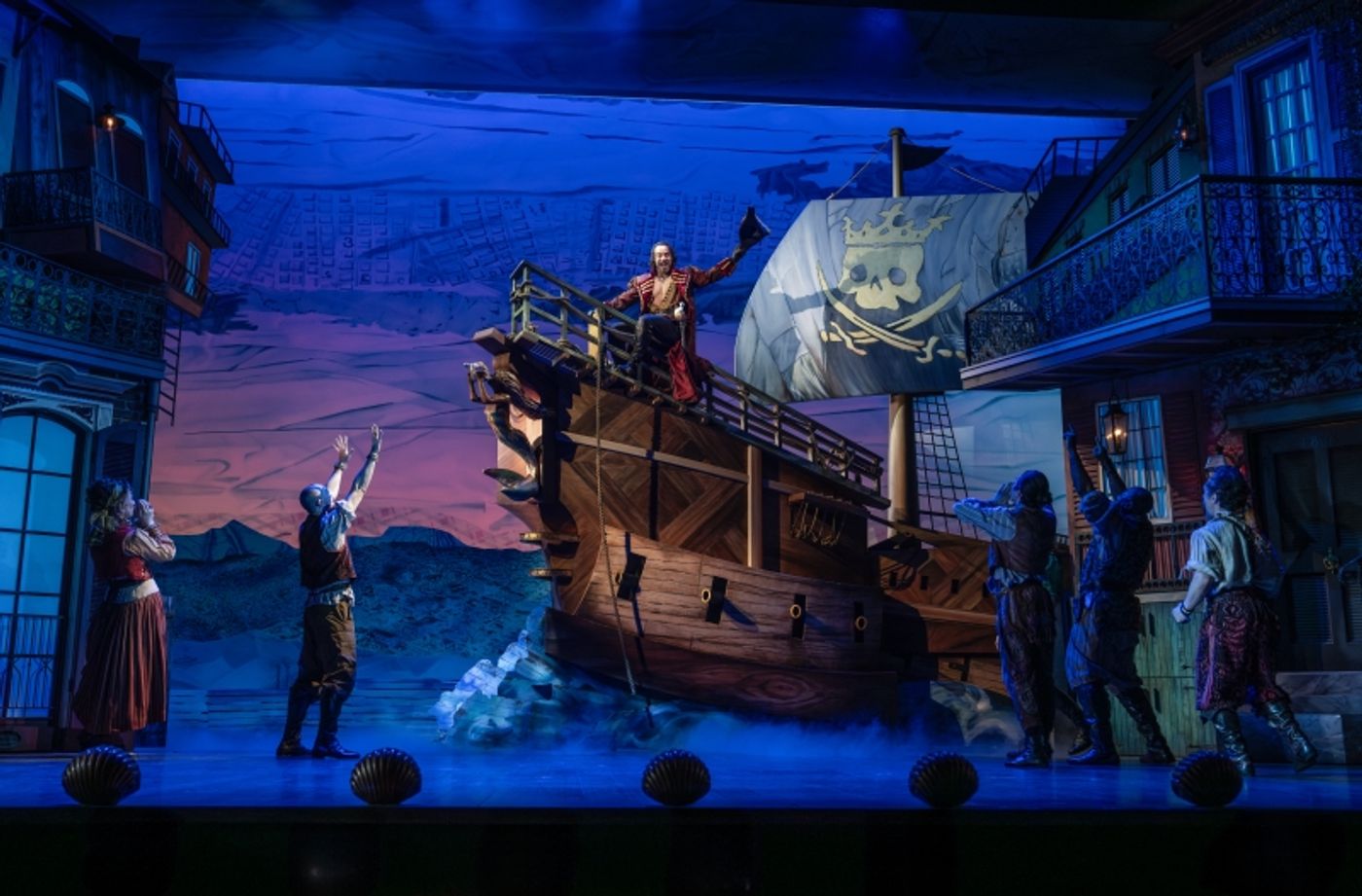
A new version of the classic, The Pirates of Penzance, is currently commanding the stage at Roundabout’s Todd Haimes Theatre on 42nd Street—formerly the American Airlines and before that, the Selwyn. This revisal of the beloved show is titled: Pirates! The Penzance Musical. With an adapted script by Rupert Holmes that contextualizes the show by making its writers, Gilbert and Sullivan into characters and newly sets the action in New Orleans this Pirates! has been in development for several years. Other changes include cuts to the score, the addition of songs originally written for other Gilbert and Sullivan shows, and a final message celebrating America as a diverse nation. This marks the 27th Broadway production of the musical.
The Pirates of Penzance originally premiered at the Fifth Avenue Theatre in New York City in 1879. This was right around the time that major theatre productions in Manhattan began to be labeled as “Broadway” productions. Following the Civil War, as the proliferation of railroads allowed productions to travel more easily from New York to other cities throughout America, shows needed a short-hand phrase to advertise that they were coming to audiences following successful runs in the theatrical epicenter. “Direct from Broadway”, naming New York’s popular and central street, became the most common way to advertise this. And so, The Pirates of Penzance’s original production at the now long-gone Fifth Avenue was technically one of the first “Broadway" productions.
And yet, the Fifth Avenue Theatre was far from the theatre district where Broadway shows play today. The theater, which originally opened in 1868, was located at 28th Street and Broadway. When theaters began being built in Manhattan, they were constructed at the southernmost tip of the island, where the majority of settlers were located. Then, as building growth expanded northward, so did the congregation of theaters, so that the theatre district that was initially located all the way downtown moved to Union Square, then Herald Square, and eventually to Times Square, where it still sits today.
In the 1860s, the Herald Square area was a natural place to build a new theater. The Fifth Avenue was named as such even though it wasn’t actually on Fifth Avenue because it was meant to replace a theater on Fifth Avenue that burned down. (This isn’t the last time a production of Pirates would play a lost Broadway theater named after a street that it wasn’t actually on!) The first American productions of several Gilbert and Sullivan operas, including Pirates of Penzance and also H.M.S. Pinafore, were seen on the Fifth Avenue stage. It was also a notable theater because it was the first in the world to have air conditioning, which at the time, in 1877, meant fans blowing air over ice that wafted into the theater through vents. If you look closely you can still see some of these primitive air conditioning vents in theaters today, including the Lyceum.
The original production of Pirates was a huge hit, and the only Gilbert and Sullivan opera to premiere in America. Gilbert and Sullivan were experiencing problems due to lack of copyright law at the time it premiered, with their hit productions spawning copy-cats which they received no renumeration for. Premiering Pirates in America was part of a plan to combat this and ensure that the writers received payment for the original Broadway production of their show. The delightful comic opera about a young man who becomes immersed in a world of pirates gave audiences an evening of indelible songs, and the show has remained a favorite for revival. Its many revivals on Broadway are emblematic of the evolution of Broadway and of the theatre district as a whole since the show’s 1879 premiere.
The Pirates of Penzance’s first Broadway revival was in 1900, 21 years after its premiere. The Castle Square Opera Company toured cities throughout America, including Chicago, Boston, and New York, presenting a plethora of operas in repertory. In 1898,1899, and 1900, their New York productions were held at the American Theatre, which was built in 1893. The American Theatre, also known at times as the American Music Hall, was one of the first theaters built on 42nd Street, when the theatre district moved northward to that area. Our oldest current Broadway theaters, the Lyceum, New Amsterdam, and Hudson were all built in 1903, and at the time that the New Amsterdam was erected on 42nd Street, it joined the American Theatre as well as the Theatre Republic (now the New Victory) as they started to form a new hub for performance spaces in Manhattan. The 1900 revival of Pirates on 42nd Street played only eight performances as the production was played in repertory.
The next time that The Pirates of Penzance was revived was in the summer of 1912 by The Shuberts at their Casino Theatre on Broadway near 39th Street. The Casino was a prime Broadway venue to play from the 1880s when it was built to 1930 when it was demolished. But it didn’t start out this way. When the Casino was built in 1882, the theatre industry thought that 39th Street and Broadway was a ridiculous location for a Broadway theater because the theatre district would never move that far uptown.
Marked by a unique decorative dome on its corner, the Casino proved nay-sayers wrong. It became the first theater in America to be lit entirely by electricity. It was the first theater in the world to have a rooftop garden, where audience members could be entertained while looking out at the growing city. In 1898, the Casino presented Clorindy, or the Origin of the Cake Walk, the first Broadway show with an all-Black cast. In 1900, Florodora, which became one of the longest running Broadway shows of all time, with its “Florodora girls” the talk of the town, played the Casino. When Pirates came to the Casino stage in 1912, the Casino was in the center of a theatre district that was moving north, but by 1930, the Casino, which had been the northernmost legit theatre when it was built, had become the southernmost stage in the theatre district. It was demolished to make way for more space for the garment district.
The 1912 Casino revival by The Shuberts wasn’t the only time that Pirates was seen on Broadway in that decade. The show was brought back to New York in both 1915 and 1918 as well. The 1915 production played in rep with three other operas including H.M.S. Pinafore at the 48th Street Theatre. The 48th Street Theatre, which seated fewer than 1000, was located—you guessed it—on 48th Street, across from what today is the James Earl Jones Theatre and was then the Cort. One of two Broadway houses on that side of the street, east of Broadway, also including the Playhouse, it was never the most popular theater in the district and was demolished in 1955. In addition to the 1915 Pirates, the theater also hosted the historic The Cradle Will Rock and the long-running Harvey.
Pirates’ 1918 revival was held at a much more distinguished venue. From fall 1918 to spring 1919, The Society of American Singers’ production of Pirates played in repertory with more than a dozen other shows at the Park Theatre. The Park was located at Columbus Circle near 58th Street. It was a large space seating over 1300 that originally opened in 1903 as the Majestic with the original Broadway production of The Wizard of Oz. At the time, Columbus Circle was often referred to as Grand Circle and this theater was quite grand, architecturally. Several theatre owners assumed the district would continue to move northward as it had been and so the Park Theatre was a gamble on this that didn’t pay off. Once it was clear that the theatre district was staying put below Columbus Circle, the Park became a movie theater and TV studio before eventually being demolished to make way for a different kind of area at the southwest corner of Central Park.
The Pirates of Penzance revivals on Broadway in the 1920s were both at theaters that we know and love today. A 1926 revival at the Plymouth (now the Schoenfeld, home of Buena Vista Social Club) and a 1927 revival at the Royale (now the Jacobs, home of The Outsiders) had 45th Street lit with the comedy of Gilbert and Sullivan for two years in a row. The Plymouth production, which starred Vera Ross in one of her six appearances as Ruth, would be Broadway’s longest running Pirates until its 1980 production.
The 1930s boasted far more Pirates revivals than any other decade on Broadway with eight separate productions of the show playing the Main Stem between 1931 and 1939. Several of these were return engagements of the popular property and multiple times, Pirates played the Majestic and the Martin Beck (now the Al Hirschfeld). A brief 1935 stay at the now-demolished underappreciated Adelphi Theatre, counted future Broadway leading man Alfred Drake in its ensemble. The production, alongside the operas it played in rep with, marked the 20-year-old Drake’s Broadway debut; he would go on to originate leading roles in the original productions of Oklahoma! and Kiss Me, Kate.
Revivals 16 through 21 of Pirates happened during the 1940s. The show continued to be incredibly popular in stock and amateur as well as in professional theatre, particularly with opera repertory companies. This decade marked the last time that opera repertory companies made regular appearances on Broadway, partially because of shows like Oklahoma! and Kiss Me, Kate changing the musical theatre art form.
Several of the show’s 1940s revivals were presented at now-lost Broadway theaters, marking more changes in the Broadway district. A 1940 Pirates revival played the 44th Street Theatre, once across the block from the Shubert, whose basement was at a time home of the famous Stage Door Canteen. The theater was demolished in 1945 to make room for the New York Times building. In 1942, one year before Oklahoma! opened in the same theater and changed Broadway, Pirates made an appearance at the St. James. This production featured the Boston Opera Company; The Pirate King was played by Bertram Peacock who appeared in the show on Broadway three separate times. There was a 1944 revival at the Ambassador and a 1946 revival at City Center, considered a Broadway production because of the contract that the show was on. (New York City Center musicals these days are considered off-Broadway productions.)
In the late 1940s, The Pirates of Penzance made two stops at Broadway houses that are no longer. The 1948 revival at the New Century was done by D’Oyly Carte Opera Company. It was the fourth time that the company, which retained the copyright for the work of Gilbert and Sullivan for a long time, produced the show on Broadway. This Pirates was directed by Anna Bethell, who both performed in and directed D’Oyly Carte Opera productions. It was rare to see a woman directing on Broadway at the time, and it would happen again when D’Oyly brought the show back in 1951 staged by Eleanor Evans. Later in 1948, after Pirates, the New Century Theatre’s most significant hit would open; Kiss Me, Kate’s original production played the theater that used to be on 7th Avenue near 58th Street. The New Century was a large Broadway house seating 1700 (comparable to the Minskoff or St. James today) built in 1921 as Jolson’s 59th Street Theatre, even though the house was not on 59th Street! Al Jolson opened the theater which only functioned as a performance space for 33 years. As the Venice in 1937, it was where The Cradle Will Rock company marched to and performed unconventionally when a legit performance was deemed illegal because of the show’s message. To close out the decade, a 1949 revival of Pirates played at the Mark Hellinger, which is now the Times Square Church; the same production would return to the Hellinger in 1952.
In addition to the 1951 revival directed by Evans and the 1952 revival which returned to the Hellinger, the 1950s saw a 1955 production of Pirates at the Shubert. While opera companies playing repertory on Broadway became rarer after the 1940s, nearly all of the productions of Pirates on Broadway before the most recent three were done as part of opera repertory, including those in the 1950s and the one in 1976 at what is now the Gershwin. The actors in these productions were largely involved in opera productions; most of the time they were not New York-based actors and were not frequently in musicals otherwise. This changed in 1980.
The Public Theater presented The Pirates of Penzance as part of their Shakespeare in the Park season at the Delacorte during the summer of 1980, and it was the hottest ticket in town. This production of the show had a contemporary feel, with a musical comedy style informing the performances and interpretation of the score. The show transferred to Broadway where it won the Tony Award for Best Revival and became the longest-running Gilbert and Sullivan production of all time. In fact, the 787 performances (plus 29 previews) that this revival chalked up were more than the 365 performances played by Broadway’s previous 25 productions of Pirates added together! (3 productions had an unknown count of performances and weren’t counted.)
When Pirates launched at the Delacorte before moving to the Uris (now Gershwin) and then Minskoff, it initially starred Kevin Kline as the Pirate King, Linda Ronstadt as Mabel, Rex Smith as Frederic, Patricia Routledge as Ruth, George Rose as the Major-General, and Tony Azito as the Sargent of Police. During the show’s years on Broadway, replacements included a plethora of Broadway stars as well as stars from other arenas, such as former teen idols Robby Benson, Patrick Cassidy and Peter Noone, who all replaced as Frederic. The 1980-1982 Pirates revival and its filmed version gave new life to the property, proving it to be the opposite of old-fashioned and stodgy.
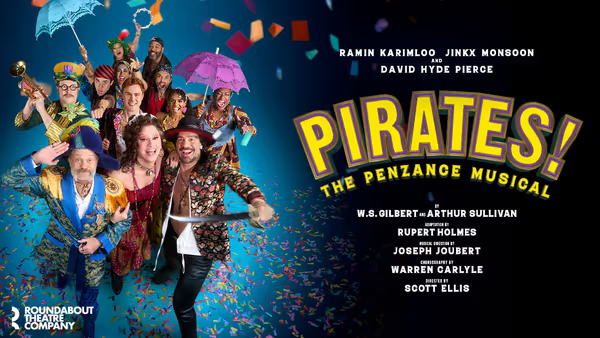
And yet, the current revival of The Pirates of Penzance, currently stylized as Pirates! The Penzance Musical is the first Broadway appearance of the show since then. It took over 40 years for Gilbert and Sullivan’s masterwork to make its way back to Broadway despite never leaving stock and amateur stages or losing general public familiarity. The show’s most beloved number is in fact referenced in Hamilton as well as in many other pieces of media. To the credit of the current revival, unlike nearly every production worldwide since 1980, the production doesn’t either copy the Papp vision or return to a devoted traditional style for the piece; it has created something entirely new. Led by David Hyde Pierce, Jinkx Monsoon, Ramin Karimloo, Nicholas Branch, Samantha Williams, and Preston Truman Boyd, this Pirates marks the show’s return to 42nd Street, that legendary thoroughfare, for the first time since 1900, during its second Broadway production.
BroadwayWorld Merch
Shirts, mugs, phone cases & more
|
Powered by

|




Comments
To post a comment, you must register and login.