


Student Blog: INTERVIEW: Tyler Dobrowsky on Adapting Shakespeare’s Caesar for Contemporary Audiences
I sat down with Tyler Dobrowsky to talk about his creative vision and process for adapting Philadelphia Theatre Company’s Caesar for a modern audience.

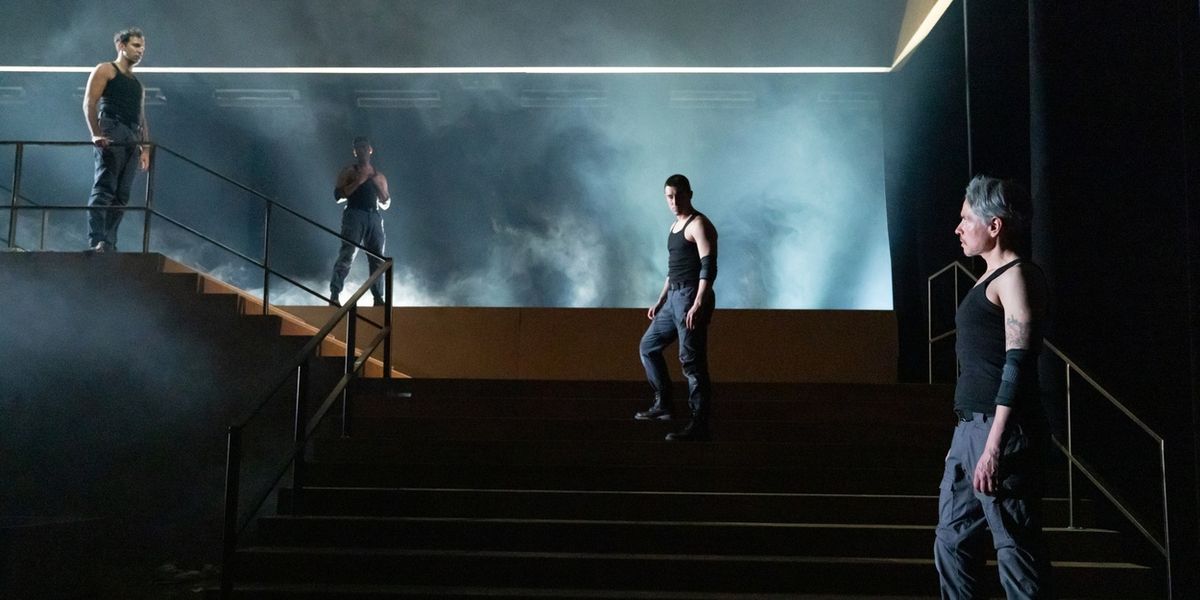
What does it mean to adapt Shakepspeare’s Julius Caesar for the 21st century? Well, here in Philadelphia, a local theatre company is answering that question with a captivating new adaption of this Shakespeare classic. Last week, I sat down with Tyler Dobrowsky to talk about his creative vision and process for adapting Philadelphia Theatre Company’s Caesar for a modern audience.
One of the major changes you've made for this production of Caesar was downsizing the cast to just four characters. What was your reasoning for that change?
I’ve worked on Julius Caesar a number of times and I know the play really well. I think it’s an incredible play. In the productions I’ve worked on previously, it felt like people were still interested in the story but that they were getting lost with all of the different characters. There are like thirty characters and usually you have 12 actors, so there’s a lot of doubling, and that can get confusing. Also, I thought it was a challenge to myself where I was like, let’s see how far we can cut it and still tell the story effectively. Let’s see what is the most ruthless cutting you can do for the play. I thought that would be really exciting for me and the actors to do and it’s been fun to work on it.
Why did you choose to adapt Caesar to be through a 21st century lens?
Working with Morgan, the director, I think we wanted to make it feel as contemporary as possible so that contemporary audiences could really relate to it. A lot of the ideas and themes in the play feel current in today's political climate and we wanted to remove as many barriers as possible. We were interested in saying, “what happens if these folks are dressed the way senators or presidents dress today?” We also wanted to use projections and screens because so much of our lives these days are mediated by our phones, televisions, or whatever the case may be. So making sure that screens and images are part of the play hopefully also make people think “Oh! That's like my life. That’s how I experience everyday life and there it is, kind of, onstage,” and thus, they’ll have a bigger relationship to it.
Has there been anything challenging you’ve faced so far in adapting this show and bringing it to life?
I’d say yes and no. In some ways it's been a really blissful process. I’ve had a great time working with Morgan and the actors have been great. It's been really fun and rewarding. As far as challenges, there is a lot of tech in the show, projections, and sound design. So getting all of the videos and projections to a place where they are of a high quality has been challenging. It was a lot of work that really pays off but can feel a little extra for the sound designer or video designer because it's more than your normal play. For the actors, I don’t know if actors love tech, and there's been so much tech! So, just being patient, determined, and not letting myself get too tired or down. That’s been the biggest challenge, the amount of tech and implementing it.
The flip side is that once you get through tech, then you get audiences, which is SO nice! It's been a lot of work, but it's paying off.
Do you have a favorite scene or moment in the show?
There’s a scene that I kind of cobbled together between Marc Antony and Caesar before Caesar gets assassinated. It’s not in Shakespeare play but I gave Marc Antony some lines that Calpurnia, Caesar’s wife, had. I also took some lines the two of them had together earlier in the play and put it in that scene. That was so we could see Caesar and Marc Antony’s relationship a little more clearly. I think it’s really effective, I love that scene.
There is also the war, which is the last scene. There’s a lot of choreography. It’s fight choreography, but it also looks like a dance. It’s beautiful.
PTC will be holding a few community events and discussions to compliment performances of Caesar. Why is it important to ptc to engage the community in these post-show discussions?
At PTC, we are constantly looking for ways to engage young people and the community so it's not just like “I came, I saw a show, and then I left.” We don’t want to just be an anonymous theater, we want people to feel like they have a home here and that this is a place that they can come to and talk about the plays, and by extension all kinds of stuff that's happening today. By offering those opportunities to talk and engage further, that makes people feel more welcome and adds to the experience.
What do you want the audience to walk away from this show feeling or thinking about?
You know, I hope they love it! I don’t know, I mean, I hope they like it. I hope they are inspired by the ideas that are in the play, ideas that are in the script that Shakespeare wants you to talk and think about. But also, what the production is doing, setting it in the 21st century, the casting choices… up and down i think its full of ideas. I don't think it's necessarily didactic, it's not trying to say “Caesar is this current president or former president.” I think it's trying to get you to think about some of the deeper ideas that are inside the play in a way that feels very current and modern. So I hope people leave thinking “wow, that was visually very evocative and chalk full of ideas.” I hope it leaves them thinking about what it means to be alive today, an American today, all of those things.
You might think Shakespeare is kind of this old, dusty thing but then to kind of connect it and have the audience recognize these ideas and conflicts in this play set 2,000 ideas are things we are still talking about. It’s part of what it means to be human in some ways.
And finally, how would you describe Caesar in one word?
Iridescent, which means holding something up to the light and depending on how you look at it, it reflects the light in different ways. I think if you turn it this way, the play could be about how these evil senators killed the good caesar. Or it could be about how these really righteous, good senators killed the evil, autocratic, wannabe dictator Caesar. You don't have to do that much to shift [Caesar] like that. So, that's what I kind of love about it. It's a play that you can do in so many different ways.
You can catch Caesar at Philadelphia Theatre Company now through February 22nd.
Prefer BroadwayWorld in Google Search?
Add us as a preferred source so our stories show up more often in Top Stories and Google’s AI answers — for you.
Sign up for all the news on the Fall season, discounts & more...

.png?format=auto&width=365)




