


Review: Trinity Rep's THE WINTER'S TALE Delivers Flashes of Pure Theater
Ambitious, intelligent Shakespeare with moments of genuine magic
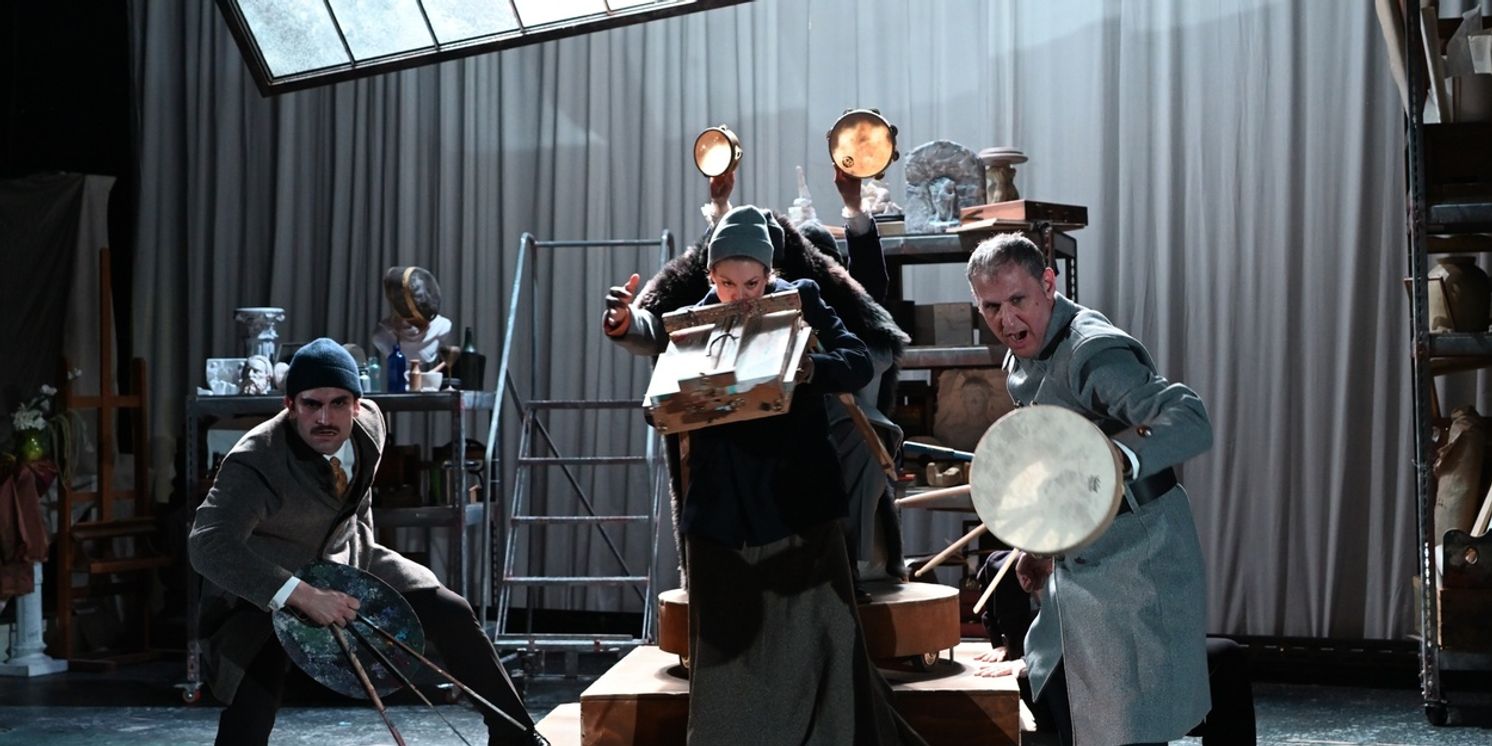
Midway through Trinity Repertory Company’s production of The Winter’s Tale, a handful of courtiers gather scattered objects from the stage — a painter’s palette, a bodhrán, a pair of tambourines — and begin, slowly, to move together. For a moment you can’t quite decipher what you’re seeing. Then, with gathering, terrible momentum, it resolves: they are the bear.
It is one of the purest pieces of theatrical invention this reviewer can recall, and it earns its place among the finest moments in Trinity Rep’s long history of ambitious Shakespeare.
That the production generates such moments is a testament to director Ben Steinfeld, a Brown/Trinity Rep alum and co-artistic director of the acclaimed Fiasco Theater, working here with an ensemble of uncommon skill and cohesion. The execution throughout is lucid, imaginative, and deeply assured — with one understandable exception.
The Winter’s Tale is generically amphibious, a late romance that carries the DNA of Shakespeare’s tragedies and comedies while fully belonging to neither. Written near the end of his career, it pitches violently from domestic catastrophe to pastoral festivity, shattering the unities with a sixteen-year leap announced by Time itself stepping onstage.
Its central challenge remains one of the most vexing in the canon: King Leontes’ sudden, entirely unmotivated jealousy toward his wife Hermione and boyhood friend Polixenes. Unlike Othello, painstakingly poisoned in measured drops by Iago, Leontes simply detonates on one line — “Too hot, too hot!” — with no visible fuse. The text offers no explanation. Actors, even as accomplished as Stephen Thorne, are unmoored. Directors must choose how to justify the rupture; here, it lands more as confusion than inevitability, the production’s one less persuasive moment whose fault is not in the stars, so to speak, but in the script. Even Homer nods.
Steinfeld situates the entire play inside an artist’s studio: skylight overhead, shelves thick with busts, canvases, and draped forms, the detritus of creative labor framing every scene. At rise, the ensemble poses on and around a central couch being photographed with an anachronistic camera. Edwardian brocades, sweeping skirts, and a note-perfect sailor suit for Leontes' young son Mamillius establish a world of courtly solidity frozen in amber — an order soon to fracture.
Scenic designer Edward T. Morris and costume designer Toni Spadafora-Sadler conjure an imaginatively rich, vividly realized world where art and life uneasily mirror one another under Kat C. Zhou's crisp lighting. It's a design logic that pays dividends throughout.
The trial of Hermione is spatially devastating. With the judge seated downstage center, back to the audience-as-jury, and Leontes ascending a skeletal metal staircase to loom over the proceedings, the staging implicates us in the injustice we witness. Rachael Warren’s Hermione, dignified and flinty, stands on a low central platform that will later serve as her statue’s plinth. The production cleverly prefigures its endgame.
That statue scene — among the most perilous in Shakespeare — is handled with rare intelligence. Warren initially faces upstage, visible to the actors but withheld from us. We experience the miracle through their faces; when she finally turns, the effect is not "magic," but completion. Superbly staged.
Thorne’s Leontes, once past the rupture, gathers gravity and remorse with compelling authority. His long penance feels earned. Mauro Hantman’s humane, conflicted Camillo provides a steady moral counterpoint, while Rebecca Gibel’s Paulina anchors the production with ferocious clarity. Gibel carries sixteen years of grief and purpose without tipping into sanctimony; it is a performance of finely calibrated restraint.
Omar Robinson lends Polixenes warmth and authority, and Abram Blau brings an appealing earnestness to Florizel. But it is Jessie March, doubling as Perdita and the doomed Mamillius, who delivers the production’s quietest and most devastating gesture. In the final moments, she crosses to a shelf, lifts the leather ball Mamillius once played with, turns, and extends it toward Leontes. Because she has embodied both children — the lost and the restored — the image carries the full weight of what the play cannot undo. It lands like an icepick to the heart: simple, cunning, and devastatingly precise.
The Winter’s Tale remains one of Shakespeare’s most structurally confounding works. This Trinity Rep production embraces its volatility with intelligence, style, and deep theatrical imagination. When it soars, it achieves something close to the miraculous. Highly recommended.
The Winter’s Tale, directed by Ben Steinfeld, through March 22 at Trinity Repertory Company, 201 Washington Street, Providence. Tickets $26–$87 at trinityrep.com.
Photo: Mark Turek
Reader Reviews

Videos