

Review: THE FAR SIDE OF THE MOON at Canadian Stage
Lepage's inventive 2000 show orbits back around for another look
By: Ilana Lucas Nov. 12, 2025
We’re now closer to the year The Jetsons was set, 2062, than the moon landing. If that fact disturbs you, you’re not alone.
“Since we surveyed, mapped, explored, and planted a flag,” writes Robert Lepage in his director’s note to THE FAR SIDE OF THE MOON, “our interest in the moon seems to have greatly diminished.” Lepage, however, believes that, while it may no longer be as much of an enigma, the moon will never lose its poetic appeal.
This Ex Machina production presented by Canadian Stage is a remount of Lepage’s 2000 work cowritten with Adam Nashman and Peder Bjurman, in its original incarnation somewhat closer to the moon landing than our cartoon space family. Twenty-five years on, the appeal of the two-hour one-act endures as well, a story with the eternal theme of sibling rivalry that looks both inward to our deepest neuroses and upward to something outside the self.
Ethereally structured, occasionally ponderous but ultimately gratifying, The Far Side of the Moon unspools and drifts like the mechanical umbilical cord tying an astronaut to safety during a space walk. The sheer beauty of Lepage’s inventive design is compelling reason enough to drift in tandem.
LePage uses the Space Race between the US and Russia as a metaphor for the competition and rift between two brothers, which further destabilizes upon the death of their mother, whose illness left her quietly disintegrating in an apartment with only a fish for company. Olivier Normand plays both Philippe and his brother Andre, suggesting that the brothers, one cerebral, one materialistic, are really two sides of the same coin.
Philippe is a PhD student whose dissertation seems consistently in limbo. He’s arguing that our obsession with space travel is inherently narcissistic, fueled by his research on 19th century rocket scientist Konstantin Tsiolkovsky, whose pioneering aeronautics theories included the concept of a space elevator that could take users to orbit. The milquetoast academic supports himself by hawking newspaper subscriptions in the evening; obsessed with the heavens to the point of sleep-spacewalking, at 42 he’s never even been on a plane.
On the other hand, Andre, a TV weatherman, is brash and bombastic, interested in sharing the finer things in life with his husband and exceedingly uninterested in taking care of his late mother’s fish. He suggests that Philippe learn to live a little with their small inheritance and perhaps even see the earth from above. Ironically, both brothers spend their days looking to the sky, but one’s so focused on the practical impacts of weather that he rejects philosophy, while the other’s focus on philosophy prevents him from practically applying his work.
Normand clearly differentiates the brothers, Philippe filled with a heavier ennui when he’s not working on his contest entry to have a message included in SETI’s broadcast to potential extraterrestrials, and Andre twitchier and blustering when he tells a lie (frequent) or gets stuck in an elevator.
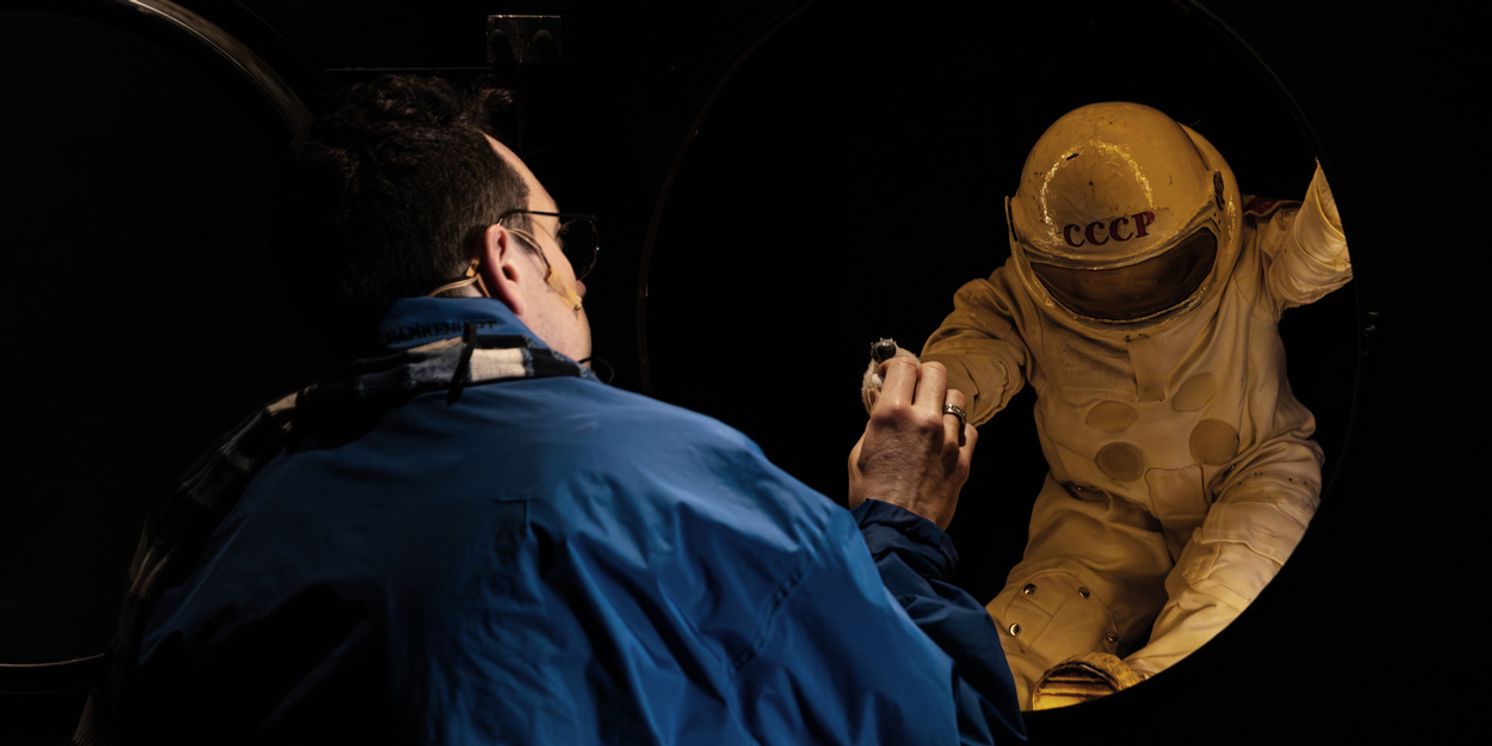
Meanwhile, Lepage creates a dreamlike, almost hallucinatory quality with his mirrored box of a set, projecting news footage of astronauts and cosmonauts and changing the scale of scenes with puppets to play out a miniature drama on a shelf. The domestic sphere blends into the astronomical, a laundromat’s washing machine or fishbowl becoming the window of a spaceship, and a small satellite trundles across the stage on a wire. A somber, erhu-heavy score by Laurie Anderson adds to the feeling of slipping past reality, and the time capsule feel of the play is underscored by how the set unfolds in a literal unboxing.
This is a one-man show, but a lot of smooth behind-the-scenes assistance helps to create the magic, a talented puppeteer (Éric Leblanc) animating miniature astronauts (design by Pierre Robitaille and Sylvie Courbron) and unseen hands swiftly pulling Normand through the porthole in one smooth motion as he dreams about space and takes flight. Deceptively simple techniques, such as a mirror positioned to reflect Philippe as he tumbles on an airport waiting room floor to resemble a spacewalk, reinforce the delightful theatricality of the experience.
It’s a shame that the structure of the play as a one-man show means we never get to see the brothers actually hash it out, monologues attempting to fill the void of true confrontation. And the climactic realization about his mother that strikes Philippe seems to arrive from a different nebula than the central conflict.
But the bittersweet show is ultimately more about the journey than the destination. It shoots for the moon and lands among the stars, a thousand points of light illuminating the little disappointments of a life that didn’t go as planned. In a powerful scene where Philippe pedals his bike out into the night, we’re reminded that if it’s too painful to look within, we can always look up instead.
When you see a picture of a lunar astronaut in full helmet, you don’t see the person’s face. The body is present, but the face is a reflection of his surroundings, as if the place is so full of wonder that the human absorbs it in awe. There’s a man in the moon, and a moon in the man. For Philippe and Andre, the moon becomes a reflection of their relationship, orbiting each other while always remaining tantalizingly out of reach. For the audience, it’s a chance to reflect on an ambitious production that takes us along for the ride.
Photo of Olivier Normand by Li Wang
Reader Reviews
Videos