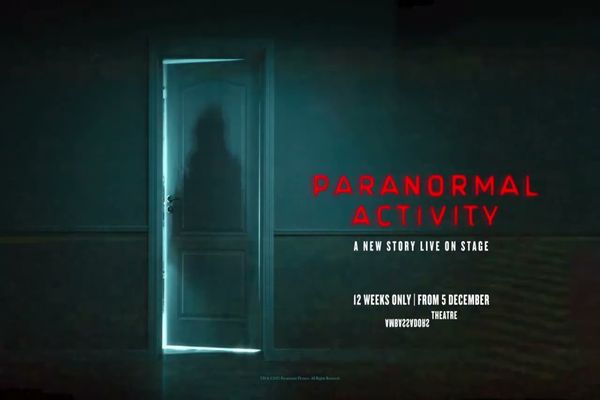


Review: PARANORMAL ACTIVITY, Ambassadors Theatre
Schlocky horror show abandons the very thing that made the original film a smash hit.
By: Franco Milazzo Dec. 15, 2025
 London is a city built on ghosts. Romans, plague pits, abandoned Tube stations and the collective memory of audiences who still shudder about The Woman in Black. There’s even a theatre supposedly inhabited by a ghost dolphin called Flipper.
In recent years, the capital has become particularly fond of ghost stories that promise to get under the skin. From 2:22 A Ghost Story trading West End jump scares for star casting, to immersive hauntings that blur the line between audience and participant, spectral theatre has been enjoying a brisk afterlife. Into this crowded séance steps Levi Holloway’s Paranormal Activity, hoping that a famous franchise and a heavyweight creative team will be enough to rattle London’s chains once more.
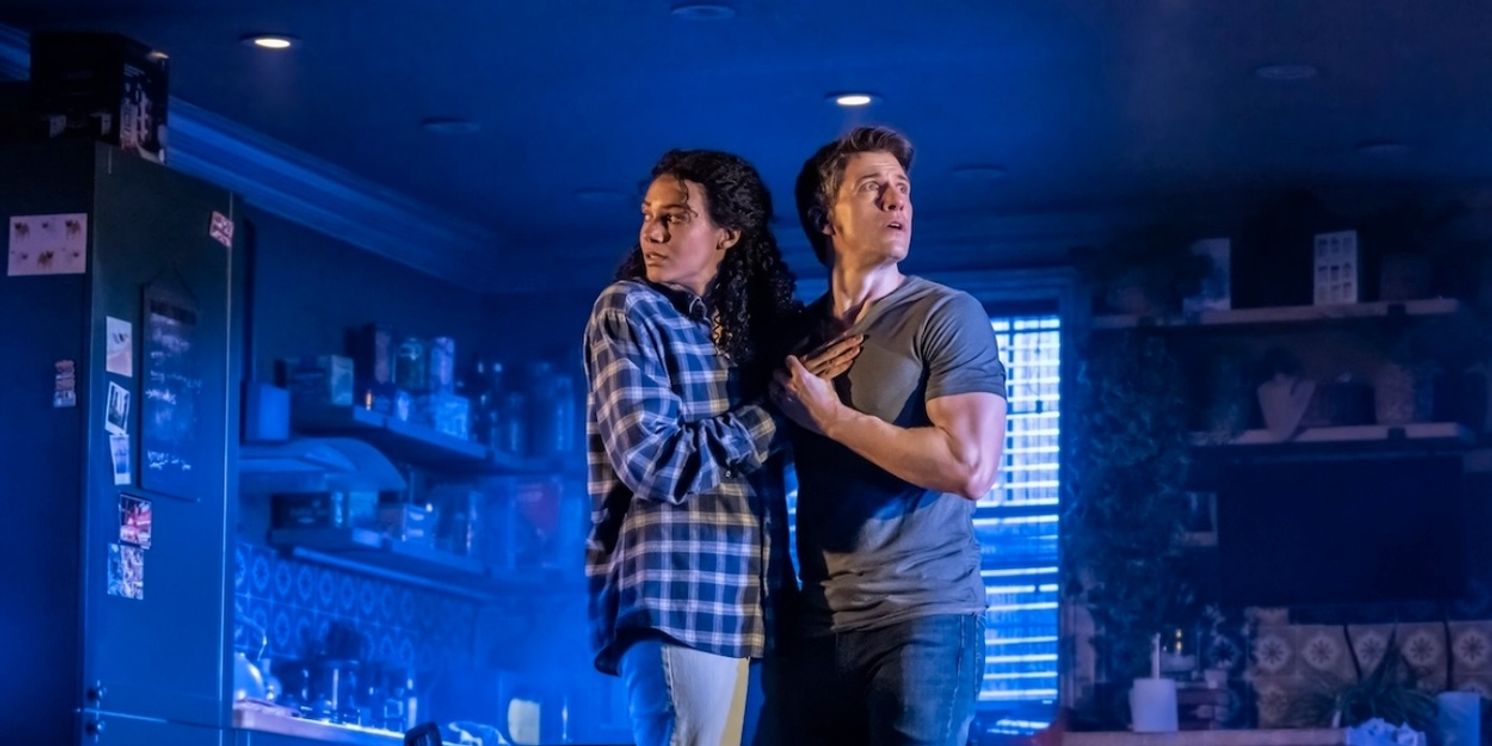
Starting with the loud sound of a Chekhovian car crash, we watch American couple Lou (Melissa James) and James (Patrick Heusinger, a late replacement for Ronan Raftery) settling into a suburban English home. James’ mother (Pippa Winslow) makes occasional calls from the US to enquire how they are settling in and when she can expect a grandchild.
It is soon apparent that Lou and James are less moving to London as more moving from Chicago and the events that occurred there. Places are not haunted, we’re told, people are and it becomes obvious quite quickly that whatever has spooked them out of the Windy City has followed them to the Big Smoke. And so begins a psychological unravelling before a final “shocking” revelation. (At least be polite and pretend to look surprised when it happens.)
Director Felix Barrett is the big cheese here. But is that Cheddar or Stilton? The artistic director and founder of immersive theatre specialists Punchdrunk has since 2000 been the captain of a ship with many victories behind it but is now lumbered on the sandbars of financial uncertainty. According to its most recent filings, it only exists due to the generosity of Arts Council England and it is clear that the once-admired ambitions of this venerable company have been slowly sinking since the end of the COVID-19 era.
The Burnt City opened in 2022 and was its biggest ever show, but cost more than it made and so closed in 2023. In artistic terms, its successors sited in its London HQ have compared poorly to the open-world mask adventures that made Barrett such a sought-after director. The 90s-themed audio-based promenade Viola’s Room was a hit last year particularly with theatre critics more used to a three-act story and an interval drink than Punchdrunk’s standard free-ranging fare but, sadly, they were not the target audience; their usually fervent fans piled in more out of curiosity than anything else and (highly unusually) few returned after their initial foray.
Latest effort Lander 23 is in previews. It arrived this November after two months’ delay related to “technical issues” and currently has no opening date in sight (never a good sign). If the captain is looking to abandon ship, is he perhaps hoping Paranormal Activity will be his ticket to new horizons?
Having Barrett aboard and at the helm carries the implication that you are about to be unnerved in inventive, boundary-pushing ways. After a run in Leeds, it now has a new ending and has opened in Chicago and London. Unfortunately, the state of this play suggests that even that retooling may not be enough to save this hot mess. If anything, Barrett’s involvement feels more like stuntcasting than a guiding hand, a familiar name deployed to reassure audiences before the lights go down.
The central problem is baked in from the start. Oren Peli’s original 2007 film was a critical success and a masterclass in doing more with less. Moreover, it made a staggering amount of cash. Filmed in his own house for the (by Hollywood standards) tiny sum of $15,000, it has gone on to make close to $200m at the box office and spawned six other movies.
At the heart of its terrifying appeal was a technique seen in 1999’s The Blair Witch Project. The use of the found-footage format was neither novel nor decoration but, in Peli’s hands, it was the mechanism of fear. Static cameras. The sense that watching itself was an act of vulnerability. Long, merciless silences that probably turned East European film directors green with envy.
This stage version abandons that entirely. No surveillance. No recording. No sense of the audience peering into something they shouldn’t. Not even a 2:22-style baby monitor. Staging Paranormal Activity without found footage is like having The Muppet Christmas Carol without any muppets and Michael Caine wandering about looking a bit lost.
Instead, the production leans hard into theatrical effects. Fly Davis’ stage design is a perfunctory-looking cross-section of a house but the set was built with magician Chris Fisher’s illusions in mind. What seems plain and ordinary hides some ingenious trickery.
The trouble is that, for all this clever machinery, only two moments are genuinely frightening (we have been asked via a cute poem not to reveal potential spoilers). Everything else is ominous wallpaper. The irony is that a low-budget film that rationed its scares understood tension far better than a theatre show purpose-built to deliver it.
Making matters worse is how much Barrett relies on Gareth Fry’s sound design. Rather than cranking up the tension organically, he deploys Fry’s deep rising bassy effects to tell us when we’re going to get a surprise. The use of total darkness to mark the end of one scene and the beginning of another is, admittedly, less garish than 2:22’s mind-numbing use of a flashing red neon border but it’s still a super-schlocky choice. And then there’s the stop-start nature of the storyline which navigates between jump scares with the skill of a drunken slalom skier.
The original Leeds cast do what they can with stereotypical material that barely contains anything that draws us in. Performances are committed and sincere, but they are sunk by underwritten characters who exist mainly to announce their emotional states. At separate points, James and Melissa solemnly inform the other that they “don’t even recognise who you are anymore”. This is less subtext and more an instruction manual. Horror relies on empathy, and it’s hard to care about people when the script seems barely acquainted with them itself.
Narratively, the show offers nothing London audiences haven’t heard before. A troubled couple. A haunted domestic space. A buried secret inching its way to the surface. It plays like a generic campfire ghost story stretched well past its natural lifespan. You can see the twists coming long before the characters do, which drains the piece of suspense and replaces dread with mild impatience.
The ending finally gives up any claim to credibility. It hinges on a central character firstly taking an implausibly long time to remember something most people would have quietly stored at the back of their minds, and secondly being tricked not once, not twice, but three times by exactly the same ruse. By then, the supernatural threat feels less like an ancient evil and more like a broken record.
In a city spoiled for theatrical hauntings, Paranormal Activity struggles to justify itself beyond brand recognition and a famous name above the title. There are flashes of atmosphere and moments of technical skill, but fear cannot be summoned by reputation alone. Two stars feels about right here: one for the occasional inspired rug-pull, and one for reminding us that sometimes the scariest thing in theatre is wasted potential.
Paranormal Activity continues at Ambassadors Theatre until 28 March 2026
Photo credit: Johan Persson