

Review: PARADE at CIBC Theatre Presented By Broadway In Chicago
This stunning musical revival runs through August 17
By: Zac Thriffiley Aug. 07, 2025
A Confederate flag. A “Roman” salute. Invitations to serve one’s country as a means of preserving “culture.”
If you’re as unlucky as I am, you will see all of these at some point during a casual social media scroll. Some of them may have even been posted by official accounts representing federal executive departments. But they are also the words and images that invite audiences into the world of PARADE, winner of the 2023 Tony Award for Best Revival of a Musical whose national tour has marched its way into Chicago. The production, presented by Broadway in Chicago, runs through August 17 at the CIBC Theatre. Patrons would be smart to grab their tickets now to see this smartly staged and staunchly defiant production of the most stunning yet rarely staged American musical of the last thirty years.
Originally produced on Broadway in 1998 with music and lyrics by Jason Robert Brown and a book by Alfred Uhry, PARADE dramatizes the real-life events leading up to and following the 1913 trial of Leo Frank for the murder of 13-year-old Mary Phagan in Atlanta, Georgia. On April 27, 1913, Phagan’s strangled body is discovered in the basement of Atlanta’s National Pencil Factory where Leo (Max Chernin) is superintendent. The factory’s night watchman inadvertently directs police officers’ suspicions to Leo, and local politicians and residents are quick to paint him as the villain since—as both a New Yorker and a Jewish businessman—he is an outsider within their community. What follows is a fight for justice between Leo, his loyal wife Lucille (Talia Suskauer), sympathetic reporter Britt Craig (Michael Tacconi), and a city still deeply mired in racism, anti-Semitism, and a toxic form of nostalgia.
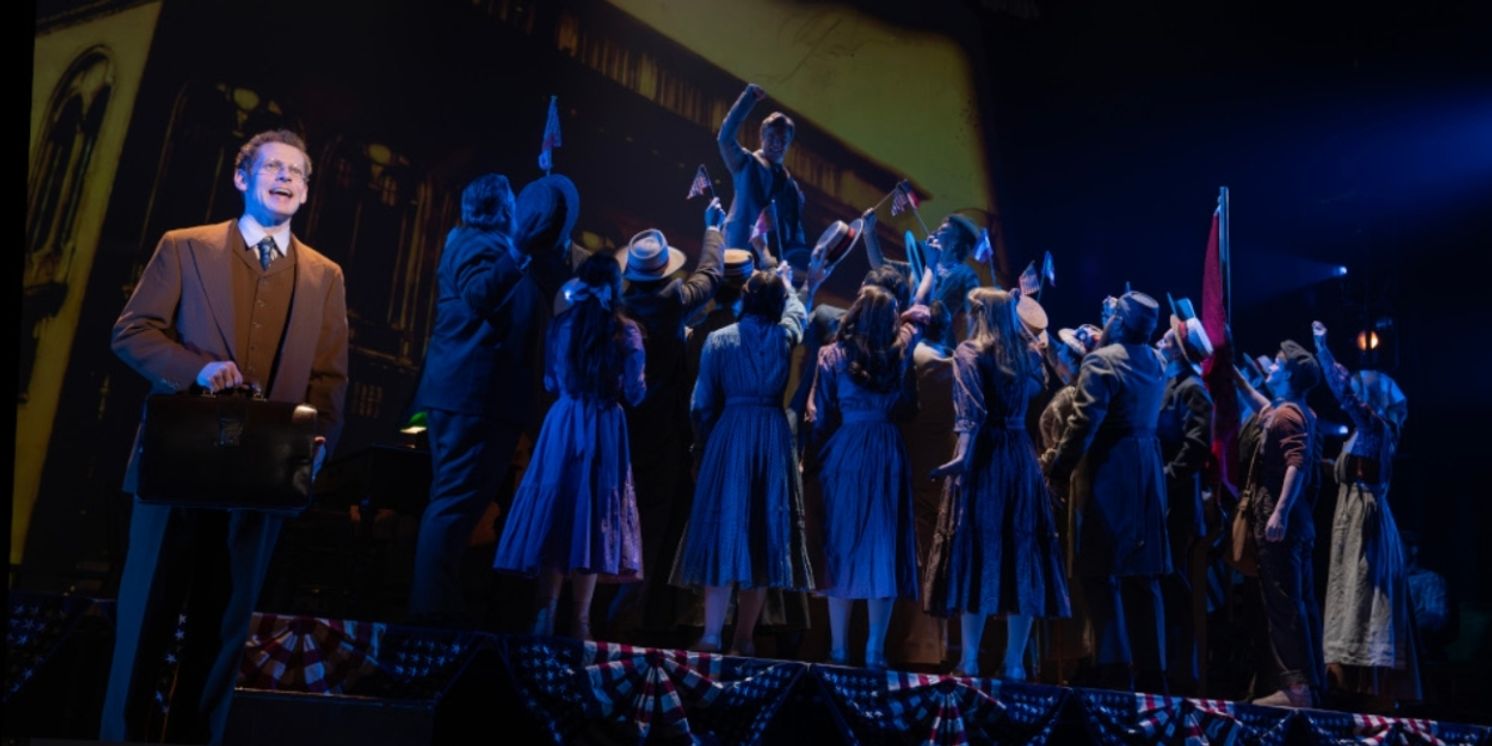
I must admit to having been wary of this revival at first. Originally developed at New York City Center in 2022 under the direction of Michael Arden, the scenic design (by Dane Laffrey) for this PARADE initially feels more like a concert than a fully-developed musical. A central elevated platform surrounded by a variety chairs, benches, and church pews occupies the main playing area. With a handful of exceptions, most of the cast remains onstage throughout the show’s two-and-a-half-hour runtime. The set here is more presentational than representational, meant to suggest locations rather than fully realize them. Sven Ortel’s projections help to fill in these gaps, showing portraits of the real-life people and locations that comprise this story, reminding audiences that the tragedy of Leo Frank is very much a historical one that should never escape our national consciousness.
Any doubts I initially had were quickly swept away by the power of Arden’s vision. This is not the “park and bark” style of musical that has become more common in an age of rising production costs and expensive building materials. Stripped of any pretense or superficiality, this PARADE feels breathtakingly fresh and frighteningly current. No doubt this is partly due to how drastically our culture has shifted since 1998; the Confederate flag no longer feels as much like a relic of history as it once did. But Arden and his creative team help draw the parallels between our own time and the Jim Crow-era South without belaboring their point. If anything, the decision to present a more simplified version of PARADE shows that this cast and crew trust audiences to see the connections for themselves.
Of course, these connections would be virtually meaningless without emotional investment from viewers, but this cast—especially its two leads—proves themselves more than capable of capturing the emotional nuances of each scene and moment. It’s no surprise that Chernin, who was the understudy for Ben Platt during the Broadway run, can sing Brown’s score with great power. But what I found most impressive about his portrayal was Leo’s clear emotional arc over the length of the musical. Initially a dour and humorless businessman at odds with his surroundings, Leo transforms under Chernin’s care into an emotionally vulnerable young man who finds meaning even in his smallest successes. One of the show’s many highlights comes during “This Is Not Over Yet,” the second act showstopper when Leo receives good news about his appeal. Because the news comes in the middle of the night, Leo must temper his excitement, and it’s both impressive and moving to watch Chernin barely conceal his excitement under the watchful gaze of the prison warden.
He finds a worthy partner in Suskauer, as well. The musical suggests that Lucille’s marriage to Leo was an arranged union of convenience, and Suskauer excellently portrays the feelings of disillusionment and loneliness that no doubt plagued many women of the time. But much like Chernin, Suskauer allows her body language and voice to grow in power as Lucille fights for her husband’s freedom and finds her own voice amidst the cacophony of men wrangling for the political and cultural spotlight. Her and Chernin’s final duet “All the Wasted Time,” which reflects on the couple’s renewed love for one another, marks a well-deserved moment of emotional catharsis for the audience after having watched the characters talk around their feelings for years.
On the subject of vocals and music, Brown’s score for PARADE is arguably his most complex, juxtaposing and blending contemporary genres like ragtime and blues with traditional religious hymns and Civil War marching tunes, sometimes even in the same song. Yet conductor and music director Charlie Alterman navigates this complexity with impressive precision, commanding a powerful orchestra of local and traveling musicians who literally and figuratively never miss a beat.
One of the few quibbles I have long held about PARADE is that Uhry’s script goes out of its way to present many of the Southern characters as irredeemably, almost cartoonishly evil. And while the original book remains intact, this production’s ensemble does an admirable job of making the psychology of the Atlanta community more understandable without excusing its behavior. The standouts in this endeavor include Griffin Binnicker as Tom Watson, the newspaperman whose crackpot evangelism gives PARADE much as its sinister edge; Jack Roden as Frankie Epps, a teenager who is radicalized by Mary’s murder and gradually becomes just as bloodthirsty as the adults around him; Jenny Hickman as Mary’s grieving mother; and Ramone Nelson as Jim Conley, the janitor whose playfulness and stunning blues riffs serve as a kind of protest against the treatment of Black Americans during this period.
Ultimately, though, the entire cast forms an incredibly in-sync ensemble committed to telling a beautiful story that, unfortunately, remains relevant over a century later. As Arden reminds us at the end of the show, the fight for justice—both for Leo Frank and so many others—remains ongoing.
Photo credit: Joan Marcus