


Review: OTHELLO, Starring David Harewood and Toby Jones
Tom Morris’s glossy new West End production lacks sufficient darkness

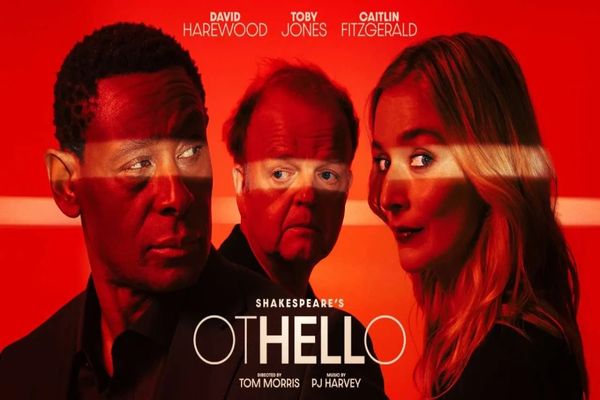
 Director Tom Morris has been busy running the Bristol Old Vic, but now returns to the capital to start a five year partnership with Chris Harper Productions to direct Shakespeare plays for the West End. His Othello looks impressive, is well acted, thoughtful and glossy, but lacking in sufficient darkness.
Back in 1997, David Harewood was the first Black actor to play the role of Othello at The National Theatre. Harewood himself has said that he played the role as a very angry man and now returns to it for the third time. In this production, he is thoughtful, more controlled and speaks with beautifully lyrical fluency. Harewood is very poised and dignified, disintegrating into a hunched and broken man.
Toby Jones brings a petulant side to Iago; spiteful and petty, rather than straightforwardly malevolent. His weasley demeanour conveys surprise that any of his plans have worked, which means he lacks the straightforward evil of many who have taken the role. Jones is confident on stage and in his lines, but there is an absence of the required darkness needed to make you shudder.
_c_Brinkhoff-Moegenburg.JPG?format=auto&width=800)
Photo Credit: Brinkhoff/Mögenburg
Caitlin Fitzgerald is a more confident, determined and fiesty Desdemona than is often portrayed. Morris has determined her to be more of Othello's equal in this production, which makes for a more interesting depiction of their relationship.
Vinette Robinson joins a line of Black women to play Iago's abused wife Emilia. Robinson is wonderful, becoming the emotional heart of the play and showing great development in her character. She appears at first to be a mere puppet to Iago's whims, but then shows huge bravery in standing up to Othello when he has slain Desdemona, and then towards her own husband. When she is finally laid by Desdemona's side singing strains of the willow song it is incredibly moving.
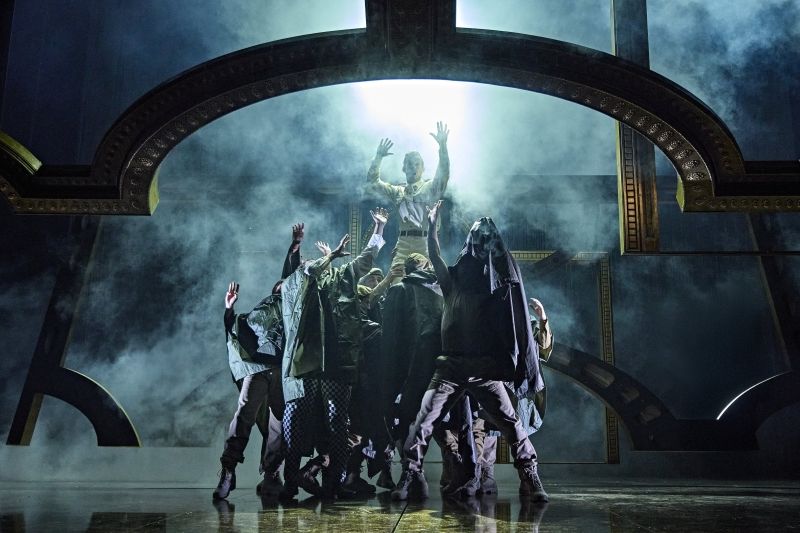
Photo Credit: Brinkhoff/Mögenburg
Tom Byrne's Roderigo is suitably shallow, giving elements of Bertie Wooster-like silliness to his lines. Luke Treadaway makes a charismatic Cassio, although consistently naïve.
Morris acknowledges the racism (to a point) and jealousy, but interestingly, leans into the mysogyny more than many productions. Strong women must inevitably be punished and there is no shying away from the bleak violence of both Iago and Othello, doled out to who they see as 'whores', 'trash' and 'strumpets'. Morris makes this play about gender more than race.
However, some of the production feels static; characters stand around a lot and there is urgency lacking at points. Uncomfortably, Morris allows the cast to play up words referring to Iago, such as 'honest', too much, causing frequent laughter in the audience. Iago is not a pantomime villain, but one of Shakespeare's most inherently manipulative and evil characters. To say this jars with what is happening on stage is an understatement.
%2C%20Toby%20Jones%20(Iago)_c_Brinkhoff-Moegenburg.JPG?format=auto&width=800)
Photo Credit: Brinkhoff/Mögenburg
Ti Green’s set begins with the gilded doorways and ceilings of Venice, reflecting the golden proscenium arch of the Haymarket theatre itself, throwing everything skywards during the storm. When we land in a stripped-back Cyprus, there are freestanding doorframes, eerie projections of close-up faces and the doomed marriage bed, which moves to centre stage surrounded by lighting rigs.
Harewood is captivating to watch and his disintegration is palpable, but the malign forces and inexplicable wickedness woven into the essence of Shakespeare's words need to be brought more to the forefront for this production to gel.
Othello runs at Theatre Royal Haymarket until 17 January 2026
Photo Credits: Brinkhoff/Mögenburg

Sign up for all the news on the Fall season, discounts & more...
|
Powered by

|







Reader Reviews
To post a comment, you must register and login.