

Review: ENGLISH at Wallis Annenberg Center For The Performing Arts
Sanaz Toosi's compelling play takes beyond the words

There are words – adjectives – which will do the job of characterizing Sanaz Toosi’s play ENGLISH, and the production at the Wallis through April 26. Words like “wondrous,” “unforgettable” “affecting,” “insightful,” “quietly profound,” and on and on. Where compliments are considered, the English language is lousy with synonyms and this much-heralded Pulitzer Prize-winner is deserving of every last one of them.
L.A. audiences are fortunate to get the remounted Atlantic Theater Company and Roundabout Theater Company staging at the Wallis under Knud Adams’s direction and with most of its Broadway cast members intact. ENGLISH isn’t so much a play about the power of words as it is about the inextricable and very complicated bonds between language, culture and identity. It may feel prescient that the prism through which Toosi examines her subject is four Iranian students studying for the Test of English as a Foreign Language (TOEFL) in 2008. In this particular moment in 2026, we should very much be interested in how Iranians speak, what they have to say and why.
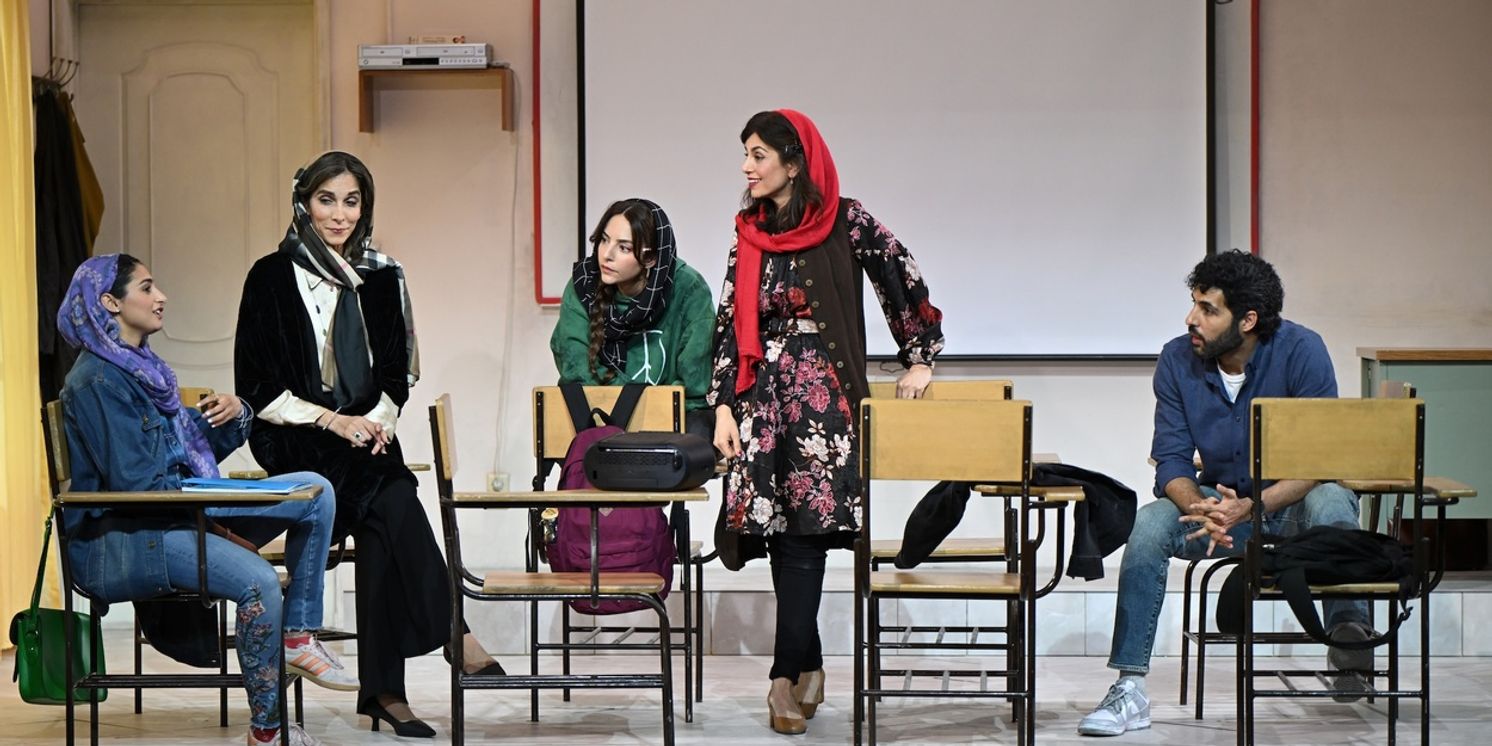
But ENGLISH is not so much a political play as a play about education. Set designer Marsha Ginsberg’s single-room classroom is an enormous box that rotates from scene to scene, the backside of which is an outside area where people can smoke and talk “out of class.” The room has windows, but the curtains are never drawn except before the play starts when instructor Marjan (played by Marjan Neshat) briefly glances out the window. Her four students are all native Farsi speakers who need to either pass the TOEFL or master the language for different reasons.
Elham (Tala Ashe), who has failed it four times previously, needs a passing grade to attend medical school and study gastroenterology in Australia and to become a teaching assistant. Roya (Pooya Mohseni) is capitulating to her son’s wishes that his daughter – Roya’s granddaughter – be raised in Canada as an English speaker. And 18-year-old Goli (Ava Lalezarzadeh) wants to learn English purely to be able to speak English…because she has always loved the way it sounds. Omid (Babak Tafti) – the only man in the class and probably the most proficient speaker - seeks a U.S. Green Card. The play’s verbal patterns are easily tracked. When speaking English, characters’ accents and mastery of the language is easily tracked. When they speak in Farsi, the dialog is delivered in fluent contemporary English, similar to what the Irish playwright Brian Friel did in his play TRANSLATIONS.
Accordingly, these students run the gamut in terms of how much English they already know, how well they can carry on a conversation – of even in craft a sentence – and the thickness of their accents. Marjan, their instructor, lived in Manchester for nine years before returning to Karaj. Her relationship to the language is as complicated as that of her students. On the outside, she’s encouragement incarnate, but she also runs her class with strict rules, the most prominent of which is that “English Only” be spoken… it says so right up there on the white board. Her pupils break the rules as they get frustrated and have to employ Farsi to express emotions, vent, or get an important point across, but the closer the class draws to the test, the more Farsi slip marks they get on that white board. Five such demerits per week, and you have to leave the class. Halfway through the course, as she drills down on the rules, Marjan reminds her pupils that in the context of the class “we are not Iranian…I will ask you to feel any pull you have to your Iranian-ness and let it go.” Which, as the teacher herself will learn, is considerably more easily pledged than achieved.
Adams’s beautifully synced-up cast navigate the delicate push-pull dynamics that exist in a classroom setting – student to teacher, peer to peer, and in some cases something similar to parent to child. Of the five actors (two of whom, Ashe and Nashat were Tony Award-nominated), there is not a single weak link.
The deeper into the lessons these students go, the more complex the stakes and more we witness a toll being taken. Rapid-fire games demonstrating a person’s ability to come up with a word turn competitive. Discussions around names or dissecting voice mail messages get thorny. Omid shows up for out of class time office hours during which he and Marjan (whose husband does not speak English) bond and flirt as they watch English language romantic comedies. An already resentful Elham – who hates the language - is quick to anger at any perception of favoritism and is not one to hold back. Probably more than any other character, Elham becomes a noticeably different person speaking English. “In Farsi, you balance yourself out,” Roya tells her in a particularly barbed come-to-linguistic-Jesus moment. “But wherever you land, you’re going to have quite a hard time adjusting. Because in English, you won’t have redeeming qualities.”
Ouch. And though Roya may be right, Ashe’s excellent rendering of this complicated character becomes the play’s engine. Brutally honest, highly principled and nursing insecurities no matter what the language, Elham is nobody’s friend, but Ashe infuses her with bristly charisma nonetheless.
The clash between Mohseni’s Roya and Neshat’s Marjan has a no less fascinating interplay as Roya bucks up against her son’s rejection of his culture and identity. A show-and-tell session turns personal as Roya plays an Iranian song and is dinged because the song is in English. “What is it about where we’re from that you find so repulsive,” Roya asks her instructor. “We should remember that we come from this.” Playing ENGLISH’s oldest character, Mohseni infuses Roya with a winning blend of dignity and fragility.
In addition to also leaving room for sporadic bits of humor, Toosi’s first-rate plotting and scene construction give ENGLISH its urgency; we deeply invest in these students and their instructor and want to know how they handled the TOEFL. But by the time we get there, scores and proficiency take a back seat to self-knowledge and something resembling inner peace.
The last words of ENGLISH are the only ones spoken in actual Farsi. As lovely as a translation would have been, by the time we hear them, the sound is as important as the meaning. Maybe even more.
ENGLISH continues through April 26 at 9390 N. Santa Monica Blvd., Beverly Hills
Photo of (L-R) From L to R: Ava Lalezarzadeh, Pooya Mohseni, Tala Ashe, Marjan Neshat, and Babak Tafti by Kevin Parry.

Reader Reviews
Videos